Showing posts with label bluebeard. Show all posts

imaginary outfit: locked doors


There was a fantastic tale in The New Yorker a few weeks back about the discovery of legendary riches at the Sri Padmanabhaswamy temple in India. Two ancient vaults were to be opened. The first held an estimated twenty billion dollar hoard of gold and jewels that an eyewitness described as "stars glittering on a night when there is no moon." The other, a supposed treasury for gold bars, had a faulty lock and remained closed.  Despite the staggering wealth of the first vault, there has been no rush to open the second, and many locals are insisting that the treasure be sealed back up and left in place.

After reading all sorts of variations on Bluebeard to prepare for book club next week, a story where a locked door stays locked was peculiarly nice. We hide plenty of awful things in forbidden rooms, but a locked door can also be a refuge.

In more radical Bluebeard re-imaginings, the forbidden chamber becomes a symbol for what Justine Jordan calls "the elusive authentic self" preserved against the pressure of outside curiosity. Locking those selves away used to be the preferred m.o. Now, like Bluebeard's bride, our ruling mania is exposure. We throw open whatever doors we can and invite everyone in. It isn't always a bad thing. Light can cleanse and empower, shrink all sorts of fears and dreads, reduce terrors to commonplaces, give the lonely a community. 

Still, what we share is self-report. It's a product of calculation — as it should be. Overexposure is corrosive. T.S. Eliot was on to something:
All significant truths are private truths. As they become public they cease to become truths; they become facts, or at best, part of the public character; or at worst, catchwords.
At some point, all the various accumulations of personal miscellany and the telling details of our lives we share stop being treasure. Moving through the world, we cast shadows and leave fingerprints. Those are the interesting traces. We reveal plenty without ever intending to.

I like the idea of the locked door; not to hide the terrible, but to protect the precious. I'm glad it's there.

a strange bird


At home, the bride was making preparations for the wedding feast, to which she had the sorcerer's friends invited. Then she took a skull with grinning teeth, adorned it with jewelry and with a wreath of flowers, carried it to the attic window, and let it look out.
When everything was ready she dipped herself into a barrel of honey, then cut open the bed and rolled around in it until she looked like a strange bird, and no one would have been able to recognize her. Then she walked out of the house.
Underway some of the wedding guests met her, and they asked, "You, Fitcher's bird, where are you coming from?"
"I am coming from Fitcher's house."
"What is his young bride doing there?"
"She has swept the house from bottom to top, and now she is looking out of the attic window."
Finally, her bridegroom met her. He was slowly walking back home, and, like the others, he asked, "You, Fitcher's bird, where are you coming from?"
"I am coming from Fitcher's house."
"What is my young bride doing there?"
"She has swept the house from bottom to top, and now she is looking out of the attic window."
The bridegroom looked up. Seeing the decorated skull, he thought it was his bride, and he waved a friendly greeting to her.
Jacob and Wilhelm Grimm, 'Fitcher's Bird'

Illustration: Maurice Sendak: "You Fitcher's feathered bird, where are you from?" from The Juniper Tree and Other Tales From Grimm, translated by Lore Segal and Randall Jarrell.

Also: Cindy Sherman's version.

placing them back in order


He went and captured the third sister, but she was clever and sly. After he had given her the keys ... she ... examined the house, entering finally the forbidden chamber.
Oh, what she saw! He two dear sisters were lying there in the basin, miserably murdered and chopped to pieces. In spite of this she proceeded to gather their parts together, placing them back in order: head, body, arms, and legs. Then, when nothing else was missing, the parts began to move. They joined together, and the two girls opened their eyes and came back to life. Rejoicing, they kissed and hugged one another.
Jacob and Wilhelm Grimm, 'Fitcher's Bird'

1. Image found here.
2. Ruby Sky Stiler: Two figures, 2011. Via the white hotel.

no fear

And still I felt no fear, no raising of the hairs on the back of the neck, no prickling of the thumbs. The key slid into the new lock as easily as a hot knife into butter. 
No fear; but a hesitation, a holding of the spiritual breath. 
If I had found some traces of his heart in a file marked: Personal, perhaps, here, in his subterranean privacy, I might find a little of his soul. It was the consciousness of the possibility of such a discovery, of its possible strangeness, that kept me for a moment motionless, before, in the foolhardiness of my already subtly tainted innocence, I turned the key and the door creaked slowly back.
Angela Carter, "The Bloody Chamber"

study of pansies


Bluebeard's Wives: Study of Pansies. Chromolithograph publisher's proofs of the publications of L. Prang & Co.

Found at the NYPL.

his castle

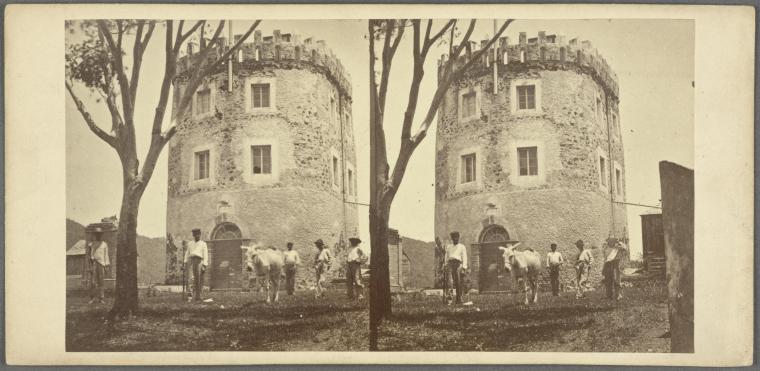
And, ah! his castle. The faery solitude of the place; with its turrets of misty blue, its courtyard, its spiked gate, his castle that lay on the very bosom of the sea with seabirds mewing about its attics, the casements opening on the green and purple, evanescent departures of the ocean, cut off by the tide from land for half a day ... that castle, at home neither on the land nor on the water, a mysterious, amphibious place, contravening the materiality of both earth and the waves, with the melancholy of a mermaiden who perches on her rock and waits, endlessly, for a lover who had drowned far away, long ago. That lovely, sad, sea-siren of a place!
Angela Carter, "The Bloody Chamber"

two views


Bluebeard's castle, St. Thomas, ca. 1865.

Found at the NYPL.

this now is yours


THIS door you might not open, and you did;
So enter now, and see for what slight thing
You are betrayed…. Here is no treasure hid,
No cauldron, no clear crystal mirroring
The sought-for truth, no heads of women slain
For greed like yours, no writhings of distress,
But only what you see…. Look yet again—
An empty room, cobwebbed and comfortless.
Yet this alone out of my life I kept
Unto myself, lest any know me quite;
And you did so profane me when you crept
Unto the threshold of this room to-night
That I must never more behold your face.
This now is yours. I seek another place.

Edna St. Vincent Millay, "Sonnet VI" from Renascence and Other Poems, 1917.

Jacques-André Boiffard: Renée Jacobi, 1930.