Showing posts with label snow. Show all posts

odds and ends / 1.29.2026


*


Remy Charlip, via Camille Brown.

*

Hiroshi Sugimoto: Glass staircase at Go'o Shrine, Naoshima, Japan, 2002.

*

The sun's rays glanced off the earth at a low angle, bent and twisted through the atmosphere, and refracted in the icy air. Mirages, fogbows, sun dogs, mock moons, and other tricks of the light were so common the men learned not to trust their eyes. On windless days, when suspended ice crystals drifted slowly through the air, they formed prisms that refracted light and made it seem as if there were multiple suns in the sky. The most spectacular such illusion, known as a parhelic circle, caused four false suns to appear at the cardinal points of a halo around the real sun. When conditions were perfect, two perpendicular lines of light, vertical and horizontal, connected these illusory orbs, intersecting in the center to form an enormous talismanic cross. The sight filled even a man as scientifically inclined as Lecointe with reverential awe. "You feel there is something else besides the earth," the captain described. "This sort of religiosity makes you sense a God, not a specific God, but a vastly superior being." 


Julian Sancton, Madhouse at the End of the Earth.

*
What will become of all that has piled up within you, so much, so much, an enormous stock of memories and habits, deferred questions, frozen answers, thoughts, emotions, tender feelings, hardships, everything there, everything there, what will become of it all the moment life extinguishes within you? The disproportionate size of this pile—and all of it for nothing?

Elias Canetti, "Fifty Disguises: Selections from The Book Against Death." The Paris Review, 1/5/2022.

*
INTERVIEWER

What happened when they arrested you?

OSWALD

They read me my rights and asked whether I knew I was breaking the law, and did I want to come easily or did I want to be an obstruction. And I said, “I’m happy to be arrested, because I don’t believe it’s an offense,” and that I didn’t want to come easily, and so I lay down and imagined my heaviest self. I was imagining I was made of gold or lead, just enjoying the difficulty the police were having picking me up. They drove us to some tents, where we gave our names and addresses and were given bail. There was a scene with the officer who arrested me, who kept saying that I was Section 12, and the officer who was writing it down, saying, “Are you sure?” Because Section 12 means up to fourteen years in prison. Section 13 is up to six months in prison or a fine. The officer kept saying, “Yep, Section 12,” but when I looked at my form a couple of weeks later, I saw that she had actually written Section 13. It was confusion. They didn’t really understand why they were arresting old women with signs.

Alice Oswald, The Art of Poetry No. 119, The Paris Review, Winter 2025.

*
Movements need signals and symbols and performance as much as they need on-the-ground commitment.

Protest marches and rallies and strikes and daily calls to elected officials send signals and generate performance and create points of entry that lead to action. A signal from one person becomes action in another. Signals, virtuous or otherwise, help to rally people around a collective cause. So, let your signal be virtuous! Let it inspire! Voicing individual support or disapproval for something you care about creates a ripple effect that begins to change public sentiment, shift culture, alter voting choices, and rejigger patterns of patronage and consumption.

What I want to say to all of the folks with platforms, or without them, wondering if it makes a difference to say anything is, of course it does you giant ding dongs!

Erin Boyle, "Go ahead, send out a signal." Make/Do, 1/28/2026.

(Related: With a post, Erin and Garrett Bucks have raised $25,000 for rent relief in Minneapolis.)

*
The inferno of the living is not something that will be; if there is one, it is what is already here, the inferno where we live every day, that we form by being together. There are two ways to escape suffering it. The first is easy for many: accept the inferno and become such a part of it that you can no longer see it. The second is risky and demands constant vigilance and apprehension: seek and learn to recognize who and what, in the midst of inferno, are not inferno, then make them endure, give them space.

Italo Calvino, Invisible Cities.  

*


*

Tomorrow: a strike


And be ready to help Springfield, Ohio, where a 30-day ICE surge is planned.

candle, snowflake, gingerbread, angel


Clara Peeters, "Stilleben mit Façon-de-Venise-Glas, Römer und einer Kerze (Still life with dainties, rosemary, wine, jewels and a burning candle)," 1607.

*


*

A tree in winter, photographed by Dr. S.B. Ward ca. 1889, via Anonymous Works.

*


*

From Listen and Hear by Kathleen Shoesmith, 1973, via stopping off place.

*


*

Barbara Cooney illustration for American Folk Songs for Christmas, via Honey and Wax Books.

*

A recipe for gingerbread ca. 1395 and gilded gingerbread and mold. The Fitzwilliam Museum.

*

Peter Doig, untitled watercolor, 1999, via le jardin robo.

*

Antonia Pinter, "Szélanya," 2024. A History of Frogs.

*

Wilson Alwyn Bentley, snow crystal ca. 1910.

*

Merry everything, friends.


odds and ends / 1.9.2025


Alice Neel, "Snow in Vermont," 1975.

*

Beguiling grainy image of a pinecone mobile found on Pinterest; I can't determine the source, but I'd like to make one.

*

Garry Knox Bennett, "Granny Rietveld." Via Commune Design.

*

Ivor Cutler, "A Clock." Via stopping off place.

*

Snowy scene by Wanda Gág, captured by Claire Zarouhee Nereim. (I wish I could have seen the exhibit at the Whitney.)

*


*
It’s winter now, some months after the phoebes outside have built their nest, raised a family, and moved on. Bitter cold, snow on the ground, blue jays crowding the feeders clownishly while the little birds—chickadees and nuthatches and tufted titmice, downy woodpeckers and yellow-bellied sapsuckers—wait anxiously for the bullies to leave so they can begin their own meal. You might think you know something about me now from the highly redacted scraps of personal anecdote I started with—but really, I could have written anything, shaped those glimpses however I wanted, and you wouldn’t know. 
You know far more about me from how I’ve been writing here ... You know what books I’ve loved and why I love them. You know I like birds, you know I watch them, you know I live in a place sufficiently rural to have trees and phoebes. You know many of my days resemble one another, and that I have a house, and that I must not be commuting daily to a job—which in turn suggests I have some other way to make an income. You know I have enough free time to look outside and note down what I see, and that I value both actions. 
And beyond those relatively simple facts, you have a sense of my sensibility: my emotional makeup, my responses to the world, my obdurate insistence on revising and revising again. What I notice, what I pay attention to.

Andrea Barrett, "Energy of Delusion," excerpted from Dust and Light: On the Art of Fact and Fiction in Harpers, January 2025. 

The inside covers of the notebooks were used to save a substantial collection of news clippings, an off-beat record of the world through those years of writing the book. There are pressed leaves, wildflowers, feathers of owls and colourful parrots and lorikeets, swans, finches, cockatoos, picked up on walks, hundreds of walks, of walking alone while deep in thought, that in the end, amounted to much of what went into creating this book. The feathers alone form a catalogue of walking through many seasons in different parts of the country.

You will find in these notebooks: broken wings of butterflies, such as the brown forest butterflies found in the summer months when the woods were abundant with their dance; travelling beetles crawling in their hundreds in the leaf litter. This collection was a part of much more. All these objects were studied and, if not intentionally, were thought about as works of scale as were the patterns on a butterfly wing which are composed of millions of scales, grandiose designs developed over aeons of time. All of these collected objects were a reminder of being grounded while facing the realities as we have done in the past, and will do so in the future in dealing with other major concerns which hold no beauty, nor added comfort to our combined humanity.

Alexis Wright, "Dream Geographies." HEAT, Series 3, number 16, September 2024.

*
Friends have begun to call, and tell us they’ve lost their homes. One said he had forgotten his passport, but he had the family dog, and he’d managed to save his child’s beloved stuffed walrus (named “Walrus”). They’d rebuild with that, he told me.

*

Looking out the window into the snow and thinking of Los Angeles. 

odds and ends / 1.29.2024


Edvard Munch, "Winter Landscape, Thüringen," 1906. Kunstmuseum Bergen.

*

Garnet and rose quartz necklaces by Marie-Hélène de Taillac, via Twist.


*

Guglielmo Veronesi, “Perla” chair, ca. 1952. Via Commune Design.

*

Calendar watch made in 1650 by Thomas Alcock that indicates "the time of tides (presumably at London bridge), mean solar time, the age of the moon in its monthly cycle, and the day of the month." Alcock lost a similar watch in 1661 and advertised for it in the February 1661 issue of Kingdoms Intelligencer. In the collection of The Metropolitan Museum of Art.

*

Child's creamware cup, ca. 1830s, via oldasadam.

*

Snow monster
 (or, how I feel by January's end).

*
In interviews collected in the book Starting Point: 1979-1996, Miyazaki referred to a universal “yearning for a lost world” he refused to call nostalgia, since even children experience it. We long not for what we remember, but what we’ve never experienced at all, only sensed beneath reality’s surface.

Alissa Wilkinson, "'The Boy and the Heron' Review: Hayao Miyazaki Has a Question for You." NYT, 11/21/2023.

We seemed to be developing a brittle incapacity to accept, let alone honor, the tender, tragic feeling that had always lain beneath the ordinary person’s experience of nostalgia. In his once famous essay “Old China,” Charles Lamb located nostalgia in “the hope that youth brings” and which time extinguishes. What we are always most nostalgic for is, in fact, the future, the one we imagined only to see it turn into the past. The actress Helen Hayes used to tell a story of how her young prospective husband poured some peanuts into her hand and said, “I wish they were emeralds.” Years later, when he was actually able to give her a little bag of emeralds, he did so saying, “I wish they were peanuts”—which, with whatever excess of sweetness, about sums it up. Nostalgia is built into us ...

Thomas Mallon, "Nostalgia Isn't what it Used to Be." The New Yorker, 11/20/2023. 

*
*
I subscribe to Vittles online magazine, because reading evocative writing about food I’m too lazy and incompetent to prepare or seek out is one of my favourite hobbies, and because I always learn something. In a recent edition, I discovered a captivating Korean suffix. “There are no thoughts, just meong, the suffix in Korean used for activities of staring into stillness, like bull meong—staring into the fire,” wrote the author, Songsoo Kim, in a beautiful article with recipes about preparing a feast that I would dearly love to eat, but absolutely will not cook.

As a black belt starer into stillness—it’s my other favourite hobby—this spoke to me deeply. I asked Kim about it and she explained meong (also written mung) is colloquially used to describe zoning out, but without a negative connotation. This, she explained, was 'an organic linguistic development, as more and more people started mentioning how staring at the fire at campsites or fireplaces together is rather healing.' There are also forest, foliage and water versions of quiet, empty staring and cafes where you can 'hit mung.' 'It’s a moment we all need,' Kim said.

Emma Beddington, "Is this the year of meong—a wellbeing trend I can actually master?The Guardian, 1/22/2024. 

*
A turtle staggered from the waves, wearily dug a shallow hole, and commenced to drop her lovely eggs. Amber had no wish to witness this; she could no longer bear to watch struggling nature. She shut her eyes, feeling that the very act of not looking was helping the turtle out in some way.

Joy Williams, "The Beach House." The New Yorker, 1/15/2024.

*
I’m not sure that I have the qualifications to give people advice about reasons to live. My daily affective state is one of great despair about the incredible destructive forces at work in this world—not only at the level of climate. What has been going on in the Middle East just adds to this feeling of destructive forces completely out of control. The situation in the world, as far as I can tell, is incredibly bleak. So how do we live with what we know about the climate crisis? Sometimes I think that the meaning of life is to not give up, to keep the resistance going even though the forces stacked against you are overwhelmingly strong. 

Andreas Malm, interviewed by David Marchese in the NYT, 1/16/2024. 

Mitchell is one of a new breed of biologists who espouse a complex-systems perspective as an antidote to reductionism. He aims to reclaim from the philosophers words like purpose, reason, and meaning, which scientists often avoid as being unquantifiable. He mostly eschews jargon. This is a plainspoken book. It gets mildly technical in matters of biology and neuroscience, but it builds an argument that is methodical and crisp, and it cuts through years of disputation like a knife through cotton candy. This is what you are, Mitchell asserts: “You are the type of thing that can take action, that can make decisions, that can be a causal force in the world: you are an agent.”

If the denial of free will has been an error, it has not been a harmless one. Its message is grim and etiolating. It drains purpose and dignity from our sense of ourselves and, for that matter, of our fellow living creatures. It releases us from responsibility and treats us as passive objects, like billiard balls or falling leaves.

James Glieck, "The Fate of Free Will." The New York Review, 1/18/2024. 

*
The “how” is just as important as the “what,” if not more so. It turns out that the how actually is the what—or at least cannot be separated from it. They share one nervous system, and that oneness is what allows style to matter.

David Salle, "Follow the Light.The New York Review, 1/18/2024. 

*
Guy Davenport ... credited his critical acumen to a childhood spent treasure hunting. Sundays after church, his dad took him to scour fields throughout the South for arrowheads:

What lives brightest in the memory of these outings is a Thoreauvian feeling of looking at things—earth, plants, rocks, textures, animal tracks, all the secret places of the out-of-doors that seem not ever to have been looked at before, a hidden patch of moss with a Dutchman’s Breeches stoutly in its midst, aromatic stands of rabbit tobacco, beggar’s lice, lizards, the inevitable mute snake, always just leaving as you come upon him, hawks, buzzards, abandoned orchards rich in apples, peaches or plums … The search was the thing, the pleasure of looking … My sense of place, of occasion, even of doing anything at all, was shaped by those afternoons.

That’s vintage Davenport. Effortlessly, unabashedly learned; tender beneath its professorial carapace; vaguely excessive. John Jeremiah Sullivan ... writes, “He once defined ‘despair’ as the sensation that you’ve run out of ideas.” I wonder how that sensation registered to “the man who noticed that ‘in all of Balthus’ one finds no clocks.”

Dan Piepenbring, "New Books.Harpers, January 2024. (Sold me on this.)

*

festive things


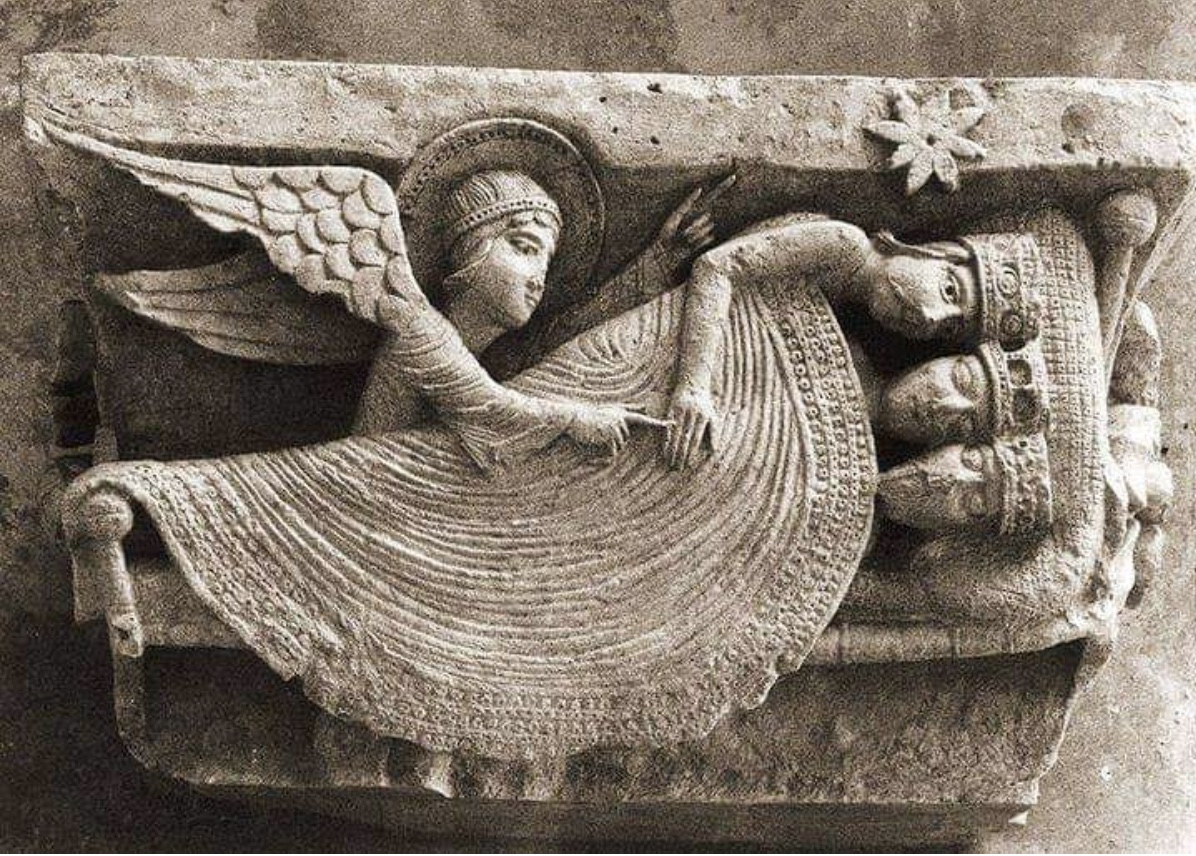
Gislebertus, "Dream of the Magi," circa 1120-30 , Cathedral of Saint-Lazare,  Autun, France. Via Stephen Ellcock.

*

Mary Delany, "Ilex Aquifolium (Tetandria tetragynia)," from an album (Vol.V, 60); Holly with berries. 1775. Collage of colored papers, with bodycolor and watercolor, on black ink background. The British Museum.

*


*

Olivier Dassault, "Untitled/Christmas card," 1987. MFA Boston.

*

Tacuinum Sanitatis, Milan or Pavia, ca. 1390-1400. Via The Fortnight Institute.

*

Schreiber pop-up toy theater book, ca.1885. The V & A.

*


Holiday dress of my dreams: Rothermal Theater Dress by Bode.

*

Star Finial, artist unidentified, United States, 1875–1925, paint and gilding on metal, 45 × 22 × 9 in. American Folk Art Museum.

*


*
... [W]e are seeing our own mortality in the close of day and year. The hours of sunlight run by more quickly, and we’re left behind in the darkness. It’s hard now to feel the privation of former winters, or experience the desolation of the landscape; it’s not even likely to snow. But we see the trees unleafing, and sense the different strains of winter light: sometimes bright and cold, often thin and misted. Much of our enjoyment of this gauntness is in relief. Fasting for advent used to make a penitence of nature’s dearth, relieved at last by ecstatic abundance. On Christmas Eve congregations would hang the branches of the churchyard trees with apples. In Moscow, they deck avenues of leafless boughs with red and gold baubles, which has the same effect.

Our contrivance of these spots of colour has its roots in nature’s contingencies: red berries on a black branch, an evergreen tree in a field of snow—Ruskin’s lesser beauties perhaps. But it takes a mind to frame them, to put the tree in a painting or a living room. Sometimes novelty itself seems poetic, as though the product of design. ... We aestheticise the tree by changing its setting, or we admire it through a picture. Christmas itself is a removal, separated from the rest of the year by its spangles and pageantry. The season makes us tourists of our own nostalgia; it’s best not to think too hard about the absurdity of chopping down a tree and covering it with tiny ornaments. What do we do with the wanwood when the new year comes? In the 16th century, after the feast and the dancing, the tree would be ceremonially burned, marking the end of festivities with a final brilliant spectacle, which does seem better than leaving it on the street for the council to collect.

Alicia Sprawls, "Christmas Trees." London Review of Books,  1/5/2017.

*
In 1419, the Freiburg bakers’ apprentices noted having seen a tree set up in a hospital, decorated with apples, wafers, gingerbread, and tinsel. In Riga, in 1510, a brotherhood of merchants are said to have set up a tree around Christmastime, then decorated it with thread and straw; they burned it at Lent. Many of the hints of early Christmas-tree—or solstice-tree, or New Year’s tree—traditions come from rules limiting them. A regulation in Upper Alsace specified that each citizen could take from the forest no more than one pine, of a height no more than eight shoes. A 1611 ban against felling trees in the Alsatian town of Turckheim is arguably the first appearance of the term “Christmas tree”: Weihnachtsbaum.

Rivka Galchen, "The Science of Christmas Trees." The New Yorker, 12/6/2022. 

*
One thing is for certain—I wouldn’t want to be a Christmas tree. It would be nice to be the center of attention, to be so decorated and lit that people stared at you in wonder, and made a fuss over you, and were mesmerized. That would be nice. But then you’d start dropping your needles and people would become bored with you and say you weren’t looking so good, and then they’d take all your jewelry off, and haul you off to the curb where you would be picked up and crushed and eventually burned. That’s the terrible part. Maybe that’s why so many people today have fake trees. They are quite popular. Their limbs come apart and you can put them in boxes and store them. You can have one of these trees until you die and you can pass them on to your children. They may not be real but when you look at them you can’t tell the difference. That always makes people happy—not being able to tell the difference. And happiness, to want to be happy, is the most natural thing of all.

Mary Ruefle,  "Recollections of My Christmas Tree.Harpers, December 20, 2013. 

*

See also: Robert Frost, "Christmas Trees."

*


*

Merry everything, friends.


glad tidings


Streeter Blair, Pasture in Winter, 1960. Hirshhorn Museum and Sculpture Garden.

*

Detail from Is This You? by Ruth Krauss and Crockett Johnson, via Mac Barnett.

*


*


*

Vanessa Bell, hand-painted calendar for friends from 1951.


Milton Avery, Pinecones, ca. 1940. The Phillips Collection.

*

Robert Watts, Xmas Event, 1962. 

*

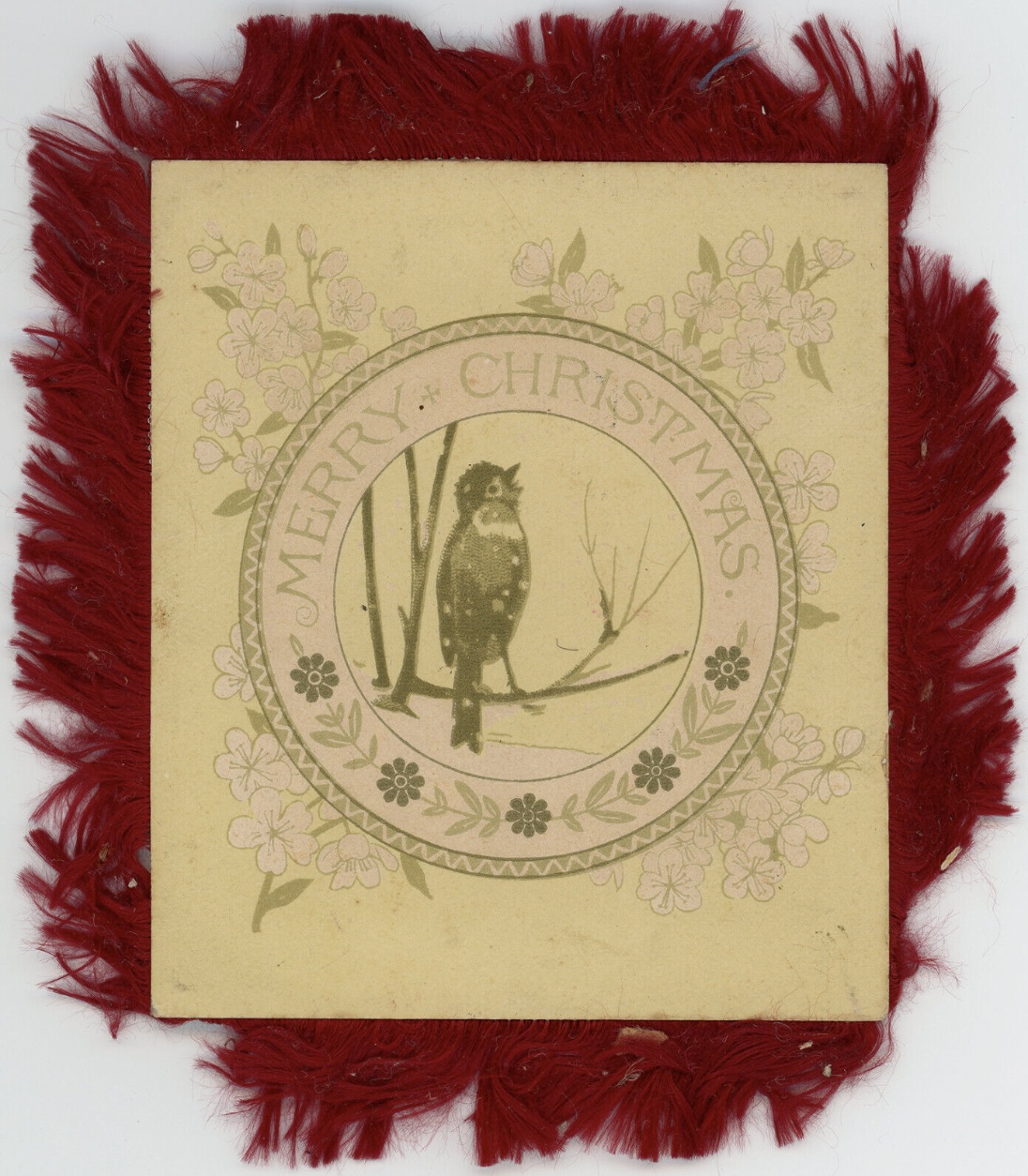
Detail from a Christmas card in the collection of Robert E. Jackson.

*


*
'What Josephine said,' explained Robert, 'was simply that it would be pretty to put candles on one of the growing trees, instead of having a Christmas-tree indoors'.... 
Soon they were busy round a prickly fir-tree at the end of the lawn. Jim stood in the background vaguely staring. The bicycle lamp sent a beam of strong white light deep into the uncanny foliage, heads clustered and hands worked. The night above was silent, dim. There was no wind. In the near distance they could hear the panting of some engine at the colliery. 
'Shall we light them as we fix them,' asked Robert, 'or save them for one grand rocket at the end?' 
'Oh, as we do them,' said Cyril Scott, who had lacerated his fingers and wanted to see some reward. 
A match spluttered. One naked little flame sprang alight among the dark foliage. The candle burned tremulously, naked. They all were silent. 
'We ought to do a ritual dance! We ought to worship the tree,' sang Julia, in her high voice. 
'Hold on a minute. We'll have a little more illumination,' said Robert. 
'Why yes. We want more than one candle,' said Josephine. 
But Julia had dropped the cloak in which she was huddled, and with arms slung asunder was sliding, waving, crouching in a pas seul before the tree, looking like an animated bough herself. 
Jim, who was hugging his pipe in the background, broke into a short, harsh, cackling laugh.
'Aren't we fools! he cried. 'What? Oh, God's love, aren't we fools!'

D.H. Lawrence, Aaron's Rod.

*
On Christmas Eve, we build a fire, then snuff it out with an old wet towel, realizing, fearfully, that we haven’t cleaned the flue in five years. Then the boiler breaks down. We plug in the space heaters. We order takeout Chinese. Only then, when almost all is lost and I am feeling so unexpectedly sad, do I realize what a sucker I am for the beautiful fake Christmas that German-American commerce concocted for us years ago. A boon for the economy and a pernicious sweet for the mind. But it moves me. My heart is a chump. I actually like the shopping, the gift wrap, the carols—even the tinkling store music. I like the invented holiday miracles, the unexpected kindnesses and transformations—at least, as they are portrayed on the TV specials! And, looking out the window and seeing only sleet, I realize that I even like the snow. Where, now, is that lovely perfect Christmas? On whose open fire are those goddam chestnuts roasting? I have a fiction writer’s weakness for fiction. It’s an occupational hazard. A business thing.

Lorrie Moore, "Chop-Suey Xmas."

*
Well, why anything? Why do we? Come every year sure as the solstice to carol these antiquities that if you listened to the words would break your heart. Silence, darkness, Jesus, angels. Better, I suppose, to sing than to listen.


John Updike, "The Carol Sing."

 
*
Despite the forecast's promise,
It didn't snow that night;
But in the morning, flakes began
To glide all right.
Not enough to cover roads
Or even hide the grass;
But enough to change the light.

Bernard O'Donoghue, 'Christmas.'

*


*

Merry everything, friends.