Showing posts with label john ashbery. Show all posts

odds and ends / 10.12.2023


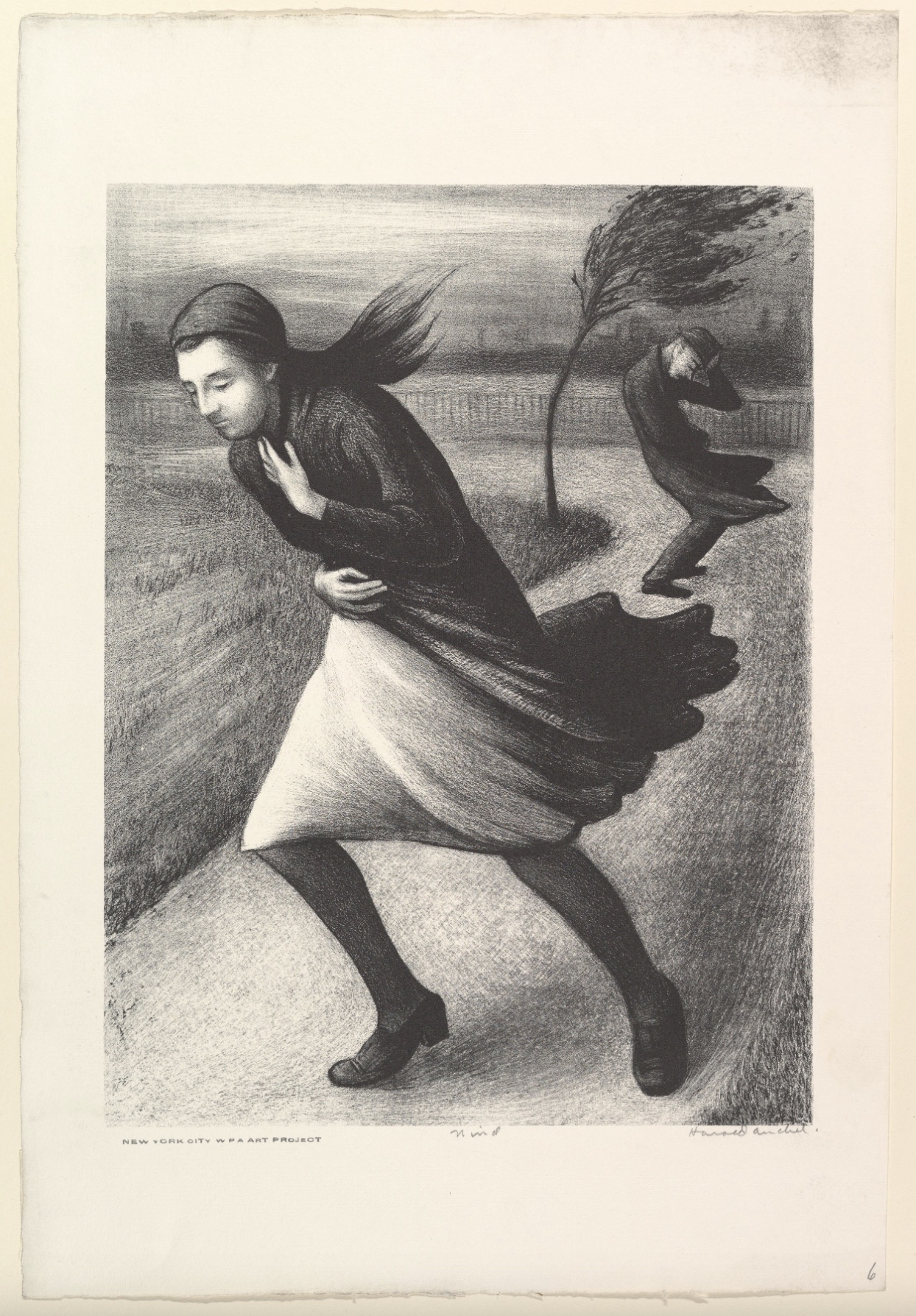
Harold Anchel, Wind. 1935-1943. The Metropolitan Museum of Art.

*

Glove, ca. 1840-1880. Bronze and paint, 1 1/8 × 7 7/8 × 4 7/8". The Menil Collection, Houston.

*

Osborne's Superfine American Water Colours travel set ca. 1830, via criticalEYEfinds.

*

Melissa Catanese, Figures #6, 2021.

*

Still from Himali Singh Soin's "The Spiral," via Ignota Books

*
It has long been the task of the humane left to reject the line of reasoning that would sacrifice civilians on the altar of 'historical inevitability,' whether in its Stalinist or Third Worldist guise—to protest the idea that untold innocents must die in the service of some grand telos. The humane left insists instead on the possibility, on the moral imperative, of bending what others take to be history’s iron tracks. The humane left’s north star is no flag or banner but the unflinching belief in the inherent, even divine, worth of every human life.

After all, it is this same belief out of which the humane left stands in steadfast opposition to Israel’s occupation of the West Bank and siege of the Gaza Strip, that drives our opposition to Israel’s ongoing bombardment of Gaza, our protests against the injustices of apartheid, our demands for a long-term and equal resolution to this conflict. Just as the humane left abhors Hamas’s attack and demands the immediate release of the hostages, the humane left rejects with all its force the exterminationist logic now promulgated by officials in Netanyahu’s government and right-wing politicians in the United States. There is no contradiction here. The left must be humane, or it is no left at all.

*


*
On December 15, 1811, the London Statesman issued a warning about the state of the stocking industry in Nottingham. Twenty thousand textile workers had lost their jobs because of the incursion of automated machinery. Knitting machines known as lace frames allowed one employee to do the work of many without the skill set usually required. In protest, the beleaguered workers had begun breaking into factories to smash the machines. “Nine Hundred Lace Frames have been broken,” the newspaper reported. In response, the government had garrisoned six regiments of soldiers in the town, in a domestic invasion that became a kind of slow-burning civil war of factory owners, supported by the state, against workers. The article was apocalyptic: 'God only knows what will be the end of it; nothing but ruin.'

Kyle Chayka, "Rethinking the Luddites in the Age of A.I." The New Yorker, 9/26/2002. 

*
The knitting machines which provoked the first Luddite disturbances had been putting people out of work for well over two centuries. Everybody saw this happening—it became part of daily life. They also saw the machines coming more and more to be the property of men who did not work, only owned and hired. It took no German philosopher, then or later, to point out what this did, had been doing, to wages and jobs. Public feeling about the machines could never have been simple unreasoning horror, but likely something more complex: the love/hate that grows up between humans and machinery—especially when it's been around for a while—not to mention serious resentment toward at least two multiplications of effect that were seen as unfair and threatening. One was the concentration of capital that each machine represented, and the other was the ability of each machine to put a certain number of humans out of work—to be ''worth'' that many human souls. What gave King Ludd his special Bad charisma, took him from local hero to nationwide public enemy, was that he went up against these amplified, multiplied, more than human opponents and prevailed. When times are hard, and we feel at the mercy of forces many times more powerful, don't we, in seeking some equalizer, turn, if only in imagination, in wish, to the Badass—the djinn, the golem, the hulk, the superhero—who will resist what otherwise would overwhelm us? Of course, the real or secular frame-bashing was still being done by everyday folks, trade unionists ahead of their time, using the night, and their own solidarity and discipline, to achieve their multiplications of effect.

It was open-eyed class war.

Thomas Pynchon, "Is It O.K. to be a Luddite?" The New York Times, October 28, 1984. 

*
At this crisis certain inventions in machinery were introduced into the staple manufactures of the North which, greatly reducing the number of hands necessary to be employed, threw thousands out of work and left them without legitimate means of sustaining life. A bad harvest supervened. Distress reached its climax. Endurance, overgoaded, stretched the hand of fraternity to sedition. The throes of a sort of moral earthquake were felt heaving under the hills of the northern counties. But as is usual in such cases, nobody took much notice.

Charlotte Bronte, Shirley

*
This movie deals with the epidemic of the way we live now.
What an inane card player. And the age may support it.
Each time the rumble of the age
Is an anthill in the distance.

As he slides the first rumpled card
Out of his dirty ruffled shirtfront the cartoon
Of the new age has begun its ascent
Around all of us like a gauze spiral staircase in which
Some stars have been imbedded.

John Ashbery, "This Configuration." The Paris Review, Issue 79, Spring 1981.

*

"It is not true that love makes all things easy: it makes us choose what is difficult."

odds and ends / 11.11.2021


Frederic Edwin Church, Autumn Landscape. Circa 1860-1870. Brush and oil paint on cardboard. Via the Cooper Hewitt.

*

Finely carved woman's hand, in the collection of tihngs.

*


*

Rae Armantrout, "Crescendo."

*


*
Manifesting, by and large, is a single-player sport. Most of what circulates online concerning how to manifest emerges largely out of the work of New Thought philosophers from the early to mid-20th century—American writers such as Neville Goddard and Florence Scovel Shinn, who mobilized biblical scripture in order to cast the argument that life as we know it is merely only a simulation, and that every individual around oneself is simply a non-playable character. To New Thought philosophers such as Goddard and Shinn, neither hustlenomics nor securing the bag were proprietary to neoliberal capitalism—getting what you want, seemingly, boils down singularly to your state of mind, the sheer vibrational force of your imagination. In order to believe in the full powers of manifestation, one has to foremost think that they are indeed the only person who exists, and that the world around themself is simply a mirror reflecting and reaffirming their self-concept—or as Goddard frames more simply, “Everyone is you pushed out.” However, instead of being reassuring, this sort of postulation makes me feel existentially insecure. If you are the only person who exists, why would anything—even, and especially manifesting—matter at all?


Gasira Tamir, "The Year of Magical Thinking." The New Inquiry, 9/13/2021. 

*

"His life was a mixture of realities and self-imposed fictions that were so potent that even he forgot who he was."

*
Yet so blind are we to the true nature of reality at any given moment that this chaos—bathed, it is true, in the iridescent hues of the rainbow and clothed in an endless confusion of fair and variegated forms which did their best to stifle any burgeoning notions of the formlessness of the whole, the muddle really as ugly as sin which at every moment shone through the colored masses, bringing a telltale finger squarely down on the addition line, beneath which these self-important and self-convoluted shapes added disconcertingly up to zero—this chaos began to seem like the normal way of being, so that some time later even very sensitive and perceptive souls had been taken in: it was for them life’s rolling river ...


John Ashbury, from "The System," 1972.  

*

Colors fill up your mind too much with all sorts of muddled stuff. Colors are too sweet a muddle, nothing more. I love things in one color, monotonous things. Snow is such a monotonous song. Why shouldn’t a color be able to make the same impression as singing? White is like a murmuring, whispering, praying. Fiery colors, like for instance autumn colors, are a shriek.


Robert Walser, translated by Damon Searles. "From the Essays of Fritz Kocher," The Paris Review, Issue 205, summer 2013.

*

Here in this little patch of mulch in my yard is a creature that begins life as a microscopic amoeba and ends it as a vibrant splotch that produces spores, and for all the time in between, it is a single cell that can grow as large as a bath mat, has no brain, no sense of sight or smell, but can solve mazes, learn patterns, keep time, and pass down the wisdom of generations.


Lacy M. Johnson, "What Slime Knows." Orion, September 2021. 

*

“We are all lichens,” the biologist Scott Gilbert and his colleagues wrote in a 2012 paper published in the Quarterly Review of Biology. Titled “A Symbiotic View of Life: We Have Never Been Individuals,” the paper argues that human bodies cannot be thought of as individual organisms. Rather, we are dynamic colonies housing a shifting community of trillions of bacteria and fungi that perform many vital functions and determine our health (including a “microbial cloud” that overflows our body, hovering, at all times, in the air around us). From this point of view, “I” has always truly been “we.”


Zoë Schlanger, "Our Silent Partners.The New York Review of Books, 10/7/2021.

*

"A certain form of mysterious shimmering, soaring cloud is starting to appear more often in the night sky, and scientists are working to understand why."

*
What I admire most about science is that it is completely unwilling to accept the many mysteries that surround us: it is stubborn, and wonderfully so. When it comes face to face with the unknown, it whips out a particle accelerator, a telescope, a microscope, and smashes reality to bits, because it wants—because it needs!—to know. Literature is similar, in some respects: it is born from an impossible wish, the desire to bind this world with words. In that, it is as ambitious as science. Because for us human beings, it is never enough to know god: we have to eat him. That’s what literature is for me: putting the world in your mouth.

Benjamín Labatut, in conversation with translator Adrian Nathan West, about When We Cease to Understand the World (one word review: marvelous).

*

"On the morning after Juliane Diller fell to earth, she awoke in the deep jungle of the Peruvian rainforest dazed with incomprehension."(NYT)

*

A short film about komorebi: "a dance of shadows emerging when sunlight filters through trees."

the real thing

Your miserable premature spring has finally turned into the real thing, confirmed by the calendar, but what a sad look it wears, especially after its promising beginnings that now seem so far back in the past. The air is moist and almost black, and sharp with chill; the magnolia petals flatten and fall off one after the other onto the half-frozen mud of the ground where only a few spears of sickly green grass have managed to lift their heads. All this comes as no surprise, it is even somewhat of a relief, and better than the dire sequel that those precocious moments seemed to promise, cataclysms instead of the ominous hush that now lies over everything. And who is to say whether or not this silence isn’t the very one requested so as to be able to speak? Perhaps it seems ominous only because it is concentrating so intensely on you and what you have to say.
John Ashbery, 'The System'

Via The Paris Review.