Showing posts with label jólabókaflóð. Show all posts

imaginary outfit: jólabókaflóð 2025 + wish-listed books for 2026


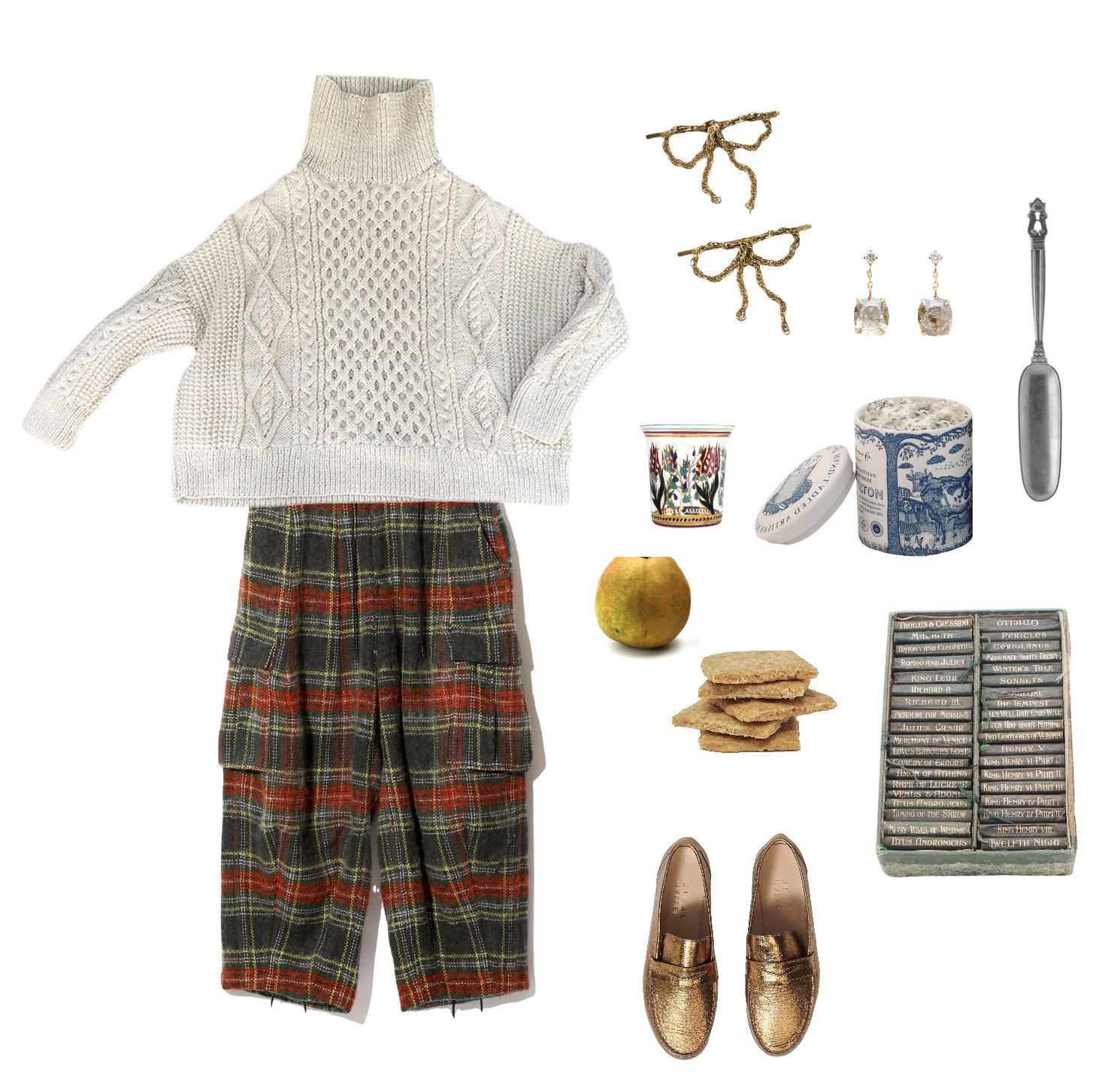
The train snakes through the icy mountains, its steady, churning roar breaking the quiet of snow-stilled space. Inside, the traveler gazes idly out the window into the darkening world. An eight-rayed star and glittering snowflake shine from the shoulder of her structured copper cardigan, while wooden adornments dangle from her ears and circle her finger. Slouchy velvet trousers break for a gleam at the ankle, like the rare green flash of sunset, paired with a peculiarly sensible pair of soft shearling shoes. She taps one silvered nail against the glass, then reaches down into a startlingly capacious bag, crammed with things to read. She pulls out a gleaming metal book and opens a marble box of sharpened scented pencils. After ringing the buzzer for a pot of tea and a fresh pear, she turns her attention again to the bag.

Inside, there is Edmund de Waal's "book about archives that is itself archival," Bridget Penney's recreation of a book that "contained enclosures ... and that encompasses all that can be captured through the filter of the writer's gaze and mind," and writings by Jenny Erpenbeck on things that disappear. There is Paul Willem's The Cathedral of Mist, telling of "the emotionally disturbed architectural plan for a palace of emptiness; the experience of snowfall in a bed in the middle of a Finnish forest; the memory chambers that fuel the marvelous futility of the endeavor to write; the beautiful woodland church, built of warm air currents and fog, scattering in storms and taking renewed shape at dusk," and a novel by Maurguerite Young that David Shurman Wallace asserts "eschews any stable sense of reality." He described his emotions reading it:
As I waded through dense paragraphs of long, winding sentences filled with images of stars and waves and angels, of seagulls and silk and butterflies, of dreams and illusions and any other abstraction you can imagine, occasionally I felt angry—on a personal level—at what I took to be the book’s obstinacy, its willingness to reprise what it had said hundreds of times before, not to mention the seemingly endless detours that defy any obvious sense of structure. At other moments, I knew that I was immersed in something beautiful and strange, something too big to understand all at once.
There is also a rare collection of Young's essays with her 1945 piece, "The Midwest of Everywhere,"  because this is a place, too, that the traveler calls home:
For me, a plain Middle Westerner, there is no middle way. I am in love with whatever is eccentric, devious, strange, singular, unique, out of this world—and with life as an incalculable, a chaotic thing, meaningful above and beyond the necessary and elemental data of my subject ... I am told by commentators both cynical and wistful, those who have never inhabited my regionless region, that we of the Middle West have no Main Stream, no focus, no elite. 'True,' I would answer, 'the Middle West, though it may have a hidden Gulf Steam, has no Main Stream because it is oceanic'—that is, touching on all shores and limitless. There are no boundaries I know of. I have seen, on the grassy ocean, many a lurching ancient mariner—and once, in an Indiana cornfield, a dead whale in a boxcar. 
The Middle West is probably a fanatic state of mind. It is, as I see it, an unknown geographic terrain, an amorphous substance, the ghostly interplay of time with space, the cosmic, the psychic, as near to the North Pole as to the Gallup Poll.

The traveler thinks. What does she want to read? After all, it is Christmas Eve. Finally, she finds what she is looking for—a book of Yuletide hauntings.

Merry everything, friends.

*

Other jólabókaflóðs (Yule book floods).

*

imaginary outfit: jólabókaflóð 2024 + wish-listed books for 2025


Where has the time gone? I'm trying to resist feeling frantic; the days have seemed even shorter than usual for December, and many of the things I like to do this time of year are only partway finished or yet to be done. Oh well. They'll be just as enjoyable in the slow week between Christmas and New Year.

I'd like there to be five extra hours in the day today, and I'd love to spend a few of them in a bar—specifically, Auntie Mae's Parlor in Manhattan, Kansas. I stopped there on my big cross-country drive in August, inspired by "Somebody, Somewhere." The drinks were excellent, the atmosphere laid-back, and they had little glasses stuffed with old Trivial Pursuit cards: idyllic. I'd order a whisky sour and sit and read, or at least pretend to read while I eavesdropped on the conversational hum of people drifting in and out. And I'd take along some sort of treat for the folks behind the bar.

What book to bring? Rootling through my to-read pile, which has attained vast and terrifying dimensions, I find novels about questioning perception written by a collective"weaving, programming, and pioneering women," and a fantasy originally published in 1981. There is a book about faux mountains, another about mountain hoaxes, and a new volume of apologies for stolen rocks. A beautiful edition of two special poems is in the mix, along with a memoir of life with 1,117 pomegranates, recipes for candied fruits, and an exhibition for a show I wish I could have seen. I find this collection of études, though I cannot play them, these photographs of apple trees, and while I'm dreaming, a first edition of Villette. I've somehow turned up a copy of this sold-out work, which is "a loose compendium of photographs and texts that picture, examine, explore, and / or suggest the human body in states of abandon, helplessness, terror, subjugation, serenity, and transcendence" and this "history of feminist designs for American homes, neighborhoods, and cities," described by Paul Goldberg as"full of things I have never seen before, and full of new things to say about things I thought I knew well." And Yoko Ogawa, one my favorite living writers, recommended this two-parter, saying it "portrays with devastating immensity how those on the dark fringes of society can be consumed by the darkness of their own hearts."

Wishing us all the ability to escape the darkness.

Merry everything, friends.

*


*
Other jólabókaflóðs (Yule book floods).


imaginary outfit: jólabókaflóð 2023 + wish-listed books for 2024


December 24th, and time again for my favorite Icelandic tradition—the Yule Book Flood. So here I am, swaddling myself in knits and plaids and plonking down on the small grey sofa by the fireplace. (Though it is small and upright, it is peculiarly suited to extravagant lolling.) There, in the glow of the Christmas lights and the ambient red heat of the electric fire, with a sharp, salty snack and something to drink to hand, knowing that, finally, everything is wrapped and ready for tomorrow, I'll pick up something to read.

My imaginary to-read shelf is well-stocked. On it, I've finally secured a long longed-for copy of Edith Sitwell's A Book of the Winter, and I have the collector's edition of Michelle Oka Doner's Intuitive Alphabet. Then, there's Alex Arzt's fascination with feral cabbages and Suzie Alan Skunk's Maybe I Think You Stink, a "celebrated work of poetry and skunk culture written by and for the small animal community." Mathias Énard's new novel about "the one day in the year where Death and the living observe a temporary truce" beckons, too. I might while away a happy hour or so learning about the secret lives of stones or exemplary fools or odd jobs, or perusing exhibition catalogs "of the Disappeared, Destroyed, Lost or Otherwise Inaccessible" or Lois Dodd's windows and reflections. There's copy of The Girls, a "wry, macabre tale of simple country living, brutal murder, and a reasonably happy couple" by a "most startlingly offbeat suspense novelist," and Howard Fishman's life of Connie Converse, too:
"Converse was notable for preserving a greater level of obscurity more extreme than any of the others: recordings never commercially available; no connections to any scene or famous figure; being a guitar-playing singer-songwriter (and home-taper) in the early 1950s, before such a thing existed, who played only among friends before dropping out of music in the 1960s and ultimately disappearing shortly after."

(I think I found out about this book through Kelsey Keith's Substack.) 

In other Substack recommendations: Jess Stanley's praise of Naomi Klein's Doppelganger landed it on the must-read shelf:

Klein has taken everything frightening in the world—Steve Bannon! Vaccine denial! Fascists! Colonialism and racist scapegoating! Inaction on climate change!—and made the state of the problem clear. Sometimes you just want someone older, wiser and cleverer than you to put your worries in order and point you in the right direction. Klein does this! 
More directional reading: Sadiya Hartman, Christina Sharpe, Rinaldo Walcott, and Vicky Osterweil on looting, which Osterweil describes as "a nearly irrecuperable aesthetic gesture against the police, whiteness, and the regime of property that gives those forces power and purpose," and David Graeber's Pirate Enlightenment, or the Real Libertalia, a book about, yes, 17th-century pirates, but also about what Francis Gooding calls "living, practical" experiments in "new ways of organizing social life," not to mention "blood pacts and poisonings, magicians and princesses, off-grid pirate towns on tropical islands, impostor kings lording it over phoney empires, and more."

Back in real life, I'll probably spend the evening in my pajamas with the Penguin Book of Christmas Stories. Italo Calvino and Angela Carter for Christmas—what could be better?

Wishing everyone, everywhere peace and somewhere safe and quiet and calm to read.

*


*


imaginary outfit: jólabókaflóð 2022 + wish-listed books for 2023


Warren Zevon, writer of songs about werewolves and serial killers, once said that we love to buy books because we believe we are buying the time to read them. If I could buy time, I might, but buying books is more fun, particularly from bookstores you know and love, others you hope one day to visit, and others, strange and glittering, that exist only online.

Scattered across the galaxy of open tabs on my computer, bookstore shopping carts are full of titles that have caught my eye, some new, like a yet-to-be published book on how it might be wise to live more like lichens, those delightfully weird little opportunistic microworlds conjured by fungi and algae, and some old, like Stella Baker's 1933 Pull Devil, Pull Baker, a genre-busting biography of one Count Nicolas De Toulouse Lautrec De Savine, K. M. (Knight of Malta). Boiler House Press describes it as "the oddest book you may ever read." That is enough part me from my hard-earned cash, but then I found stumbled upon this Neglected Books blog post ca. 2007, which is full of many tantalizing excerpts, not least:
There is, perhaps, no thing called Truth in any book — or at any rate that can be arrived at by appraisal from a standpoint outside the book itself. Words in books are like citizens in cities; as long as they live in accord with their neighbours, they are beyond outside challenge…
Odd and delightful: Is this my favorite genre? Maybe! I am also a sucker for books about the perils of editing. After reading Jared Michael Pollen's marvelous review. I am longingly eyeballing Helen DeWitt's The English Understand WoolIt's one of the Storybook ND titles, and the whole series activates my hoarding impulses, as does this complete set of Lando's Decadence University Press zines, mysterious science fiction comics with titles like Stones in Focus, "looking into the emotions and consciousness of rock formations." 

The 50th-anniversary re-issue of a novel by Herman Melville's great-grandson beckons, as does Lucy Ives' new novel, Life is Everywhere, even if it is, sigh, about a grad student. Shola van Reinhold's Lote has some grad school flavor, too, but Juno Jill Richards is persuasive:
“Have you read Lote yet??!!” we asked each other, with increasing urgency, on text threads and social media. “Did you hear about Lote?” we queried, unprompted, at pandemic-friendly outdoor social functions. In a manner sometimes annoying to our nearest and dearest, we found ourselves made over into Lote hype people, insisting that everyone drop what they are doing and order a copy right now.
Emily Hall's The Longcut is about "an artist who doesn't know what her art is"—(is it me? Lol. I digress.)—and Not Without My Ghosts is about art haunted by spirituality. I am wild to get a copy of Batia Suter's Parallel Encyclopedia—she is a genius of creating meaning through arrangements of found images—and also covet Stephen Ellcock's The Cosmic Dance

And then there is a love story set between the wars, the "poignant yet unsparing" saga of an Osaka family in decline, "an authoritative and visual history and dictionary of the foods of the world," a compilation of pathetic literature and a collection of poems of death, a book about the invention of nature photography, a "a horror fiction, a work of speculative theology, an atlas of demonology, a political samizdat and a philosophic grimoire" in one "theoretical-fiction novel," not to mention a cookbook with a section on "the usefulness and frugality of breadcrumbs" and another with Angela Carter's recipe for potato soup (I so wish someone would re-issue this). And who could resist a "fascinating exploration of the eldritch matter of foreknowledge," a book about "the broken lineage of troubadour culture" and Simone Weil, and an investigation of "the links between thought and poetry and natural science." And then there are all the Percival Everett novels I have yet to read; gotta remedy that. Oh, and Gwendoline RileyJessica Stanley said My Phantoms was her favorite novel this year. I may need to buy some time after all.

Merry everything, friends.

*

*

Imaginary outfit: jólabókaflóð 2021 + wish-listed books for 2022


'Tis the season for my annual ignoring of overfull shelves and precarious piles to revel in the promise of a fresh stack of books. So here is an imagined me, free of sniffles and aches (damn head colds), with the luxury of quiet time alone (ha), festively clad in crinkly green dots and cozed in cloud-soft woolens, fortified by a plate of oranges and a mug of black tea toddy, wondering what to read next after a year of reading too much. (I keep hoping to write about some of what I read in 2021—Erpenbeck! Ishiguro! Eisendrath! Yan Ge! Labatut! Oh well, maybe next year.)

Tales of lost ships, disappearing foghorns, and lonely lighthouses beckon. I am tempted by idiots and stories of men mistaken for gods, but also mad mountaineers and a mauling by a bearArt history, reconsidered. Then there are the lives of artists, some well-known, others obscure and prolific, some of revelatory vision, others of unexpected turns. A fiction of plagiarist poets and essays by a real one, as well as words to conjure ghosts.  A book of letters and the story of a lost friend. An "animation of the polyphonic world around us," a new book about matsutake worlds, and an old book about learning the language of the mosquito. "The literary equivalent of a mic drop.Rainbow goblins and odd apples. Childhood favorites, reissued. Advice on how to start writing and when to stop. Perhaps a history of the world that makes a better future feel possible or a compilation of images "to inspire revelations and revolutions." Or maybe a newly translated classic about how to be human. (I could use the help.)

*

Am I dressing like a renegade grandma holiday elf these days? Heck yeah. Anything to up the cheer quotient for this second COVID Christmas. Red and green galore, intarsia snowflakes, reindeer knitwear—it's all happening, styled with a nod to my great-grandmother, whose standard winter uniform was a house dress worn with a fuzzy cardigan and a ski hat from the drug store dollar bin.

*

imaginary outfit: jólabókaflóð 2020 (and too many books to read in the time allotted)


Ah! Another year, another jólabókaflóð upon us! Come, let us don our party gowns and soft-soled slippers, deck ourselves in antique diamonds, and curl up on silk-upholstered divans under tufted velvet quilts. The lamps are lit, and the soft glow limns trays of crumbly, deliciously moldy cheese, ruddy-cheeked pears, and faceted goblets of Chateau d’Yquem Sauternes. Tiles of glazed gingerbread teeter in stacks, impressed with beguilingly peculiar images—a woman tending bees, three running hares, an ammonite. But the true glories await on silver salvers, perched on a respondent marquetry table inlaid with mother-of-pearl stars: old, old books—books with marbled fore-edges, books with uncut pages. Books that dust your fingertips with gilt as you turn a new leaf. A paper knife is to hand, and someone has thoughtfully stopped all the clocks. We can read as much (and as long) as we wish.

A dream; a dream.

*

The idea of uncut pages is a fragment half-remembered from Anna Karenina. I skim the Constance Garnett translation, looking for the reference:
Anna answered a few words, but not foreseeing any entertainment from the conversation, she asked Annushka to get a lamp, hooked it onto the arm of her seat, and took from her bag a paper-knife and an English novel. At first her reading made no progress. The fuss and bustle were disturbing; then when the train had started, she could not help listening to the noises; then the snow beating on the left window and sticking to the pane, and the sight of the muffled guard passing by, covered with snow on one side, and the conversations about the terrible snowstorm raging outside, distracted her attention. Farther on, it was continually the same again and again: the same shaking and rattling, the same snow on the window, the same rapid transitions from steaming heat to cold, and back again to heat, the same passing glimpses of the same figures in the twilight, and the same voices, and Anna began to read and to understand what she read. Annushka was already dozing, the red bag on her lap, clutched by her broad hands, in gloves, of which one was torn. Anna Arkadyevna read and understood, but it was distasteful to her to read, that is, to follow the reflection of other people’s lives. She had too great a desire to live herself. If she read that the heroine of the novel was nursing a sick man, she longed to move with noiseless steps about the room of a sick man; if she read of a member of Parliament making a speech, she longed to be delivering the speech; if she read of how Lady Mary had ridden after the hounds, and had provoked her sister-in-law, and had surprised everyone by her boldness, she too wished to be doing the same. But there was no chance of doing anything; and twisting the smooth paper-knife in her little hands, she forced herself to read. 
Tolstoy: coming through with an uncannily resonant metaphor. 

*

I did force myself to read, again and again, this year, trying to get my attention back in line, knowing the best escape available to me was burrowing into a book. To tempt myself, I ordered books with abandon, anything that caught my eye, spending un-needed gas money at various small bookstores. 

Rifling through my to-read pile, with one eye on the clock, as I steal an hour on Christmas Eve to type this, here is an alphabetical summary of some of what I find:

Eula Biss, Having and Being Had. On Immunity was such a dazzler that I will read whatever she writes, though there is something alienating about the quality of self-reflection in some of her other writings.  Lauren Oyler gets close to it here (n.b, NYT link): 
Professional artists—who are paid completely arbitrary but potentially significant sums to do the thing they most want to do, by entities that range from nefarious to worthy—are in some ways well situated to examine the contradictions of class. In other ways, though, people “compelled” to make art (as Biss says she is) don’t know much about reality at all: they are the rare, lucky individuals whose lives approach the ideal ...
Frances Borzello, Seeing Ourselves: Women's Self-Portraits. I somehow stumbled across Rachel Cooke's 2016 review in The Observer (the book—a survey of women artists, and how they depicted themselves, from 14th century on—was published in 1998) and was sold from the first line: "Some books are so beautiful, you tremble to open them." After listing a selection of the women featured, Cooke concludes:
Here are ideas for a hundred novels I will never write, or perhaps just one too-clever-by-half genre-bending book on female identity which, if I had the time and the money, I would research in the grand libraries of the world, this volume on my desk in every single one.
Leonora Carrington, The Hearing Trumpet and The Complete Stories. Ever since I edited a short piece on Carrington in Broccoli Issue 05, I have meant to read her work. Merve Emre's piece in the 12/21/2020 New Yorker is a compelling nudge:
When asked to describe the circumstances of her birth, the Surrealist painter and writer Leonora Carrington liked to tell people that she had not been born; she had been made. One melancholy day, her mother, bloated by chocolate truffles, oyster purée, and cold pheasant, feeling fat and listless and undesirable, had lain on top of a machine. The machine was a marvellous contraption, designed to extract hundreds of gallons of semen from animals—pigs, cockerels, stallions, urchins, bats, ducks—and, one can imagine, bring its user to the most spectacular orgasm, turning her whole sad, sick being inside out and upside down. From this communion of human, animal, and machine, Leonora was conceived. When she emerged, on April 6, 1917, England shook.
Ted Chiang, Exhalation. Most newish movies seem to evaporate out of my consciousness as the closing credits roll, but Arrival (a linguist works to communicate with alien life; time and questions of free will percolate) didn't. It was based on a Chiang short story and made me curious to read his work.

Jamaica Kincaid, My Garden Book. Recommended by a couple of friends; I am saving this to read in February, when my garden is still in snow-covered dormancy.

Lives of Houses, ed. by Kate Kennedy and Hermione Lee. Found thanks to Kate Bolick's engaging review in the NYRB:
The tradition of truly epiphanic, thoughtful writing about our relationship to the home seems confined to a hard-to-reach cupboard in which specialists might root around, rather than a central aisle that most of us will return to throughout our lives. Hence my delight over the new collection ... edited by Kate Kennedy and Hermione Lee, which brings together some of the best writing about the home that I’ve ever had the pleasure to read—and, crucially, loads of black-and-white photographs and illustrations.
Pictures?! YES. 

Alain Mabanckou, The Negro Grandsons of Vercingetorix. Sometime in the blurry period of 2020's great Before and After, I subscribed to Rhian Sasseen's Phrase Book, a newsletter all about works in translation. Her description of this novel—'a realistic approach to how political conflict feels both rapid and slow-moving'—chimed with the times.

Machado de Assis, The Posthumous Memoirs of Brás Cubas. Parhul Seghal described the book this way in the NYT:
[A] metafictional, metaphysical tale narrated by a man struck dead by pneumonia. Too grim? I neglected to mention that he’s being carried into the afterlife on the back of a voluble and enormous hippopotamus.

If we imagine the historical progress of the novel like the evolution of man—from a crouching primate to upright homo sapiens—Machado’s book represents the moment when the novel learned to dance. 
In a year short on laughs, this sounded irresistible. 

Daniel Mendelsohn, Three Rings. The beautiful excerpt in The Paris Review about model-making and W.G. Sebaldpure readerly pleasure. I cannot wait to read this.

Ann Petry, The Street. This 1946 story of a Black single mother's struggles was first the novel by a Black woman to sell a million copies. At Lit Hub, Tayari Jones wrote:

There are no stunts here or sleight of hand. This novel, like real life, is rife with seeming contradictions and layered with complex truths. And like the human experience this book is riddled with pain, but somehow powered by hope.

Hugh Raffles, The Book of Unconformities. Purchased thanks to another stellar Seghal NYT review (and the recommendation of Stephen Sparks of Point Reyes Books):

The Book of Unconformities is a consummately “unstable and intimate energy-space,” and among the most mysterious books I’ve ever read—a dense, dark star. It’s the biography of a few notable stones, including a 20-ton chunk of pockmarked meteorite, mica prepared in Nazi concentration camps, the layer of marble running under Manhattan. Between these narratives flickers the devastating story of Raffles’s two sisters, who died within months of each other in the mid-1990s.
Claudia Rankine, Just Us. I stayed awake into the small hours of a September morning, riveted and discomfited (productively, I think/hope) by Citizen; this is another one I can't wait to read.

Anna Seghers, Transit. The NYRB describes it as "an existential, political, literary thriller that explores the agonies of boredom, the vitality of storytelling, and the plight of the exile with extraordinary compassion and insight." (The Christian Petzold adaptation was an unsettling wonder.)

Judith Schalansky, An Inventory of Losses. Her Atlas of Remote Islands is a prized treasure; very eager to explore this new work: 
Each disparate object described in this book—a Caspar David Friedrich painting, a species of tiger, a villa in Rome, a Greek love poem, an island in the Pacific—shares a common fate: it no longer exists, except as the dead end of a paper trail.
Robin Wall Kimmerer, Gathering Moss. This year showed that the ability to recognize the sublime near at hand—in a mushroom, a bumblebee, or a clump of moss—is invaluable. 

And even with all these unread books (not to mention the ones crammed in the dark corners of shelves and piled on my office floor) I have some I plan to order once the holiday postal mayhem resolves:

Kevin Brockmeier's new ghost book (The Brief History of the Dead has stayed with me, with its uncanny city of vanishing folks and lonely polar explorer); Zachary Mason's riff on Ovid (The Lost Books of the Odyssey I remember affectionately); a new collection of Sheridan Le Fanu's gothic tales (because Dorothy Sayers references them), and everything/anything by Danielle Dutton. And what about this new George Saunders on Russian short stories?! (Is this the year I dive back into reread my shelf of Russian literature? Maybe.)

Merry everything, pals.

*

imaginary outfit: jólabókaflóð 2019 (and a haphazard collection of wish-listed books)


Resplendent in corduroys, turban, and bobble sweater, the intrepid reader curls up on the divan and tucks her cashmere-coddled feet under a soft merino throw. Heavy vintage rings clink together softly as she languidly turns deckle-edged pages, peering at images of artworks fantastical and strange by the quavering light of a twisted candle. Beside her, a plate of Triscuits, olive-stuffed celery, and a mini glass bottle of Coca-Cola perch atop a teetering tower of books to read. For a handful of hours, grim news and heart-aching care fade as she gets lost in words and pictures and the questions they spark in her wondering, wandering mind. Time to celebrate jólabókaflóð, the Icelandic tradition of exchanging books on Christmas Eve and spending the rest of the night reading.

Like a bobble sweater, the list of books that caught my eye in 2019 to read in 2020 is fanciful and particular, with funny patterns and an appealing bumpiness. 

If you, like me, would like to rifle through an 18th-century Dutch apothecary's cabinet with 55 secret drawers, The Collector's Cabinet and Miniature Pharmacy is a literal dream come true. There are vellum overlays and geological specimens and tiny footnotes galore.

I'm also coveting Jochen Raiß's collection of found polar bear photographs, a new volume of the painter Lesley Vance's work (I saw an exhibit of her paintings in 2012—something like colorful blurry ghosts of still objects—and wish wish wish I could have bought one), and The Pillar by Stephen Gill, a collection of photographs capturing various birds moving through the same specific place as the seasons change. It has text by Karl Ove Knausgård:
We see the same landscape in spring and summer, in autumn and winter, we see it in sunshine and rain, in snow and wind. Yet there is not the slightest monotony about these pictures, for in almost every one there is a bird, and each of these birds opens up a unique moment in time.
I'd buy this Ann Craven book for the title alone: Shadows Moons and Abstract Lies. I'd also love a copy of the exhibition catalog for Endless Enigma, one of the most interesting shows I saw in 2019. Bellaire, Ohio: An All-American Town, a collection of photographs made by high school students, offers a different perspective on living in the sorts of places coastal reporters breeze through to sum up people they don't understand.

Moving away from picture books, my friend Jess mentioned the radical power of reading Franco Berardi, who offers strategies for living in the apocalypse. I was hunting up essays related to The Odd Women by George Gissing and found this Vivian Gornick piece in Dissent which made me want to read it, as well as the two "great novels of the revolution" she mentions at the close: Nikolai Chernyshevsky’s What Is To Be Done? and Rabindranath Tagore’s The Home and the World.

Granta's "Best Books" are a trove of reading inspiration. Because I love Barabara Comyns, I plan to hunt up a copy of A Touch of Mistletoe for its "alluring boy-painters and bull terriers, a Pre-Raphaelite brightness and a moreish Dickensian atmosphere."

Margaret Cavendish's cosmic earrings sparked my curiosity; the NYRB publishes a collection of her poems, and writes:
Margaret Cavendish, the Duchess of Newcastle-upon-Tyne, was a groundbreaking writer—a utopian visionary, a scientist, a science-fiction pioneer. She moved in philosophical circles that included Thomas Hobbes and René Descartes, and she produced startlingly modern poems unlike anything published in the seventeenth century or since, at once scientific and visionary, full of feminist passion and deep sympathy with the nonhuman world.
So, that's filed under a 2020 must-read, alongside Stories of the Sahara by Sanmao, translated by Mike Fu. At The Paris Review, Tash Aw described it as 'a hypnotic meditation on love and loneliness in a foreign place.'

I was also captivated by a 1981 review of G.B. Edwards's The Book of Ebenezer Le Page about an 80-year-old man who lives a quiet life of subtle profundity. Guy Davenport writes, "I know of no description of happiness in modern literature equal to the one that ends this novel."

This Lucy Scholes essay on The Ice Age by Margaret Drabble makes the case that this 1977 book is a Brexit novel, and quotes this passage:
All over the nation, families who had listened to the news looked at one another and said ‘Goodness me’ or ‘Whatever next’ or ‘I give up’ or ‘Well, fuck that’, before embarking on an evening’s viewing of colour television, or a large hot meal, or a trip to the pub, or a choral society evening. All over the country, people blamed other people for all the things that were going wrong—the trade unions, the present government, the miners, the car workers, the seamen, the Arabs, the Irish, their own husbands, their own wives, their own idle good-for-nothing offspring, comprehensive education. Nobody knew whose fault it really was, but most people managed to complain fairly forcefully about somebody: only a few were stunned into honourable silence.

(Gossipy sidebar: Drabble's sister is the writer A.S. Byatt, and they apparently fell out over a tea set.)

Two windy books caught my eye: Heaven's Breath: A Natural History of the Wind by Lyall Watson and Where the Wild Winds Are by Nick Hunt. Alexandra Harris's Weatherland: Writers and Artists Under English Skies is also on my nightstand; I loved her book Romantic Moderns

Hugh loves hearing chapter books read aloud, and I am thinking it might be time to try The Little Grey Men, a story about the last gnomes left in England. Even escapist reading doesn't offer much escape: last gnomes and fickle winds feel tied to the unraveling climate.

There's a stack of thick books waiting for me on my shelves: Ducks, Newburyport by Lucy Ellman—"a single, sinuous sentence tracking a middle-aged Ohio woman's perambulations of thought"; Horizon by Barry Lopez—"a grave, sorrowful, beautiful book" about the ways we've damaged the world; and Anniversaries by Uwe Johnson (a gift from last year's list).

Always too many books to read; the best problem to have.

Merry everything, friends.


*

I was watching Christmas in Connecticut (a madcap 1945 rom-com about an influencer forced to live in her scam illusion of womanhood), and Barbara Stanwyck wears the most delightful and preposterous clothes pretending to be a model housewife. Her awful fiancé calls one of her outfits "a little ultra," and my new 2020 resolution is to wear more "ultra" clothes around the house. And anyway, my house is always chilly. I usually wear a ski cap indoors all the time, so a turban is maybe ... practical? (Ha ha.) 

*


imaginary outfit: jólabókaflóð (and bookmarked books to give or get)


Somehow, just this year—a virtual age after it ricocheted around the internet echo chambers—I discovered jólabókaflóð — "Yule book flood," an Icelandic holiday tradition that involves exchanging new books on Christmas Eve, then spending the rest of the night curled up reading.

This is basically the holiday tradition I have been dreaming of my whole life.

After this brutal, bruising year, I find myself wishing I could gather everyone I care about in my home and give them comforting things: soup, soft slippers, a book to read. I imagine piles of blankets, pillows pulled from beds and heaped on the ground, people curled up everywhere reading. The sharp-sweet tang of clementine peels and the warm smell of toasted bread. The rustle of pages turning and the occasional pad of slippered feet; sometimes maybe the clink of a spoon. And then talk; torrents of talk, punctuated by laughter. A very humble sort of retreat before we gather ourselves together for whatever 2019 will bring.

I keep a haphazard list of things I want to read as the year ticks along; below are a few titles from that list. I haven't read them and can't vouch for them (though I may do a post in the new year on my favorite reads from 2018). They just sounded interesting to me, and maybe to you, too.

*

Hilde Bouchez, Wild Things —A book full of clouds about the thingness of things.

Parul Seghal's NYT review of Inger Christensen's The Condition of Secrecy sold me:
The collection is slim and heady. Like all her writing, it aims to be a history of no less than everything: the origins of the stars and our souls, the beauty of fractals and of third-century Chinese poetry. It is a book about eating strawberries, witch-burning and the challenge that the soft, scumbled sides of clouds pose to geometry. It’s about standing in the garden and watching yellow slugs “moving like slow flames” in sunlight.
Mathias Énard, Tell Them of Battles, Kings, and Elephants. (Sometimes the title alone is enough to sway me.)

I somehow came across a review on roughghosts describing The Taiga Syndrome by Cristina Rivera Garza as 'a subtle twist on the Latin American detective novel [that] is, in a sense, less of a mystery and more of a dreamlike exercise in mysteriousness.' And then I read the rest of the review and decided that I need to read it as soon as possible. (And every book Dorothy, a Publishing Project, touches is worth attention.)

A private source of rage is the self-help gospel of finding yourself in your work and the idea that work somehow defines who we are; given that so much of the work that supports U.S. society is soulless (or at least the work that pays and offers benefits), what does that say about what society thinks of people working service jobs? So Convenience Store Woman by Sayaka Murata, a novel about a woman who seemingly somehow finds total fulfillment in her work as a convenience store clerk, discomfiting her family, sounds wickedly appealing.

Like by the classicist A.E. Stallings offers an "archaeology of the domestic" and marries three central interests of mine: ancient literature, poetry, and motherhood.

A review in The Economist paired The Waterless Sea by Christopher Pinney, a book on the theory and history of mirages, with Nancy Campbell's The Library of Ice, and after I read it, it took most of my willpower not to drop everything and immediately start reading both.

I always like to browse Reaktion Books; they have books about badgers, the North Pole, shadows, and birch trees, among many delightful others.

Any book that describes ghosts as a whirling pile of hay is a book for me: The Ghost: A Cultural History, by Susan Owens.

An email from Lapham's Quarterly featured a beautiful excerpt from The Land of Little Rain by Mary Austin, and I am saving it for a moment when my mind needs to visit the desert.

From the NYRB's description of The Adventures of Anatole by Nancy Willard: 'Anatole has a knack for seeking and finding adventure, often with Plumpet, his orange cat, who is accustomed to ghost trains, amnesiac soldiers, flying horses, and wallpaper portals'—well, sign me up.

My friend Amanda sent me a copy of Treasure Hunt House by Kate Davies and Becca Stadtlander; I haven't had time to do much more than gasp and swoon, but I am looking forward to reading it; it's a book my ten-year-old self would have adored, a lift-the-flap scavenger hunt through a marvelous house with all sorts of interesting history about curious objects.

To fulfill my needs for gossipy histories: In Byron’s Wake: The Turbulent Lives of Lord Byron’s Wife and Daughter Annabella Milbanke and Ada Lovelace by Miranda Seymour.

Zadie Smith describes Karl Ove Knausgård's writing as 'like crack,' and I feel like I should read My Struggle, but I have already spent so much of my life reading the words of self-centered men. Fortunately, Uwe Johnson's Anniversaries just came out in translation; I can spend 1,700 pages reading about a woman instead (even if it is written by a dude).

Drew Gilpin Faust's wonderful piece about Pauli Murray made me ashamed at how little I knew about her; I need to read Song in a Weary Throat.

Anna Kavan's Ice sounds fantastic:
[A] vertiginous, time-looping narrative depicts an itinerant man’s obsessive stalking of an evanescent young woman—a platinum blonde, rail-thin 'glass girl'—across an apocalyptic, barely habitable landscape. Nebulous geopolitical calamities, including a possible nuclear detonation, are ushering in a new ice age. Yet the reader cannot distinguish between material reality and the hectic projection of the hero, who admits: 'I had a curious feeling I was living on several planes simultaneously; the overlapping of these planes was confusing.'
It's also embarrassingly clear to me that I need to read more writers of color; I'm looking forward to picking up Glory Edem's Well-Read Black Girl as a starting place.

Oh, and I am ferociously coveting The Folio Society's newish The South Polar Times, which collects and reprints all of the handmade newspapers Captain Scott's men made during their epic sojourn in Antarctica.

Last year I only read about 50-some books, so I've got to pick up the pace.

Merry everything, friends.

*
Block print paisley pajamas from Toast / Tory Burch Inez heavy sweater / deer and cabin pyramid / L.L. Bean washable wool throw / C.P. Slippers / Heath Ceramics Bluejay lunch set / Satomi Kawakita tiny pearl earringsThe South Polar Times by The Folio Society.