Showing posts with label egypt. Show all posts

gebel kamil

From the 4/5/2011 NYT:
Ebay and other Web sites pulse with hundreds of sales pitches. “The pieces below have an exceptional patina,” a site called Star-bits.comsaid of 10 pictured fragments.
The ads are for chunks of meteorites, bits of asteroids that have fallen from the sky and are as prized by scientists as they are by collectors. As more meteorites have been discovered in recent years, interest in them has flourished and an illegal sales market has boomed — much to the dismay of the people who want to study them and the countries that consider them national treasures.
“It’s a black market,” said Ralph P. Harvey, a geologist at Case Western Reserve University who directs the federal search for meteorites in Antarctica. “It’s as organized as any drug trade and just as illegal.”
The discovery of a rich and historically significant meteorite crater in southern Egypt, just north of the Sudanese border, has shown the voracious appetite for new fragments. Just as scientists appeared to be on the cusp of decrypting the evidence to solve an ancient puzzle, looters plundered the desolate site, and the political chaos in Egypt seems to ensure that the scientists will not be going back anytime soon.
The mystery began thousands of years ago with Egyptian hieroglyphs, which refer to the “iron of heaven.” Archaeologists have long debated whether the Egyptians made artifacts from iron meteorites that fell to Earth in fiery upheavals. The main evidence came from ancient knife blades of iron that had high concentrations of nickel — a rare element in the Earth’s crust that was considered a signature of extraterrestrial origin.
But doubts grew as investigators found terrestrial sites rich in nickel that ancient peoples could have mined. And scientists in Egypt never found an impact crater and a nearby lode of meteorites.
Then in June 2008, Vincenzo de Michele, an Italian mineralogist and former curator at the Natural History Museum of Milan who had explored the Egyptian desert for nearly two decades, was scanning the area on Google Earth when he saw something unusual.
He told Mario Di Martino of the Italian National Institute for Astrophysics in Turin, and together they formed an expedition that surveyed the site in February 2009. To their delight, the desolate area bristled with iron meteorites — more than 5,000 of them — and they named the crater Gebel Kamil, after a nearby mountain.
The team members signed a note of discovery and put it in a bottle at the crater’s bottom. The find was a first. It was the only meteorite crater ever discovered in Egypt — its mouth 150 feet wide — and the team vowed to keep it confidential as long as possible.
But a return expedition in February 2010, found that the bottle had disappeared. The secret was out.
Full story here

Pleasing to think that even today someone can discover a field of 5,000 meteorites.

Pictured: A looted 60 gram fragment of the Kebel Gamil meteorite.

***
Unrelated but awesome: the triangular shadows of mountains.

imaginary outfit: the egyptian galleries


Making yourself at home in a city like New York is surprisingly easy and deceptively hard. It's big but not private. There are a million places to see and 8 million people to share them with. Finding a place for yourself takes doing.

My home away from home is The Metropolitan Museum of Art. The city is full of amazing museums, but it's the one I find most comfortable. I visit about once a week. It feels like stepping into the home of some carelessly grand, insanely wealthy, and slightly eccentric relation who lets you rifle through her jewel box. It's ideal for wandering, because seeing everything is an impossibility. There is always something new to notice.

The first three or four times I visited, I couldn't get past the Egyptian galleries. They pulled me in like an iron filing to a magnet (it's not just me - the lines to go in those wings are always the longest). If you have never been, to walk through them is to wonder that anything is left in Egypt at all. There are 36,000 objects in the collection - everything from temples to tombs, sphinxes to sarcophagi, ancient raisins shriveled like gravel, string after string of beads sifted from the sand, tiles from faience factories, painter's palettes, tiny hippopotami, unused inlays, golden toe caps, wig rings and makeup applicators - all arranged in a warren-like cluster of rooms, some large and grand, some very small. Long, narrow galleries snake back and through the space, taking you through hundreds of years of history in a few short feet. It's not excellent for hurrying, but that suits me fine.

The study galleries are my favorite - little pocket rooms tucked off to the side and packed floor to ceiling with shelves full of objects that aren't quite special enough to merit a place of honor, but are too wonderful to hide - boxes of gold leaf, fragments of statues, cast-offs from a bead factory. I look at those shelves and imagine armies of men and women making each item, using them, breaking them, discarding them ... and then, thousands of years later, another army of men and women painstakingly searching, treasuring, cleaning and cataloguing each one.

I can't get enough it. After I visit, I always dream of Cairo.

egyptians


A very, very few of the objects on view in the Met's Egyptian galleries. From top:

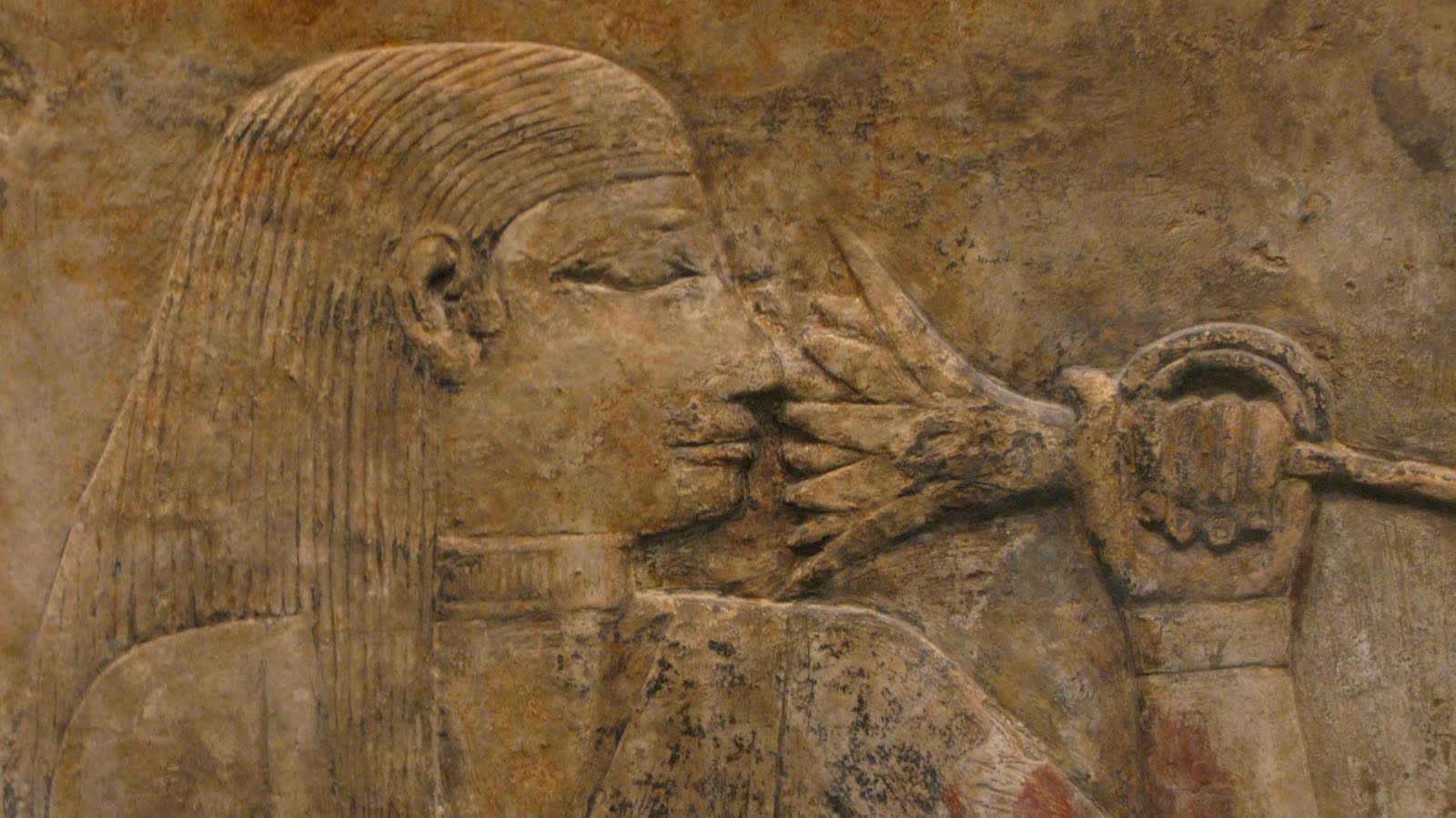
Niankhwadjet inhales a lotus (limestone detail from a false door). 2575-2520 B.C.
A spouted bowl (2649-2465 B.C.) and two plates (ca. 2750-2649 B.C.).
Blue-green faience wall decoration from the funerary apartments of King Djoser, ca. 2630-2611 B.C.
Feet of the Overseer of the Granary Kaiemsenuwy, 2345-2181 B.C.
Assorted hippos
Scarabs from Dynasty 18
Raisins, dates, figs + pomegranates from the tombs of Hatnofer and Amenhopte.
Gold fragments from the North Pyramid Cemetery. 1971-1668 B.C.
Linen sheets from the reign of Hatshepsut. 1479-1548 B.C.
Storage jars from the reign of Thutmose III. 1479-1425 B.C.
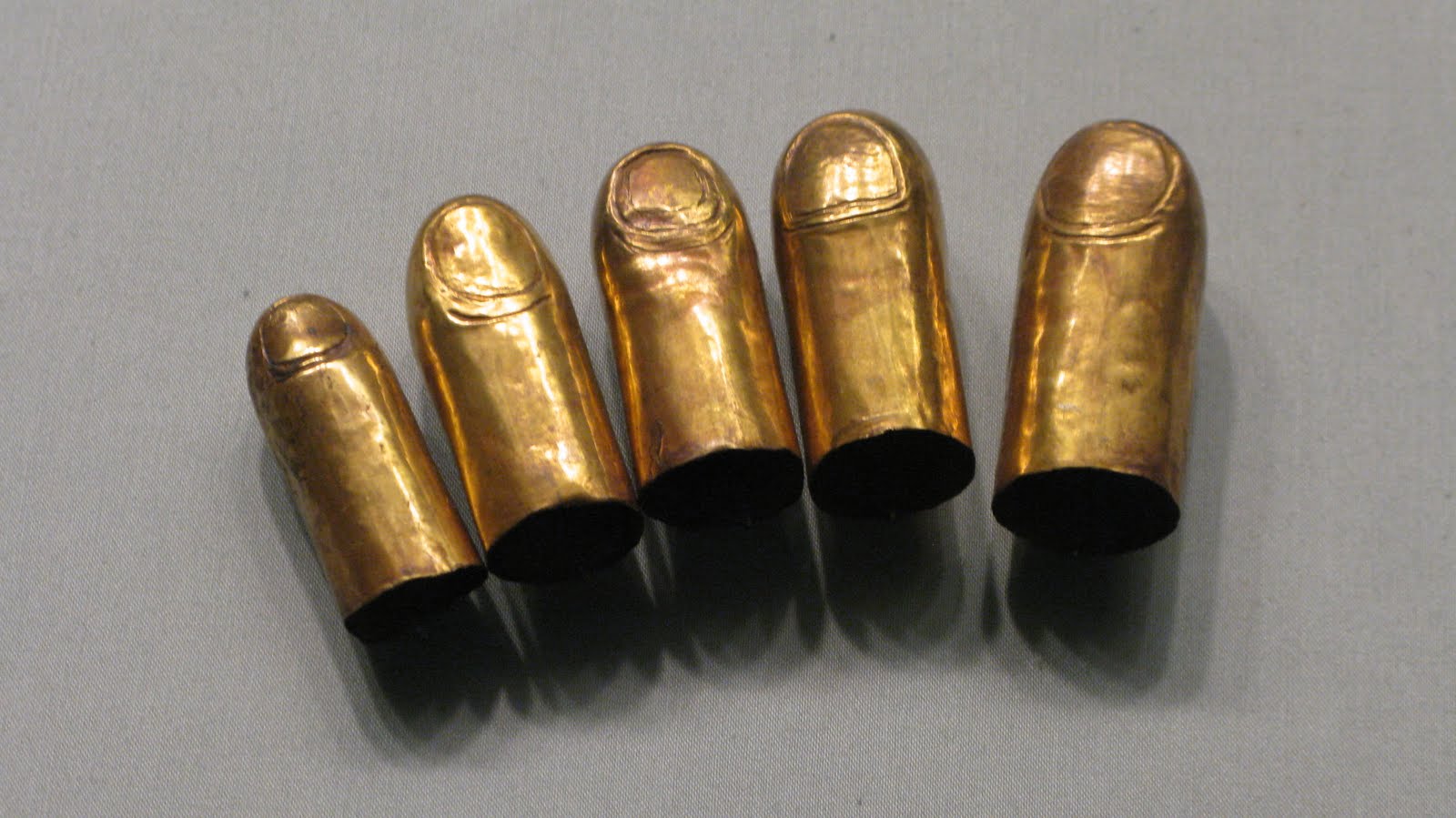
Gold toe caps from the tombs of the three minor wives of Thutmose III. 1479-1425 B.C.
Statuary fragment from the Great Temple of the Aten at Amarna, 1353-1336 B.C.
Lotus blossoms
A detail of a block from the sanctuary in the Temple of Mentuhotep II at Deir el-Bahri, 2010-2000 B.C.
View of Study Gallery 120
Assorted wing fragments
Faience inlay of a hawk from the Ptolemaic period
Mummy wrappings, A.D. 80-100

today

A new day in Egypt - 'a complete explosion of freedom, a complete explosion of expression.'

Amazing.

'there is no going back now'

Worth reading: Yasmine el Rashidi: 'Tomorrow, to Tahrir Again' at the NYRB blog.

I'm riveted to the Guardian's live coverage of the Egyptian protests. It's hard to feel like much else matters right now.