Showing posts with label eula biss. Show all posts

odds and ends / 3.7.2021


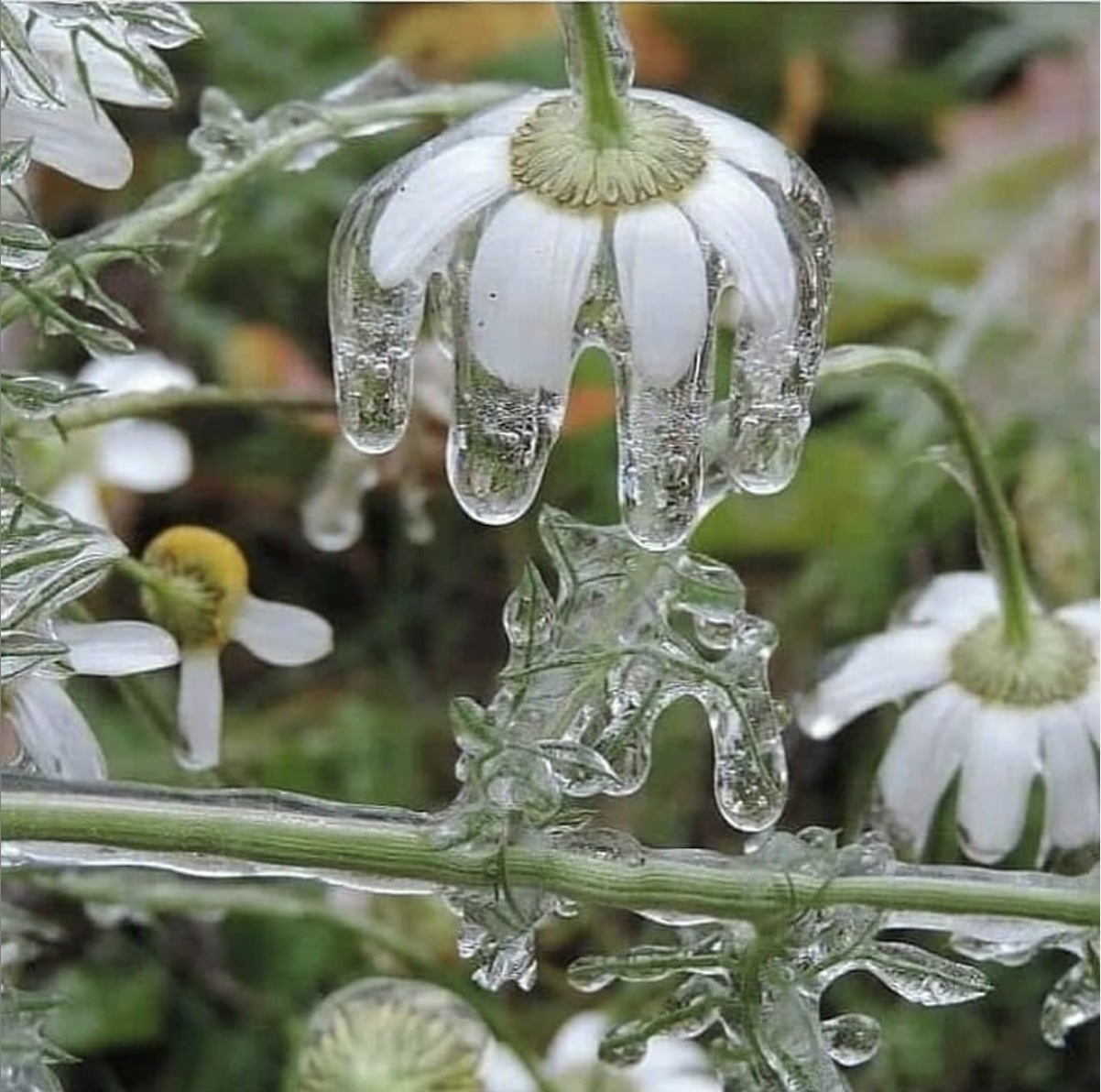
Photo of a frozen daisy, found here.

Maria Sybilla Merian, drawings of two moths from Merian's Drawings of Surinam Insects &c, ca. 1701-1705. The British Museum.

*

Quilted Robe à la Francaise, ca. 1750. In the collection of The Metropolitan Museum of Art. (Rennes stocks a covetable modern version of the luxury quilted housedress by Maku.)

*

Unknown artist, lover's eye ring, ca. 1890. The Metropolitan Museum of Art. (Other eyes.)

*

Judy Kensley McKie, Butterfly chest, 1993. 

*
We live on a wild planet, a wobbly, erupting, ocean-sloshed orb that careens around a giant thermonuclear explosion in the void. Big rocks whiz by overhead, and here on the Earth’s surface, whole continents crash together, rip apart, and occasionally turn inside out, killing nearly everything. Our planet is fickle. When the unseen tug of celestial bodies points Earth toward a new North Star, for instance, the shift in sunlight can dry up the Sahara, or fill it with hippopotamuses. Of more immediate interest today, a variation in the composition of the Earth’s atmosphere of as little as 0.1 percent has meant the difference between sweltering Arctic rainforests and a half mile of ice atop Boston.


Peter Brannen, "The Terrifying Warning Lurking in the Earth's Ancient Rock Record." The Atlantic, 3/2021.

*

Life with an obsessive, often absent, geologist must have been hard. In one recollection Mary Ann is described as 'an eccentric little round-faced woman,' oddly dressed, with rouged cheeks and black curls, often seen walking a few paces behind Smith, 'who plodded steadily on his way, apparently too much immersed in his geological meditations to give a thought to her who followed behind.' Occasionally she had tantrums. Smith never argued but walked quietly out of the room, locking the door behind him. More than once she was known—and who could blame her—'to dash some object through the window of her temporary prison as he passed outside of it.' In February 1842 she was sent to York Lunatic Asylum, where she died two years later. Hers is a story that asks to be written.


Jenny Uglow, "The Reader of Rocks." The New York Review of Books, 3/11/2021. 

*

For rock hunters: A jazz musician explains how to find micrometeorites.

*

She has freed me from the nagging worry about relevance, because, reading her, I know I am entirely irrelevant, nearly extinct or saved from extinction by some kind conservationists who allow me to graze on austere pastures.

Mary Gordon, "Beatifying Patricial Lockwood." LitHub, 2/24/2021. 

*
Everything is too long these days, isn’t it? Every series is at least two episodes too long, podcasts go on for hours, you have to scroll through pages of someone’s barely disguised eating disorder mania to get to the recipe on their blog, and every documentary on Netflix is four hours long, forcing me to go to Wikipedia halfway through just to finally find out what happened ...


Jessa Crispin, "Why I Am Obsessed with this Podcast's Merciless Little Romps." The Spectator, 2/27/2021. 

*
This notion of oneself as a kind of continuing career—something to work at, work on, “make an effort” for and subject to an hour a day of emotional Nautilus training, all in the interests not of attaining grace but of improving one’s “relationships”—is fairly recent in the world, at least in the world not inhabited entirely by adolescents.

Joan Didion, "Letter from 'Manhattan.'" The New York Review of Books, 8/16/1979.

*
Yes, writing is very hard, and no book really lives up to its aspirations, but once you’re an adult you can’t be writing bad books all over the place. People might read them! It’s not your right to be a writer. It’s not your right to be read. It’s not your right to be a public figure. A just society is one where everyone has a home, food, healthcare, an education, and vacation for four weeks a year. A just society does not mean everybody gets to be a celebrated writer if they want to be. 


Lauren Oyler, interviewed at The End of the World Review

*


*


*
The blues are both a feeling and a situation, [Angela] Davis writes. America is in the blues now, and the blues are in our history. The United States isn’t occupied by Nazi Germans, it’s occupied by the same people it has been occupied by since it was colonized. “Occupied territory is occupied territory,” James Baldwin wrote in 1966, “even though it be found in that New World which the Europeans conquered, and it is axiomatic, in occupied territory, that any act of resistance, even though it be executed by a child, be answered at once, and with the full weight of the occupying forces.”


Eula Biss, "The Resistance." The Paris Review, 2/23/2021. 


*


*
I have striven hard to be pleased with my new situation. The country, the house, and the grounds are, as I have said, divine. But, alack-a-day! There is such a thing as seeing all beautiful around you—pleasant woods, winding white paths, green lawns, and blue sunshiny sky—and not having a free moment or a free thought left to enjoy them in. The children are constantly with me, and more riotous, perverse, unmanageable cubs never grew. As for correcting them, I soon quickly found that was entirely out of the question: they are to do as they like.

Charlotte Brontë, writing to her sister Emily in 1839, via Lapham's Quarterly Vol. IV, No. 2, Spring 2011.

*

"One person is the hider, and the other person is also the hider."

*


odds and ends / 6.25.2020


Protest sign calling for reparations for the Tulsa Riot, ca. 2000. National Museum of African American History and Culture.

*

"The Least You Could Do"—"Black people all across the US are receiving the world's weirdest form of reparations: Venmo payments from white people."

*


*

An incredible reading/resource list: Bilphena Yahwon's The Womanist Reader

“I needed to find something that would make sense of the grief and despair that was not just choking me, but so many other Black women.” 

*

Sascha Bonét writes for The Paris Review on collage as "a historical practice of Black imagination":

It has helped us to envision unfathomable futures in the face of violence and uncertainty. It has been a creative way to love each other even though we haven’t been shown care, to express the depths of our experiences even when no one ever asked how we felt, to give evidence to all the things unseen. 

*

The Wide-Awakes: 'They deliberately targeted young people, calling massive crowds of youths to ‘wake up'... their iconography of an open eye, talk of throwing off past stupor.” 

*
"[O]ne motivating factor that I am not proud of but that I have recognized as relevant—in my personal circle, a larger number of white people are speaking up, and unconsciously I think that makes it feel safer and more important to care," one person wrote. "I recognize that this is ... highly problematic ... [b]ut I wouldn't be telling the truth if I didn't recognize this as a layer of this moment for me."

An answer Gene Demby received when he asked Code Switch's new white followers: why now? 

*
Refusing to collude in injustice is, I’ve found, easier said than done. Collusion is written onto our way of life, and nearly every interaction among white people is an invitation to collusion. 
 
Eula Biss,"White Debt." NYT 2015.

*
The only way to avoid rot is to be proactive: check every apple, every tree. At the first sight of something amiss—a bruise or broken skin, a sunken place—toss that apple out, but don’t stop there. Scrub all the others and monitor them closely, but know that it’s likely already too late. Better to trim and burn the infected branch, or even the whole tree

Helen Rosner, "How Apples Go Bad." The New Yorker, 6/6/2020.

*
The work of the people is what endures. It’s unromantic work, done in small increments, sometimes just as a blueprint for whatever future movements might arise, and it’s more precious than any bronzed monument or seal or city name. The work of the students who will not rest until the cops leave their schools. Of the medics who guide people under the shade of a tree and flush the tear gas out of their eyes. Of the people who sew masks, or make bags of supplies and bike them across the city through police barricades. Of the people who carry bags of ice so that the water stays cold. Of the Black people who sacrifice their own safety to keep their people safe. Of the people who show up to courthouses, and in front of police stations, and in the suburbs. Of the mothers who grieve their dead children and who, despite their grief, continue to fight for the living. The new monuments the people are building toward cannot yet be seen. And still, here we are, leaping forward.

Hanif Abdurraqib, "The Vanishing Monuments of Columbus, Ohio." The New Yorker, 6/24/2020. 


odds and ends / 11.3.2018


From the top:

Peter Blume, Vegetable Dinner. 1927.

The two women in Vegetable Dinner are both images of Peter Blume's companion Elaine ... The woman on the left, with her fashionable clothing and lit cigarette, evokes his love of parties and freedom, while the woman on the right chops vegetables to represent commitment and domesticity. This expresses Blume's conflict between his affection for Elaine, who "had very competent hands," and his need to live the bohemian life of an artist ... The dramatic cropping of the two figures, together with the knife pointing ominously at one woman's thumb, transforms this ordinary scene into something far more menacing, and suggests that neither of Elaine's roles would have made the artist completely happy. Blume eventually parted from Elaine, remembering later that their relationship was "always in a state of high tension anyway. It could never have survived as a marriage."

*

"No!" by Thomas Hood.

*

Admiring all things patched and quilted at Carleen.

*

Victorian glass and sterling hand and key pendant.

*

Marsden Hartley, Landscape No. 25. Always think of this painting this time of year.

*

Filed under fancy pants: Studio Hecha Matisse multicolor hand-painted vintage denim at West End Select.

*
Humans have often looked at insects and seen themselves, or the selves they would like to be. Early-modern European naturalists peered into termite mounds, anthills, and beehives and saw microcosms of well-ordered states: monarchs, soldiers, laborers. (There was no general recognition that bee “kings” were actually female “queens” until the sixteen-seventies, when a Dutch microscopist, Jan Swammerdam, pointed out that bee kings had ovaries.)

Amina Srinivasan, "What Termites Can Teach Us." The New Yorker, 9/17/2018. (This article may be the single most enjoyable thing I've read in the past month.)

*

Can you copyright a quilt?

*
“Posing Modernity” has been organized by Denise Murrell, a former chief executive who recently earned a Ph.D. in art history at Columbia University. The idea for the show — and the thesis that preceded it — came to her after sitting through a few too many art history lectures that pored over the white subject of “Olympia,” but barely mentioned its black one. Ms. Murrell sought to discover more about the model for the maid and other women like her, and what they could tell us about modernism. 

Roberta Smith, "A Long Overdue Light on Black Models of Early Modernism." NYT, 11/1/2018.

*
Like superficial spirituality, looking on the bright side of things is a euphemism used for obscuring certain realities of life, the open consideration of which might prove threatening or dangerous to the status quo. . . . The acceptance of illusion and appearance as reality is another symptom of this same refusal to examine the realities of our lives. Let us seek “joy” rather than real food and clean air and a saner future on a liveable earth! As if happiness alone can protect us from the results of profit-madness.

Audre Lorde, The Cancer Journals, quoted by Becca Rothfield.

*
Refusing to collude in injustice is, I’ve found, easier said than done. Collusion is written onto our way of life, and nearly every interaction among white people is an invitation to collusion. Being white is easy, in that nobody is expected to think about being white, but this is exactly what makes me uneasy about it. Without thinking, I would say that believing I am white doesn’t cost me anything, that it’s pure profit, but I suspect that isn’t true. I suspect whiteness is costing me, as Baldwin would say, my moral life.

Eula Biss, "White Debt." NYT 12/2/2015. I just finished Biss' Notes From No Man's Land.

*
There is something dying in our society, in our culture, and there’s something dying in us individually. And what is dying, I think, is the willingness to be in denial. And that is extraordinary. It’s always been happening, and when it happens in enough of us, in a short enough period of time at the same time, then you have a tipping point, and the culture begins to shift. And then, what I feel like people are at now is, “No, no, bring it on. I have to face it — we have to face it.”

angel Kyodo williams, Zen priest and activist, in conversation at OnBeing.