Showing posts with label bugs. Show all posts

beastly gifts


A set of three Gustavsberg ceramic owls, to wink knowingly.

A Couperier Coursolle rabbit pocket-knife.

Jim Nollman's experiments in interspecies communication, featuring "300 turkeys, 12 wolves, [and] 20 orca whales."

A deck of cards adorned with a menagerie of extinct animals.

A stainless steel fish flask, for drinks to go.

House of Hackney's tigerish loveseat (or, somewhat less grandly but still extravagantly, a tasseled tiger pillow).

A swan pencil-sharpener, for serene sharpening.

Winona Irene's black kitty, to claw back stray tresses, and Catnip, a magazine for cat lovers edited by a person allergic to them (me!).

Brass snail knobs, for gastropodic gleam.

Socks with squirrels, in every size.

The Golden Mole, a "lavishly illustrated collection of the lives of some of the Earth's most astounding animals" by Katherine Rundell. (I'll read anything she writes—an amazing writer.)

One of Alexis Stiteler's creaturely hand-drawn sweatshirts (next drop Sunday, December 10 at 4:00 pm ET.)

A vintage cast-iron monkey hook, for hanging around.

Mosaic scarab ring, because beetles are gem-like beauties.

Natalie Lete's fish belt bag, made to swallow phones and keys.

British Colour Standard's wolf's head candle, for light with bite. 

Cactus Shop's license-plate tribute to slime mold, because being a mammal isn't everything.

*

One more indulgence: These funny gift guides are an annual delight to compile for all of you anonymous folks out there. I don't make any money from them—no affiliate links, no placements, nada! I'm an online renegade!—but if they have brought you joy or amusement, please consider making a donation to Doctors Without Borders. I'm donating what I can, too, and holding the people of Palestine, Ukraine, and Sudan in my heart. Thank you.

read lately / 7.21.2023 - books by clockmakers and books by writers

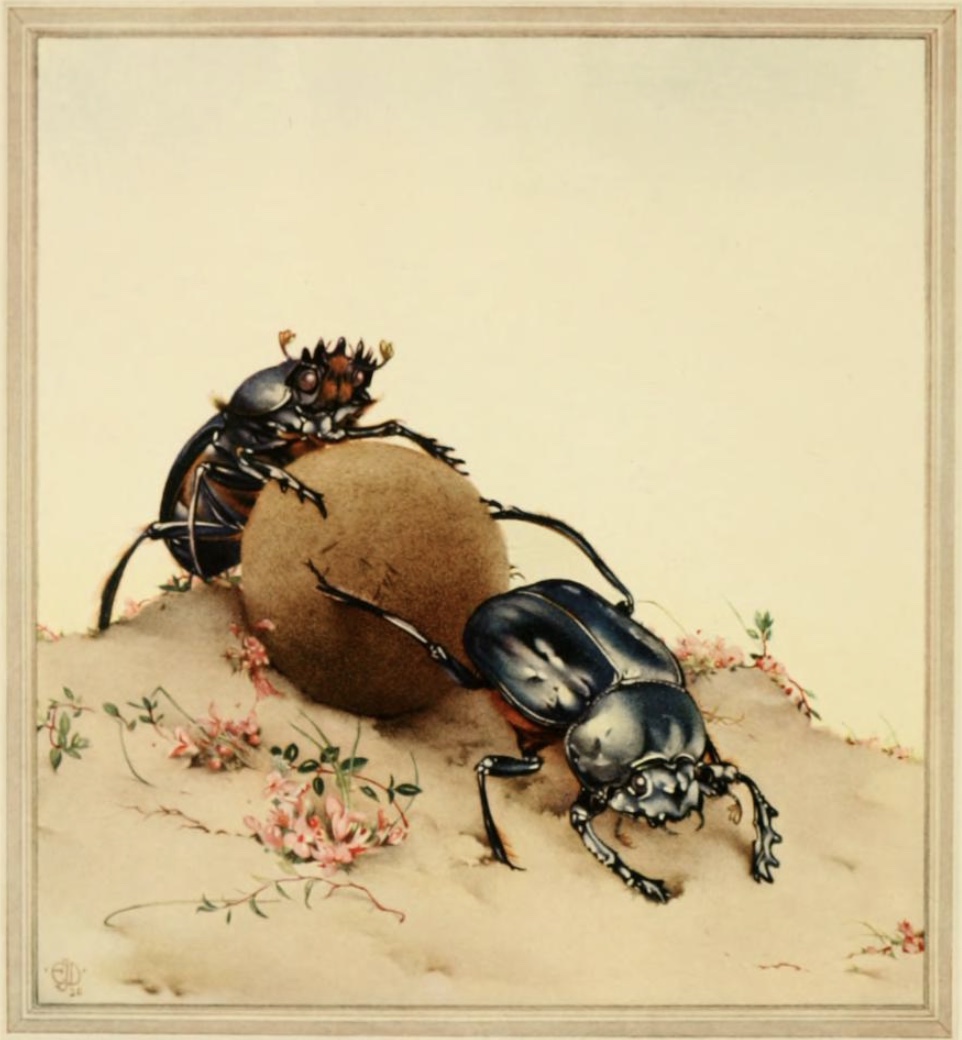
Ah, summer: I am in the garden every day, smashing the Popillia japonica using my roses for their bacchanals. The rocks edging the beds are spattered with iridescent carcasses.

But when I am not busy killing beetles, parenting, or earning money, I read.


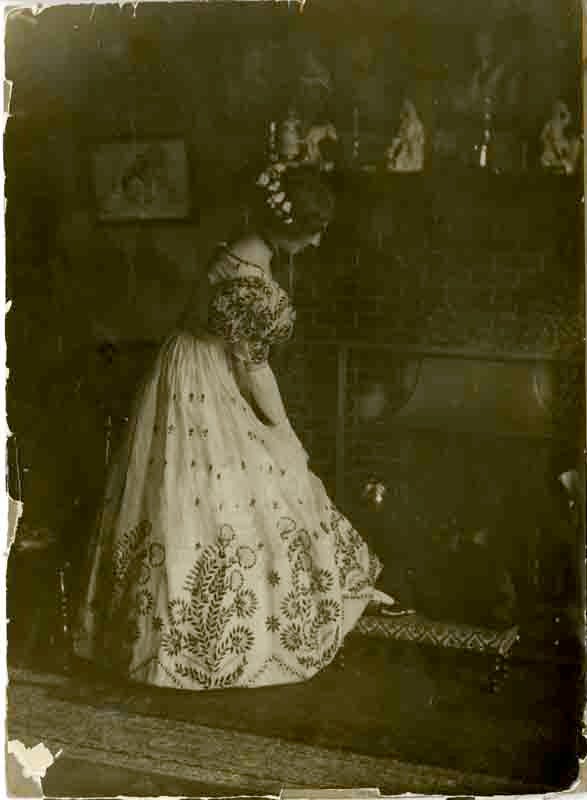
A perfect ensemble for my murderous garden activities: a gown bedecked with beetle-wing cases.


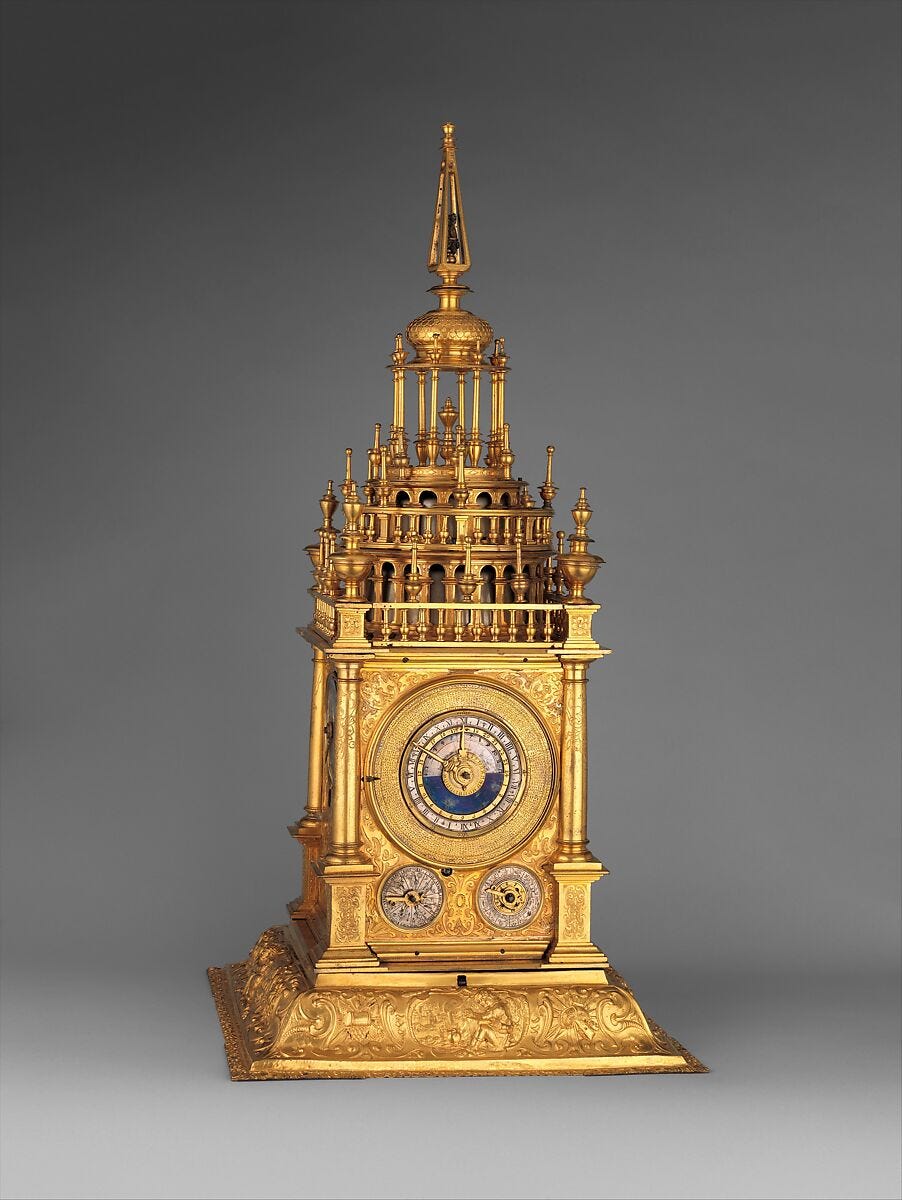
Lucy Ives, LIFE IS EVERYWHERE. Stashed in the less-popular corners of encyclopedic museums, usually somewhere near the Dresden shepherdesses, shell-shaped salt cellars, and silver-chased vinaigrettes, you find guild pieces. These are fantastically overcomplicated, technically astonishing, and functionally impractical items, like boxy clocks and massive padlocks, some long-dead artisan made to scrabble admittance to a guild—the group that controlled access to materials, opportunities, and markets for a specific craft. Anyway, this book is a 21st-century guild piece—a whiz-bang objet crafted to impress other writers. It is composed mostly of the items in one forlorn grad student’s bag: two novocaine-girl fictions-in-progress (i.e., that weirdly pervasive genre centering youngish/immature women, usually grad students or academics, oppressed by their privileged 21st-century lives), a rejection letter from a publisher, a bill, pompous academic papers, etc. (The structure is a literal riff on Ursula K. LeGuin’s “The Carrier Bag Theory of Fiction.”) There are pages and pages of impressive sentences, interesting-ish ideas, and convincing spoofs of repulsive genres, all oriented toward a very of-the-moment crisis mash-up of Me Too incident, overlooked/misread works in the archive, hidden queer histories, sad grad students, miserable academia, and the Power of Fiction. Look, I love literary shenanigans—that’s why I picked up this book, and that’s why I slogged through it, hoping there would be some sort of writerly legerdemain that made it worth it. Alas. Ives is a dauntingly bright human. But reading a performance of brilliance is not the same as reading a brilliant novel.

I was so aggravated by this book and its extravagant squandering of Ives’ talent and my time that I had to read five novels, one Agatha Christie, and a slew of Peter Wimsey mysteries to recover my readerly equilibrium.


I mean, it is a lot for a clock.


Alan Hollinghurst, THE LINE OF BEAUTY. This book reminded me of an English garden—a meticulously, artfully, and seductively controlled presentation of nature. There is beauty in abundance—beauty of form, beauty of line, beauty of attention, and, dear god, so many, many beautiful sentences. AND there is a plot! Its very traditional approach—focused on characters and what happens to them, with a big crash of action at the end—makes plain that form is well and good, but what’s essential for novelistic greatness (and all greatness is radical) is astute attention, inimitable skill, and having something meaningful to illuminate. (Just that, ha!) This is a story in three acts, set in the Thatcherite England of 1983, 1986, and 1987. Nick Guest—a young gay aesthete with a thing for Henry James fresh out of college—is enmeshed with the Fedden family through his friendship (and crush) on Toby, their golden son, and his protective relationship with Catherine, their troubled daughter. The Feddens move in rarified social circles—there’s a house in Notting Hill; Gerald, the father, is an ambitious and opportunistic Conservative member of Parliament in emotional thrall to Thatcher, and Rachel, the mother, is part of an extravagantly wealthy, titled Jewish family. True to his name, Nick is a guest in the Feddens’ world, occupying a permanent-seeming yet precarious position that depends on his discretion and utility. His sexuality is accepted as long as it is unstated and unseen, but when his personal life collides with the Feddens, disaster ensues. As someone whose childhood and youth happened during the evolving terror of the AIDS epidemic, I had horror in my heart almost from page one because the reader experiences Nick’s developing sexuality and sensual freedom knowing the future he doesn’t see coming. It’s the rare book I finished and wished I could read again and again, but each time told from the perspective of a different character, because they are all that compelling. If you are looking for a subtle, satisfying, mesmerizing read, this is it.

Cormac McCarthy, THE PASSENGER. Ugh, this post is already terrifyingly long, and we haven’t even gotten to this book, which has absolutely colonized my brain. While STELLA MARIS, its sister, is a focused encounter with the limit of human intelligence, THE PASSENGER is a study of fragmented existence in what comes after, of lives in an unfathomable world. Alice Western, the center of STELLA MARIS, appears here in flashbacks as a young teen encountering her grotesque hallucinated vaudeville, led by The Thalidomide Kid. Her brother, Bobby, meanwhile, is living with her death. He survived a catastrophic race car crash and works as a salvage diver, cobbling together a tenuous existence in 1980s-era New Orleans populated by a loose confederation of misfits and outcasts. It is a grubby world streaked with the uncanny and sinister—plane crashes and missing bodies, federal agents and JFK conspiracy theories—but the mysteries never resolve; they mutate. That Bobby’s father helped build the atom bomb, and that Bobby and Alice loved each other too much are the two facts of his life. He goes down, again and again, into murky depths, looking to recover something, looking for Alice. But what’s there cannot be recovered. The scenes in this book are so intensely cinematic and potent that I feel like they put actual cinema to shame—I am not sure mere images could be as vivid or expansive as what McCarthy creates here and in the space between these two books. Reading this was like handling a snake, an encounter with incredible, unsettling, absolute aliveness. I couldn’t put it down. (Sidebar: I would like to read a brilliant essay on the ways the atomic bomb is percolating back up into cultural consciousness now … these books, of course, but also WHEN WE CEASE TO UNDERSTAND THE WORLD (another book loved), “Asteroid City,” and “Oppenheimer.”)

Bombs away.


Jenny Erpenbeck, KAIROS. When Katharina learns that Hans has died, she pulls down a box of memories tracing the origins of their relationship, which began in a city divided by a wall that would not stand much longer. Perhaps it is not surprising that a romance between a nineteen-year-old woman and a middle-aged man curdles into something toxic, but the peculiar bitterness of the poison is a product of its place and time—in the sense of a grand experiment ending, in the loss of faith that something better was possible, in the horrible compromises and betrayals made in the name of ideals. I did not think this book attained the level of THE END OF DAYS, which, to me, is a peak life reading experience, but it was an engrossing, revealing encounter with a moment in time echoing through our own.

Edith Wharton, THE MOTHER’S RECOMPENSE. A fusty title for a sharp, sharp book. Here is a snippet from Ethel W. Hawkins’ review for The Atlantic in 1925:
In many respects The Mother’s Recompense is Mrs. Wharton at her best. It has the distinction of style, the wit, the emotional intensity, and, under the sardonic manner that repels the sentimental reader, it has the deep preoccupation with the ethical problem, and the sense of the ideal immanent in the actual, even in the shabby and shoddy actual, so characteristic of her fine art.
As a young woman, Kate Clephane left her husband for another man, and, as a result, was cut off from her baby by her husband and his family—a loss she has carried for twenty years. In the time since, she led a blameless life in exile, except for one slip—a love affair with a much younger man. Then, WWI happened, and the world changed. Kate finds herself contacted by her daughter, an independent-minded, fabulously wealthy young woman who wants a relationship and to share all that she has. As Kate steps into this new life, she experiences the disequilibrium of seeing that the circumstances of her life were a fluke of timing and feels the touch of constraints that drove her to leave. Then, her past becomes something she cannot escape. Wharton, exquisite narrative sadist, appears to create an avenue for Kate to have it all, but being who she is, can she take it? This is a shattering portrait of a woman caught in a changing culture. Why we are not all reading Wharton all the time, I do not know.

Alejandro Zambra, THE BONSAI. A book about lovers who lie to each other about what they have read and what they are writing and the small cast of friends who cross their paths. There is also a bonsai tree (symbol alert!) and oodles of literary references. Many lines made me laugh out loud, but it is very much the sort of book a clever young literary dude would write to amuse and impress other clever literary people. Amusing enough pool read, though.

Agatha Christie, THE AFFAIR AT STYLES (the first Hercule Poirot mystery). Stiff as a celluloid collar with a teeter-totter plot: He’s guilty! No, he’s not—wait! Yes, he is! All the classic Christie elements are here—tormented pretty ladies, weaselly husbands, family secrets, burned letters, little grey cells—but this one is not as highly burnished as her later work.

Dorothy L. Sayers, WHOSE BODY? / CLOUDS OF WITNESS / THE UNPLEASANTNESS AT THE BELLONA CLUB / HAVE HIS CARCASE / BUSMAN’S HONEYMOON /LORD PETER VIEWS THE BODY. I am fascinated by Sayers, who seems to be a writer who somehow was both trapped and liberated by the genre she wandered into and the character she created. Maybe that is what makes the Lord Peter stories so toothsome. Sayers is less interested in who did it than what it means to want to know who did it and the moral ramifications of getting into other folks’ business. (Lord Peter, the OG true crime enthusiast.) Then, the relationship between Peter, bon vivant gentleman sleuth of unsuspected depths coping with what is essentially PTSD from WWI, and Harriet Vane, the ambitious, independent murder mystery author he rescues from a poisoning conviction, gets into the absolute tangle of love, sexual attraction, obligation, career, gendered expectations, what it means to truly be a partner, and what it means to commit to a calling in a way rare to encounter. So while these books offer ingenious plots, satisfying denouements, Jazz Age fizz, and sophisticated literary references, what I love most is the other, unexpected notes they hit, too.

Kid stuff:

Beverly Cleary, BEEZUS AND RAMONA / RAMONA THE PEST / RAMONA THE BRAVE / RAMONA AND HER FATHER / RAMONA AND HER MOTHER / RAMONA QUIMBY, AGE 8. My kid enjoyed listening to me read these, but I found the aggressive averageness of the Quimby-verse a bit of a bummer to inhabit. That said, Cleary wrote these books over 40 years—the first one was published in 1955 and the last in 1999—and the shifts in parenting culture are amusing to clock. Four-year-olds playing at the park unsupervised! Kindergarteners walking whole blocks to school on their own! Dads bowling and SMOKING CIGARETTES in the house! Moms spending all of their time cleaning, cooking, parenting, and working—oh wait.

E. Nesbit, THE STORY OF THE TREASURE-SEEKERS. In this book, written in 1899, the five plucky Bastable children hatch improbable plots to improve their family fortunes, leading to scrapes and shenanigans. It is narrated by a Bastable child who affects anonymity (figuring out who it is delighted us). What a strange, strange person, Nesbit—co-founder of the Fabian Society (a.k.a. ardent socialist) with an extraordinarily convoluted personal life (it inspired A.S. Byatt’s THE CHILDREN’S BOOK) who wrote fictions where (spoiler alert) everyone ends up comfortably wealthy.

Jon Klassen, THE SKULL. Klassen is dominating the micro-niche of creepy horror stories for the six to eight set. (My kid was so freaked out by the eyeball alien in THE ROCK FROM THE SKY that after we read it, we had to hide it on the back of the bookshelf for two years.) In this droll and deadpan tale, Ottilla is on the run; from what, who can say? She finds a house inhabited by a skull; it is chased nightly by a headless skeleton. With a bucket, a rolling pin, some tea, and some nerve, she finds her way to a happy—or happy enough—ever after.

Currently reading: SUMMER; THE COMPANION SPECIES MANIFESTO; and LICHENS: TOWARD A MINIMAL RESISTANCE.

Bookmarked: THE MILLSTONE, because of this Backlisted episode, which features several absolutely brilliant clips of Drabble talking, and THE WATER BABIES, on Drabble’s recommendation.

*

Images:

Beetle-wing dress worn by Lady Russell, Jane Eliza Sherwood (1797-1888). The Wilson.

Augsburg astronomical table clock, second quarter 17th century. The Metropolitan Museum of Art.

Press image of an atomic bomb test explosion in the snapshot collection of Billy Parrott.

odds and ends / 2.8.2023


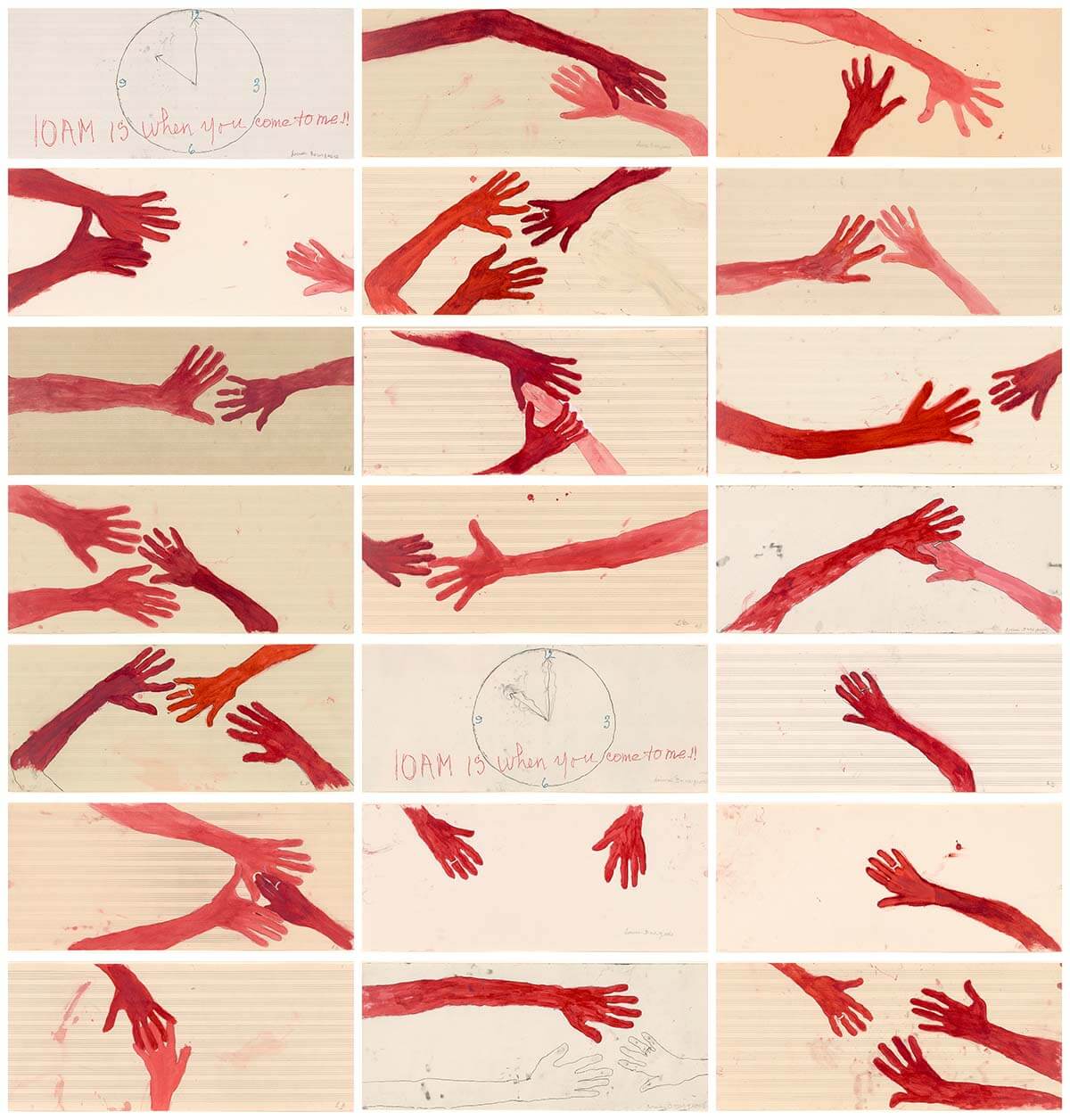
Louise Bourgeois, "10 am is When You Come to Me." Twenty sheets of musical score paper painted with Bourgeois' hands and those of her assistant Jerry Gorovoy. Via 8 Holland Street:
Bourgeois said of Gorovoy: "When you are at the bottom of the well, you look around and say, who is going to get me out? In this case it is Jerry who comes and he presents a rope, and I hook myself on the rope and he pulls me out."
*

John Roddam Spencer Stanhope, detail from "The Women of Sorrento Drawing in the Boats." De Morgan Collection.

*


*

Child's armchair upholstered with petit point sewn by Alice B. Toklas over designs by Pablo Picasso, in the collection of the Beinecke Library.

*

From Anne Truitt's Daybook, via stopping off place.

*

Leonard Baby, "We Must Be Different From Our Parents," 2023. On view starting 2/16/2023 at Fortnight Institute.

*

Crossed letter from 1846 in the collection of tihngs.

*

"What’s going on? One idea is that two titanic forces are battling for control over the world’s heart."

*
But what are comets? The etymology of the term in English—from the Greek word 'komētēs,' meaning 'long-haired'—reminds us that they were once seen as long-tressed stars. For much of human history, comets were less than celebrated. Martin Luther called them “harlot stars,” for their wanton behavior. A Lutheran bishop, in 1578, described them as 'the thick smoke of human sins, rising every day, every hour, every moment full of stench and horror, before the face of God, and becoming gradually so thick as to form a comet, with curled and plaited tresses, which at last is kindled by the hot and fiery anger of the Supreme Heavenly Judge.' A scholar countered that this theory didn’t account for why we saw comets only occasionally. 

Rivka Galchen, "What the Green Comet tells Us About the Past—And the Future." The New Yorker, 1/31/2023.

*

"Commissioned by a cat supply company, A Short Story takes viewers along on the strange, surreal journey of a large black cat seeking something precious in this world..."

*
Brilliant, beautiful Alice is barely believable as a female human being. And why should she be? She’s a quester, an outlier, a method of inquiry, an experiment maybe, experimented upon like a mink crazed in a lab. ... Alice runs circles around this Dr. Cohen. She is the circle, actually, the Ouroboros, the snake of mythology coiled with its tail in its mouth, sacred symbol of the eternal cycle of destruction and rebirth, most secularly realized by the chemist August Kekulé’s dream about the configuration of molecules. Cormac McCarthy is interested in Kekulé’s dream and in the unconscious and in the distaste for language the unconscious harbors and the mystery of the evolution of language, which chose only one species to evolve in. He’s interested in the preposterous acceptance that one thing—a sound that becomes a word—can refer to another thing, mean another thing, replacing the world bit by bit with what can be said about it.

Joy Williams, "Great, Beautiful, Terrifying: On Cormac McCarthy." Harpers, January 2023.

*
And although she was now redundant as a woman, being neither a wife, mother nor mistress, she was by no means redundant as a narratologist ... certain female narratologists talked with pleasurable awe about wise Crones, but she was no crone, she was an unprecedented being, a woman with porcelain-crowned teeth, laser-corrected vision, her own store of money, her own life and field of power, who flew, who slept in luxurious sheets around the world, who gazed out at white fields under the sun by day and the brightly turning stars by night as she floated redundant.

A.S. Byatt, "The Djinn in the Nightingale's Eye."

*
Our mother was not the sort of woman to unpack her heart everywhere; she looked on human speech as a loaded gun, and, to use her own expression, talking often felt to her like an issue of blood.

Simone Schwarz-Bart, The Bridge of Beyond.

*


*
He had a life as well as a career: his ukulele, his animals, his gardening, his inventions—including a model railroad track he’d constructed that ran from his garage workshop to the kitchen to the backyard. Its cars transported snacks to the poolside guests, and the caboose carried Alka-Seltzer. 

John Lahr, "Puzzled Puss." London Review of Books, 1/19/2023. 

*

odds and ends / 11.3.2018


From the top:

Peter Blume, Vegetable Dinner. 1927.

The two women in Vegetable Dinner are both images of Peter Blume's companion Elaine ... The woman on the left, with her fashionable clothing and lit cigarette, evokes his love of parties and freedom, while the woman on the right chops vegetables to represent commitment and domesticity. This expresses Blume's conflict between his affection for Elaine, who "had very competent hands," and his need to live the bohemian life of an artist ... The dramatic cropping of the two figures, together with the knife pointing ominously at one woman's thumb, transforms this ordinary scene into something far more menacing, and suggests that neither of Elaine's roles would have made the artist completely happy. Blume eventually parted from Elaine, remembering later that their relationship was "always in a state of high tension anyway. It could never have survived as a marriage."

*

"No!" by Thomas Hood.

*

Admiring all things patched and quilted at Carleen.

*

Victorian glass and sterling hand and key pendant.

*

Marsden Hartley, Landscape No. 25. Always think of this painting this time of year.

*

Filed under fancy pants: Studio Hecha Matisse multicolor hand-painted vintage denim at West End Select.

*
Humans have often looked at insects and seen themselves, or the selves they would like to be. Early-modern European naturalists peered into termite mounds, anthills, and beehives and saw microcosms of well-ordered states: monarchs, soldiers, laborers. (There was no general recognition that bee “kings” were actually female “queens” until the sixteen-seventies, when a Dutch microscopist, Jan Swammerdam, pointed out that bee kings had ovaries.)

Amina Srinivasan, "What Termites Can Teach Us." The New Yorker, 9/17/2018. (This article may be the single most enjoyable thing I've read in the past month.)

*

Can you copyright a quilt?

*
“Posing Modernity” has been organized by Denise Murrell, a former chief executive who recently earned a Ph.D. in art history at Columbia University. The idea for the show — and the thesis that preceded it — came to her after sitting through a few too many art history lectures that pored over the white subject of “Olympia,” but barely mentioned its black one. Ms. Murrell sought to discover more about the model for the maid and other women like her, and what they could tell us about modernism. 

Roberta Smith, "A Long Overdue Light on Black Models of Early Modernism." NYT, 11/1/2018.

*
Like superficial spirituality, looking on the bright side of things is a euphemism used for obscuring certain realities of life, the open consideration of which might prove threatening or dangerous to the status quo. . . . The acceptance of illusion and appearance as reality is another symptom of this same refusal to examine the realities of our lives. Let us seek “joy” rather than real food and clean air and a saner future on a liveable earth! As if happiness alone can protect us from the results of profit-madness.

Audre Lorde, The Cancer Journals, quoted by Becca Rothfield.

*
Refusing to collude in injustice is, I’ve found, easier said than done. Collusion is written onto our way of life, and nearly every interaction among white people is an invitation to collusion. Being white is easy, in that nobody is expected to think about being white, but this is exactly what makes me uneasy about it. Without thinking, I would say that believing I am white doesn’t cost me anything, that it’s pure profit, but I suspect that isn’t true. I suspect whiteness is costing me, as Baldwin would say, my moral life.

Eula Biss, "White Debt." NYT 12/2/2015. I just finished Biss' Notes From No Man's Land.

*
There is something dying in our society, in our culture, and there’s something dying in us individually. And what is dying, I think, is the willingness to be in denial. And that is extraordinary. It’s always been happening, and when it happens in enough of us, in a short enough period of time at the same time, then you have a tipping point, and the culture begins to shift. And then, what I feel like people are at now is, “No, no, bring it on. I have to face it — we have to face it.”

angel Kyodo williams, Zen priest and activist, in conversation at OnBeing.

odds and ends / 5.29.2018


From top:
Branches and vines quilt in cotton, silk, and wool, ca. 1875. Made by Ernestine Eberhardt Zaumseil.

*

Trademark Sylvie gingham ballet flat. (My obsession with black-and-white gingham rages on.)

*

Cole and Sons Ardmore Savuti wallpaper in the showroom of Kvanum Danmark.

*

'Beehive.' Oddfellows banner, ca. 1900. Part of to Further Seasons, a show curated by Lucia Simek at The Reading Room — 'a show about fecundity, blossoming, pollination, scientific exploration, horticulture, wizardry, danger, and beauty.' (I so wish I was Dallas so I could see this — open through June 9.)

*

Hannoh Wessel Vionette green jacket. (One of the things I loved about the new 'Howard's End' was the costuming for Margaret and Helen Schlegel; in the first few episodes, they are always wearing one thing with deep, bright color, usually red or blue. I've been channeling vibrant and unabashed Schlegel dressing by finding ways to wear more bright color; this green is my current obsession.)

*

Lady Granville's beetle parure: 'tiara, necklace, and earrings formed of dried South American weevils (lamprocyphus augustus)with iridescent green wing cases, mounted in gold in the Egyptian taste with lotus motifs.' Created by Philips Brothers, 1884-1885.

*
“Sometimes we feel like something sour and sweet at the same time . . . and sometimes we need chocolate but mixed with some fruity surprises . . . It all depends on how we feel, our mood, the weather . . . . You could say that each person’s candy bag reflects the state of mind of that person.”
Hannah Goldfield, 'How to Eat Candy Like a Swedish Person.' The New Yorker, 5/17/2018.

*

'Why is editing the best job on Earth? Because you learn facts like these.'

*

Related: 'Elegy for the World's Oldest Spider.'

*
(Fascism, he said, is “any regime that not only prevents one from speaking but above all obliges one to speak.”)
Adam Shatz, quoting Roland Barthes. 'The Mythologies of R.B.' NYRB, 6/7/2018.

*
Beckett was not a Jew. He had merely had a tiny taste of the poison of anti-Semitism. Beckett had not directly experienced torture at the hands of the Gestapo or deportation to a concentration camp. He had merely experienced these things indirectly, through the fates of his friends and through basic human compassion. He was left therefore with a paradox: the need to express what he had not experienced, to be a witness to what he had not seen. His art would come from having no power to witness, no desire to witness, no authority as a witness—together with the absolute obligation to witness.

Fintan O'Toole, 'Where Lost Bodies Roam.' NYRB 6/7/2018.

*

Obligation to witness, obligation to speak: I am calling my representatives this week to demand an end to this abomination, to advocate for choice, and to ask, again, again, for gun control.

*

'It took 35 years to build a landslide.' (More happy tears: #HometoVote.)

*

Baby Coffee 8: Clogs are a Window: 'Explorations of clogs as the ultimate in women's footwear, by Andrea Linett, Heather Anne Halpert, and Koyuki Smith.'

*

Paper geraniums.

brood v


I guess I felt attached to my weakness. My pain and suffering too. Summer light, the smell of a breeze, the sound of cicadas — if I like these things, why should I apologize? 
Haruki Murakami, A Wild Sheep Chase.

*
What cicadas leave behind is a kind of crystallized memory;
The stubborn detail of, the shape around a life turned  
The color of forgotten things ...
Martin Walls, 'Cicadas at the End of Summer.'

*

This summer: Brood V.

Top: Two Roman cicada brooches, c. 4th-5th century AD.
Bottom: Cicada amulet, glass. China, c. 206 BC—220 AD.

bisi bees


"The bees been so bisi,” cothe he, “aboute comune profit,
And tendeth al to travail while the tyme dureth
Of the somer saison and of the swete floures;
Thayr wittes been in wirching and in no wile elles
Forto waite any waste til winter approche,
That licour thaym lacke thair lyfe to susteyne.”
From the 15th century poem, “Mum and the Sothsegger.” Discovered thanks to The Paris Review.

(We had two hives of bees delivered last week, and the bees have been busy getting established.)

Top: An illustration of apiaries from the Tacuinum Sanitatis, 14th century.
Bottom: Art Nouveau Horn carved hornet pin, ca. 1910.

glasswings


Spotted on My Modern Met: the marvelous glasswinged butterfly. They have a slew of gorgeous shots, but this one is my favorite.

Photo by farrukh.

builders


Duprat places the caddis fly larvae in a controlled environment, supplying them with precious materials. Individual insects build with different levels of skill, some preferring beads and others pearls. 

In an interview with Christian Besson, Duprat mentions that an American entomologist, Charles T. Brues, observed caddis fly larva in a river in northern Nevada adding bright blue natural opals to their cases when they could, indicating that the insects use more than purely utilitarian considerations.

Fascinating stuff.

More: another interview with Duprat +  a video of the caddis at work.