Showing posts with label hands. Show all posts

a handful of apples / october


*

Cypriot limestone hand holding a piece of fruit. The Metropolitan Museum of Art.

*

A photograph of unpeeled apples by Richard Tepe, ca. 1900-1930. The Rijksmuseum.

*

Bruised stone apple, from the archives of criticalEYEfinds.

*

"Apples," folio 48 (verso), from Florilegium (A Book of Flower Studies), 1608. The Cleveland Museum of Art.

*

Doris Ulmann, "Women Gathering Apples," ca. 1930s. Ogden Museum of Southern Art

*


*

James Nasmyth,"Back of Hand & Shrivelled Apple. To illustrate the origin of certain mountain ranges by shrinkage of the globe," ca. 1870 (in or before 1873). From The moon : considered as a planet, a world, and a satellite.

*
The composer's white summer suit rests on a hanger in his study; his broad-brimmed Borsalino and stick are on a nearby table. Here is the Steinway grand he was given on his fiftieth birthday (though he composed in head, not on the piano); there is a run of the National Geographic Magazine covering the last five years of his life. On the Russian oak desk at which he worked from the time of his marriage in 1892 lies the wooden ruler Aino carved for him, with which he ruled his scores; also, an empty box of Corona cigars, and an elegant Tiffany photo frame, containing a portrait of Aino, through which the light streams. Open on the desk is a facsimile score of his greatest symphony, the Fourth. But the homely is never far away: in the kitchen, screwed to the wall, is an apple-coring machine Sibelius brought back from one of his trips to America. Made of black cast-iron, it is a Heath Robinsony contraption of prongs, screws, and blades that will peel, core, and slice your apple at the turn of the handle. From the same trip he also brought his wife a Tiffany diamond; but it is the apple-corer that sticks in the mind.

Julian Barnes, from "Ainola: Music and Silence." The Lives of Houses, ed. by Kate Kennedy and Hermione Lee. 

*
The apples are everywhere and every interval, every old clearing, an orchard. You pick them up from under your feet but to bite into them, for fellowship, and throw them away; but as you catch their young brightness in the blue air, where they suggest strings of strange-colored pearls tangled in the knotted boughs, as you notice their manner of swarming for a brief and wasted gayety, they seem to ask to be praised only by the cheerful shepherd and the oaten pipe.

Henry James, from New England: An Autumn Impression, 1905. Via The New York Review

*
The white October sun circles Kirchstetten
With colours of chrysanthemums in gardens,
And bronze and golden under wiry boughs,
A few last apples gleam like jewels.

Stephen Spender, from "Auden's Funeral."

*
I always think of those curious long autumn walks with which we ended a summer holiday, talking of what we were going to do–‘autumn plans’ we called them. They always had reference to painting and writing and how to arrange social life and domestic life better … They were always connected with autumn, leaves falling, the country getting pale and wintry, our minds excited at the prospect of lights and streets and a new season of activity beginning–October the dawn of the year.

Virginia Woolf, writing to her sister Vanessa Bell, ca. September 1927.

*

read lately / 6.1.2024 - motley stones, the pushcart war, and assorted mountains


I was at the Cleveland Museum of Art on Sunday, looking at an exhibit of fairy tale illustrations and marveling at how dots of white paint can read as glittering mail. The works I was looking at—some drawings, some prints—were all designed to live in the pages of books, but the originals had a sharp, beguiling aliveness that escaped mass reproduction. I snapped pictures—writhing serpents, inky foxes, impossibly beautiful, dead-eyed maidens against shimmering water-color skies—but they don’t capture what made the images so charismatic, the presence of the ghosts of hands. Then I went upstairs and looked at Barbara Bosworth’s photographs of stars and lightning bugs, of a woman holding a soap bubble and a man holding a flashlight, a smear of brightness, many smears of brightness.

In March, I was in Ireland. I spent a year in Dublin long ago, and when I was there, I often went to the National Gallery of Art. Mostly, I went to look at a painting by Caravaggio. Though I had seen it many times, I couldn’t recall what it looked like anymore. I just held a memory of electric feeling, of awe and wonder. As I walked through the galleries again, all this time later, I wasn’t quite sure that I’d find it. But when I saw it, I knew. It was unmistakable, so much more alive than anything else in the room.

It’s a miracle, isn’t it? All these things that people make.


Adalbert Stifter, MOTLEY STONES. There is a specific narrative move I think of as W.G. Sebald’s—a nesting of one seemingly unrelated story inside another, often with a shift of who is telling the tale, thwarting readerly expectations of where a story will go, a step off the groomed path into a wilderness that might hold anything, where the meaning is not plain but muddied and tangled, fractured by life the way tree roots break up a sidewalk. Turns out, this move is not Sebaldian—it’s Stifterian. Adalbert Stifter (1805-1868) was an Austrian writer well-known to Sebald, who cited him as an influence, and reading this collection of electrifyingly strange short stories, most named after a type of rock or mineral formation, full of sentences eschewing the comma, that old reliable friend, I felt dazed and dazzled and pulled back toward the days when I was very small, when every story was new, before patterns had been graven into my sense of how things must go or end. These are stories of kindnesses and cruelties, of specific landscapes and storms, of listening and listeners. I loved reading this book and will read it again.


Jean Merrill, THE PUSHCART WAR. I first made Jean Merrill’s acquaintance via a gleefully destructive elephant who learns the hard way that actions have consequences. THE ELEPHANT WHO LIKED TO SMASH SMALL CARS became one of our favorite picture books. Having a copy around was an excellent personality test for other parents—reflexive pearl-clutchers/non-kindred spirits eschewed chaotic noisy singalongs of “The Smashing Song.” I picked up THE PUSHCART WAR not realizing that it was by the one and same Jean Merrill. I was struck by the Tony Kushner blurb:
The Pushcart War had a profound impact on me; when I was a kid I devoured it several times, and I've carried it deep inside me ever since. The book gave me a point of entrance—my first, I imagine—into the world of resistance to political and economic injustice and chicanery. It made opposition, even non-violent civil disobedience, seem fun and right and necessary and heroic, and something even someone as powerless as a kid could and should undertake.
Well now! I started reading it to Hugh, not quite sure what we were getting into, and we tumbled into glory. It is such a smart, funny, and sharp book about the world that it has made almost everything I’ve read since, from novels to newspaper articles, feel drab and clumsy. Merrill conjures up a New York City of both the future and past, where a nefarious cabal of truck company owners are angling to own the streets. This starts by eliminating the pushcarts—but the pushcart peddlers unite (fractiously, because that is the truth of community organizing) and fight back, sparking a counterculture with its own slang (“don’t be a truck!”), codes, and folk heroes (all hail Frank the Flower). Along the way, Merrill pulls in the police, the media, celebrities, and the government and their various compromised and compromising relations to the situation at hand; it’s like The Wire, but with peashooters instead of guns and a sense of humor. In the way of many children’s authors, Merrill wrote oodles of books, but I am going to get my hands on THE TOOTHPASTE MILLIONAIRE (set in East Cleveland!) and read it next.


Eric Shipton, NANDA DEVI (1936); Maurice Herzog, ANNAPURNA (1951); Lionel Terray, CONQUISTADORS OF THE USELESS (1963); John Evans, NANDA DEVI: 1976 INDIAN-AMERICAN CLIMBING EXPEDITION JOURNAL OF JOHN EVANS (1976); Kurt Diemberger, THE ENDLESS KNOT: K2, MOUNTAIN OF DREAMS AND DESTINY (1991). When I feel a specific degree of overwhelm (presently, due to a combination of current events/big stress + making three magazines at the same time/small stress), I cope by reading books about people doing perilous things for no good reason: venturing to polar regions, sailing alone for long distances, crossing deserts, climbing mountains. The last time I dove this hard into the world of mountaineering literature, I had a baby—for me, contemplating the difficulties of climbing a mountain and getting back down with its endless permutations of murky motivations, self delusion, choice, preparation, chance, weather, skill, improvisations, and pure luck, offered more illumination about parenthood than any number of parenting books. 

Some of these books are more fun to read than others—Eric Shipton’s account of reaching Nanda Devi was wonderful, notable especially for the deep respect and admiration he had for his Sherpa climbing companions—the legendary Ang Tharkay (he reappears as the lead guide in ANNAPURNA), Pasang, and Kusang—and his aliveness to landscape. (For another extraordinary account of trekking in the Himalayas, read Jamaica Kincaid’s AMONG FLOWERS: A WALK IN THE HIMALAYA.) Herzog’s ANNAPURNA is a canonical mountaineering book about the 1950 French expedition to climb an 8,000-meter peak and absolutely wild; two-thirds of the book is about the difficulty of locating the giant mountain, and the last third is a harrowing and unnervingly cheerful account of the costs of summiting it (many, many, MANY fingers and toes). It’s littered with mildly shocking midcentury details like pills popped and trash tossed at the very summit of the mountain. Lionel Terray was a key member of the Annapurna expedition and instrumental in getting people high on the mountain down alive. His memoir, CONQUISTADORS OF THE USELESS (the best title of any adventuring memoir ever), recounts his many, many feats of climbing. Both books are an absolute hoot in that the pictures included make it plain just how much the text accounts, detailed as they are, fail to capture the actual peril of these feats. (As someone who spends a lot of time thinking about words, I find it grimly satisfying to encounter the limit of what words can do.) 

The Evans and Diemberger books both deal with disasters. Evans was part of the troubled 1976 American expedition to Nanda Devi, where the climber Nanda Devi Unsoeld died (her father, Willi Unsoeld, named her after the mountain, and was on the expedition, too). Evans’ diary is a laconic, dude-bro document of going a very long way right after his wife had a baby to do not very much; death is relegated to a postscript. The death of Julie Tullis, Deimberger’s climbing and film-making partner, haunts his book. She died in the K2 tragedy of 1986. It’s weirdly gripping to watch him grapple on the page with an impossible task: justifying questionable choices made for questionable reasons.

*

Currently reading: INTO THE SILENCE: THE GREAT WAR, MALLORY, AND THE CONQUEST OF EVEREST by Wade Davis (reread); STUFF: INSTEAD OF A MEMOIR by Lucy Lippard.

Bookmarked: HEADSTRAP: LEGENDS AND LORE OF THE CLIMBING SHERPAS OF DARJEELING; SHERPA: THE MEMOIR OF ANG THARKAY; IMAGINARY PEAKS: THE REISENSTEIN HOAX AND OTHER MOUNTAIN DREAMS; THE LIFE OF TU FU; FIELD GUIDE TO THE PATCHY ANTHROPOCENE.

Elsewhere: A rock collection.

*

Images:

Robert Frank, "Untitled (Mary and Children with Sparklers on the Beach, Provincetown), "ca. 1958.

Cabinet card of Julia Marlowe’s hand, via Anonymous Works.

Ronni Solbert’s illustration of Frank the Flower and his peashooter, from THE PUSHCART WAR.

Mountaineers from the 1961 Indian Expedition to Nanda Devi looking at the mountain from a snow camp on Devistan I. From the Suman Dubey collection, via Alpinist.

odds and ends / 5.25.2024


*

Fairfield Porter, "Path in the Woods," 1968. Collection of Smith College.

*

Pati Hill photocopying daisies on an IBM Photocopier II, Stonington, Connecticut, 1980. 
The objects Hill chose to copy, which she could not fully ascertain until the machine had seen them, are visually transformed yet convey their intrinsic properties, as well as those of the copier. "It repeats my words perfectly as many times as I ask it to," Hill wrote, "but when I shot it a hair curler, it hands me back a space ship, and when I show it the inside of a straw hat it describes the eerie joys of a descent into a volcano."

Richard Torchia, "On Pati Hill (1921-2014)," originally published in Artforum, 12/18/2014, but found via Picpus Press Issue 32, Spring 2024. Hill used the copier to make images of a dead swan, heads of cabbage, thumbtacks, cobblestones, and "an espaliered pear tree, including its roots and the ants living inside them."

*


*

Tacita Dean, "The Book End of Time," 2013. The book itself was just acquired by The Metropolitan Museum of Art.

*

 
*
“When I look at the world, I feel that something is being lost or actively undermined,” she told me. “Sometimes it feels like attention. Sometimes it feels like imagination. Sometimes it feels like”—she thought for a moment—“that thing you wanted when you became an English major, that sort of half-dreamed, half-real thing you thought you were going to be. Whatever that is: it’s under attack.”

Nathan Heller, "The Battle for Attention." The New Yorker, 4/29/2024. 

*


*
I found myself continually occupied with the thought of how often, through not realizing the nature and strength of their own desires, men have been wrecked by them.

Marilyn Milner, from An Experiment in Leisure. 

*
[Marilyn] Milner was unable to tell what made her really happy, beyond a few blips of joy that quickly faded after the new purchase or minor accomplishment grew a little stale. So she fished around for ways to find an answer. It seems like a minor problem to have, this not knowing how to answer a simple question. And yet it’s a foundational issue: what you like, what you should do with your time, where you should pour your energy. It’s a problem that feeds into every other tributary of your life, from your job to the way you raise your children. Suddenly you realize that not knowing how to answer the question (beyond a few superficial remarks like “pineapple on pizza” and “those little gold ballet flats at the boutique”) leaves you on the surface of the Earth, easily blown around by the wind or led astray by outside forces.
 
Jessa Crispin, "What Makes You Happy?" The Smart Set, 3/1/2012.

*
...Rereading the book this month, I was unnerved to discover how many fantasies, desires, impulses that I had thought my own were in fact informed by it. I saw that I had, for instance, unconsciously interpreted a number of difficult and very real events in my own family through its fictions; I saw too that several people with whom I’ve fallen in love share a glimmer of psychic resemblance to the girl Adam loves. I was unnerved to discover, in short, that a YA novel could be the source of a greater portion of my instincts and reflexes than seemed at all appropriate; that it could make desirable—so desirable, in fact, as to seem outside of desire—a whole array of emotional tendencies: toward shame, melancholy, irreverence, estrangement.

Timmy Straw, "Child Reading." The Paris Review, 11/7/2023. 

*
... a recurring image that Rohrwacher turns to is that of persons suddenly, and for no apparent reason, filmed upside down. When they fall, they fall up. It’s interesting to learn that Rohrwacher, writer and director of the work, rewrote her script after she had cast the 33-year-old [Josh] O’Connor. She said she had shifted away from the topic of a person in ‘the sunset of his life.’

But where to? Why would the younger person specialize in death, so to speak? The place where these people live is not exactly haunted but it is old, full of Etruscan ruins. Pirro and a group of local men are tomb-raiders, digging for treasures to sell. Arthur is very helpful in this venture because he has a special gift: he can divine hollow spaces underground the way others can divine water or gold. The film’s Italian phrase for this is ‘feeling the void’ (‘sentire il vuoto’) ...

Michael Wood, "At the Movies: La Chimera." London Review of Books, 5/23/2024.

*
What am I looking for in contemporary art? Now it is very difficult to tell what is beautiful and what is not beautiful. For example, when I did La Chimera, it was very clear that the treasures hidden under the earth were beautiful things. It’s very different from the time we are living in now. There is no longer a common sense of beauty. And so, what is art for me? It’s a view, an eye, a point of view on reality from a perspective that I couldn’t imagine. The art of the past was a magnet for the eye. For me contemporary art is the opposite; it is one eye that looks at the world.

Alice Rohrwacher, interviewed in Gagosian Quarterly, fall 2023 issue. 

*
Have you ever bitten into a piece of fruit so delicious, so ripe and perfect in its flavor and sweetness, that you vibrated, just a little, with pleasure? The Franciscan beggar Salvador de Orta did. He sliced into a pomegranate and—seeing in the multitude of tiny seeds a microcosm of everything beautiful in God’s perfectly ordered world—rose into the air in ecstasy. God was there in the fruit.

He was in the kitchen, too. Teresa of Ávila told her spiritual daughters that “God walks amidst the pots and pans, helping you with what’s internal and external at the same time.” So when the nuns found Teresa suspended in the air, transfixed in ecstatic union with God, a frying pan still clenched in her hand above the cooking flames, they may not have been surprised. It was God, helping her with both the internal (lifting her soul up to heaven) and the external (the frying of, perhaps, an egg).

Erin Maglaque, "Wings of Desire." The New York Review, 4/4/2024.

*
The point is, dammit, that they did have, as Iago griped about Othello, a daily beauty in their lives that makes ours ugly. In one of the stories in Pig Earth, a little old peasant lady goes out and gathers wild things in the mountains—wild cherries, lilies of the valley, mushrooms, mistletoe—and takes her booty into the city, where she sells it in the market for vast sums. She is selling not only delicious wild produce but glimpses of some lost greenness. She is the last remaining vendor of wild things, she is a kind of ghost.

Angela Carter, "Wolfing It." The London Review of Books,  July 23, 1987.

*
Everything that she needed was already there: pencils and paper collected over the years, and the flowers she’d planted herself. She had chosen them to be hardy, to grow in the shade, a few for their strange forms.

Beatrice Radden Keefe,  "The Hortus Conclusus of Barbara Baum.Light Breaks, 11/24/2023. 

*

pretty pink things / a billet-doux


*

Heart cockles, via the Natural History Museum, London.


Sam Gilliam, "Blue Edge," 1971, acrylic on canvas, The Baltimore Museum of Art via David Kordansky Gallery.

*

A Rudolph Steiner interior in Dornoch, Switzerland. Photo by Deidi von Schaewen, via Commune.

*

Victorain shell cameo, ca. 1850, via Sian Harlow Antiques.

*

An 1817 "cobweb" valentine, featured in "Victorian Romance: The Art of Cobweb Valentines." The recipient would gently pull the string in the center to reveal a hidden image.

*

Nacreous cloud formation, photographed over Kingston Upon Hull, United Kingdom, via The Cloud Appreciation Society.

*
Slight unpremeditated Words are borne
By every common Wind into the Air;
Carelessly utter’d, die as soon as born,
And in one instant give both Hope and Fear:
Breathing all Contraries with the same Wind
According to the Caprice of the Mind.

But Billetdoux are constant Witnesses,
Substantial Records to Eternity;
Just Evidences, who the Truth confess,
On which the Lover safely may rely;
They’re serious Thoughts, digested and resolv’d;
And last, when Words are into Clouds devolv’d.

Aphra Behn, "Love's Witness." 

read lately / 2.16.2023 (love stories = math problems)

 Been spending time reading books that make me feel like a dolt; it feels good to walk right up to the crumbling edge of my limited intelligence and peer out at the vast everything, perceptible to me only as vague blobs and fuzzy shapes, and realize how little I understand about anything. Wholesome content!


Tarjei Vesaas, THE BIRDS. Or: the addition of 1 to 2 sums to zero.

Mattis and his sister, Hege, live in a shabby cottage in a remote Norwegian village. She supports them both by knitting sweaters because even menial jobs challenge Mattis. He is painfully aware that he is different from other people; in the village, they call him Simple Simon, a fact that mortifies him. But as much as he wishes to connect, something breaks down whenever he tries to communicate, and what he feels remains trapped inside, whether it is his deep wonder at the beauty of a woodcock or his touching love for his sister. Hege’s consistent care for Mattis gives his fragile world stability. But when a stranger arrives and Hege falls in love, Mattis is pushed to the side. Vesaas’ quietly beautiful, subtle, troubling tale reveals the tragic costs care can exact, both for Mattis and for Hege, and the deep human need to be seen, to sit somewhere close to the center of another heart.

Percival Everett, TREES. Or, the incalculable sum: 4,400 + 1 + 1 + 1 + 1 + 1 …

There is a vast churning puke-green sea of lethally boring professionalized writerly discourse aswirl online and in drab conference rooms on subjects such as "genre” and “branding” and “craft” and “hybridity” and, yawn, I’m bored just typing this. It’s a windy inefficient way to say that Percival Everett ignores all of that and writes whatever he wants however he wants and reading anything by him is like getting to sneak out of a sad drab literary Kansas into a technicolor world with whole other realms of possible stories and thematic combinations defying rigid, market-oriented delineations. This is a murder mystery, a romp, a zombie flick, a buddy comedy, a mood, a curse, a vengeance, an invocation, a warning. It is hilarious and gross and broad and specific and shocking and serious. It is a book about racial terror, about Black vengeance and white culpability. It is a book that zanily and grimly imagines true reparations for lynching.

The crime, the practice, the religion of it, was becoming more pernicious as he realized that the similarity of their deaths had caused these men and women to be at once erased and coalesced like one piece, like one body. They were all a number and no number at all, many and one, a symptom, a sign.

Cormac McCarthy, STELLA MARIS. See also: Goedel’s incompleteness theorems.

Alice is (supposedly) a brilliant twenty-one-year-old mathematician who has checked herself into Stella Maris, a mental institution. Her brother, a failed physicist and race care driver, is in a coma and the doctors want her to pull the plug, but she can’t. Circle back to that supposedly: Alice is not really a person so much as pure mind, a vessel for ideas, and the book unspools as a dauntingly intense meditation on the limits of knowledge, specifically mathematical knowledge, which encompasses meanings mere language cannot. It is also about the tension between the conscious and the unconscious and the ways that humans remake the world we apprehend—through words, which deform all they come in contact with, but also through the advanced mathematics that enable both new ways of seeing and new pathways of destruction (Alice’s father was part of The Manhattan Project). And then there are strange miracles, like the invention of the violin. Is this a novel or a philosophical dialogue? A conversation between a troubled patient and a plodding therapist, or something more like a Greek myth recast for our therapy-infected age, the confession of a fallen minor divinity granted access to the ends of knowing, haunted by a glimpse of hell, the legacy of a godlike father, and an incestuous love for a brother seemingly lost, though he will return from the dead in future she cannot see? Most of this book sat at the far edge of what I can apprehend, but it was exhilarating to read, to see the light and shadows cast by a more brightly burning mind. (Speaking of: Joy Williams’ review of this book and its companion, THE PASSENGER, is an illuminating read.)

Yoko Ogawa, THE HOUSEKEEPER AND THE PROFESSOR. Refer to: the unexpected resonance of amicable pairs.

If STELLA MARIS is about the limits of mathematics in apprehending the meaning of everything, this is a story about numbers creating a pathway to something incalculable. The housekeeper and her ten-year-old son are drawn to the housekeeper’s latest client—a mathematics professor whose short-term memory lasts only 80 minutes. His love of numbers is a strange attractor, illuminating the world in ways the housekeeper and her son unexpectedly find irresistible, as they are beguiled by primes and the elegance of factorials, and the deep kindness and courtesy of the professor himself. (Charmingly, the Professor calls the boy “Root” because his square head reminds him of the square root symbol.) This is a beautiful, beautiful idiosyncratic book, a pure pleasure to read, even if the kid-level math problems sometimes tripped me up. Ogawa’s interest in memory fascinates me; the other book of hers I’ve read, THE MEMORY POLICE, is even more intensely focused on the ways memory, and its loss, make and unmake our world. (It was one of the three books that seemed to me to capture how I experienced the pandemic, along with Susanna Clarke’s PIRANESI and Marlen Haushofer’s THE WALL.)

I looked at the Professor’s note again. A number that cycled on forever and another vague figure that never revealed its true nature now traced a short and elegant trajectory to a single point. Though there was no circle in evidence, π had descended from somewhere to join hands with e. There they rested, slumped against each other, and it only remained for a human being to add 1, and the world suddenly changed. Everything resolved into nothing, zero. 
Euler’s formula shone like a shooting star in the night sky, or like a line of poetry carved on the wall of a dark cave. I slipped the Professor’s note into my wallet, strangely moved by the beauty of those few symbols.

Alec Wilkinson, A DIVINE LANGUAGE. Or: attempt to solve for the limit.

This presents as a crusty-old-man stunt book: 65-year-old who barely squeaked through Algebra II decides to take a year to learn algebra, geometry, and calculus, with an assist from his mathematician-professor-niece. Quickly, though, it shifts into something more profound: not only an elegant survey of mathematical history and meaning that made me want to read twenty more books about various mathematical disciplines and theories but also a profound, inadvertent reckoning with finding the limit of your capabilities and choosing to stay in that space, knowing that however hard you work, you will only ever grasp the simplest part of what’s there to be discovered.
 
Currently reading: LITTLE DORRIT.

Woodcut illustration from Filippo Calandri’s De Arithmetica.

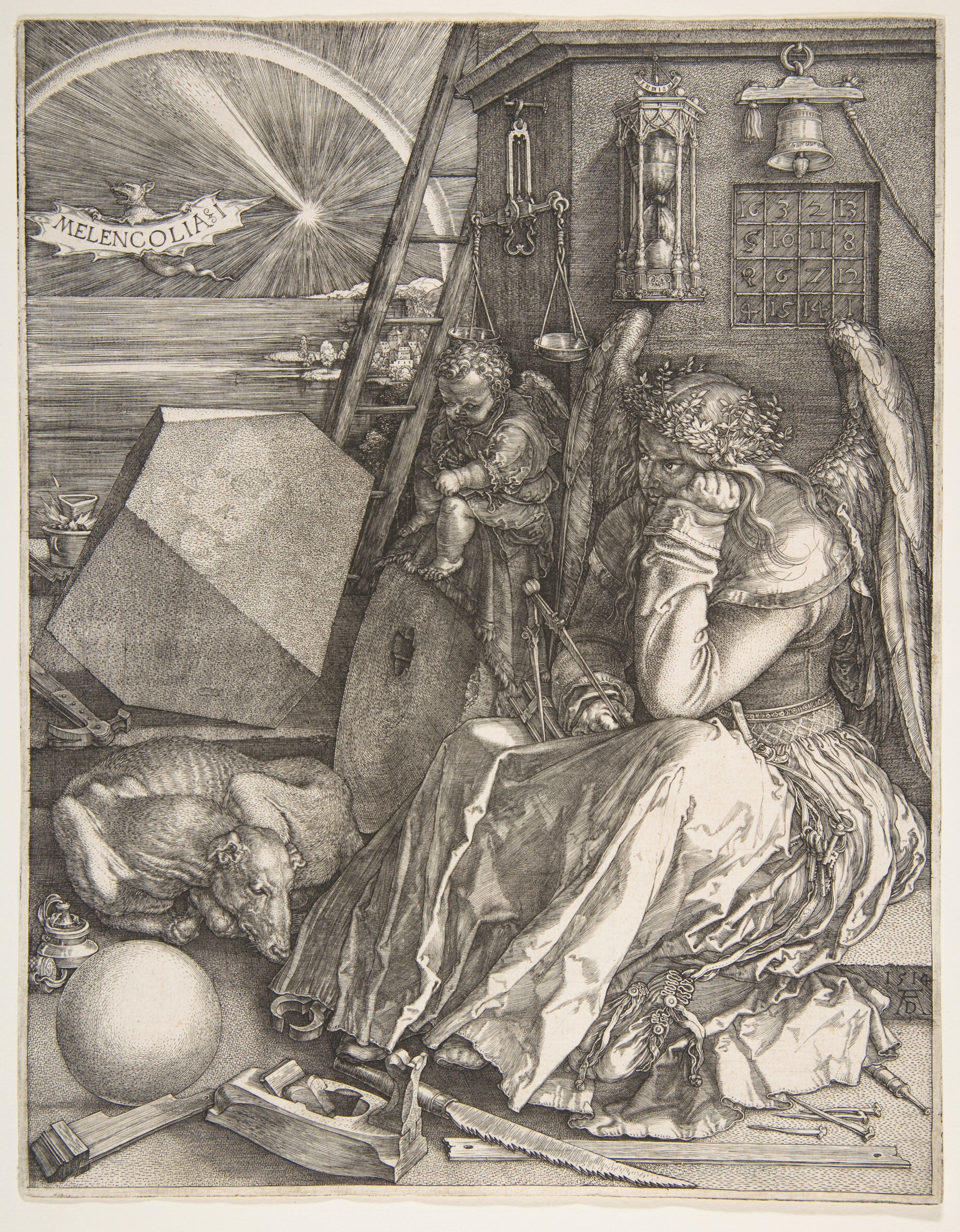
Albrecht Durer, Melencolia I, 1514. Per The Met:
The winged figure in Melencolia I has inspired many readings over its long history, although her ties to mathematical knowledge are often highlighted. Many of her accoutrements are borrowed from medieval and Renaissance allegories of geometry that personify it as a woman working at a table surrounded by tools. Perhaps most notably, a truncated rhombohedron looms large in the middle distance, dividing the foreground—a scene replete with the detritus of measurement—from the limitless background of a placid sea that vanishes into the horizon, presumably the type of natural territory the geometer purports to measure.

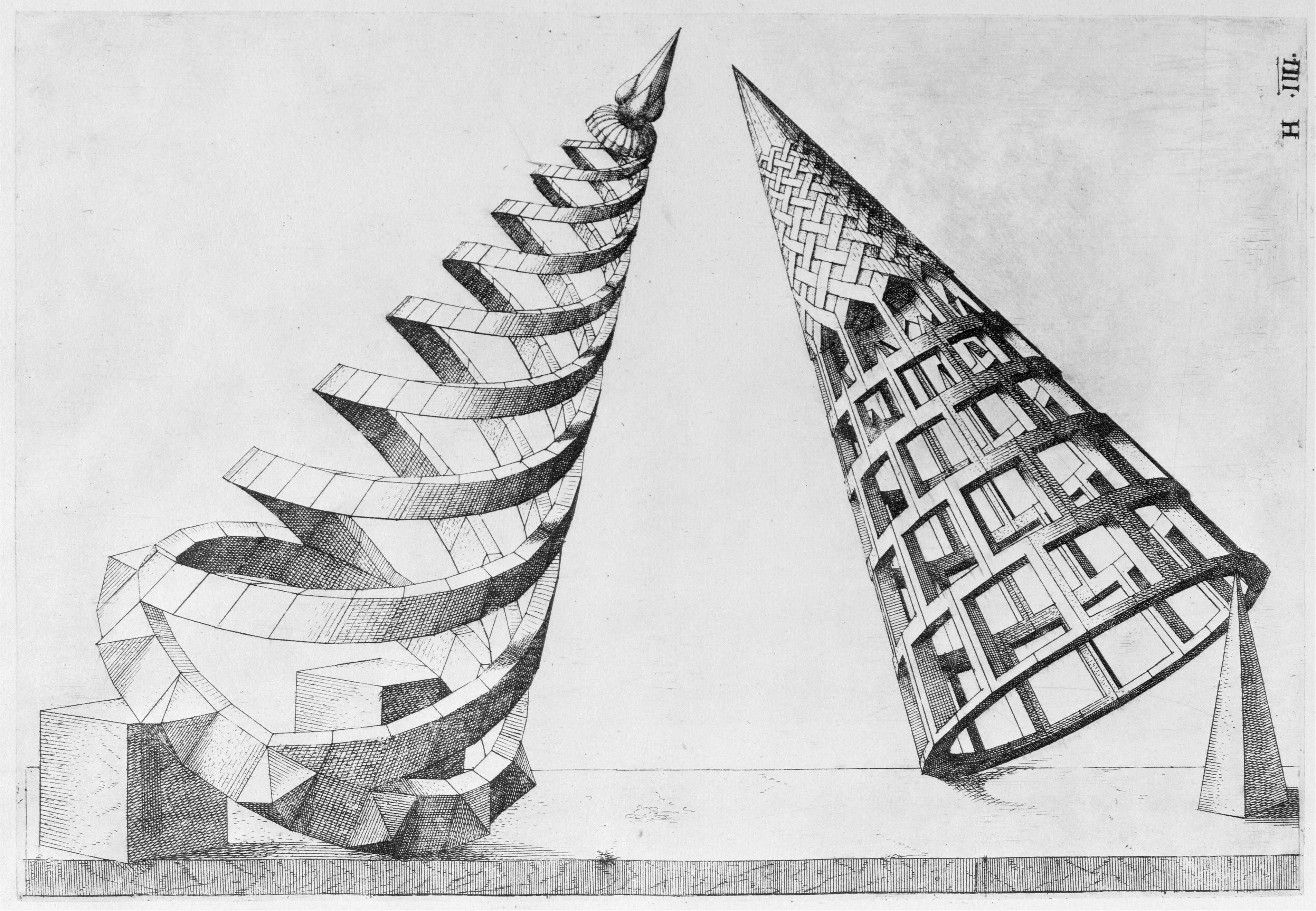
Engraved illustration from Perspectiva Corporum Regularium, 1568, by Jost Amman, after Wenzel Jamnitzer (German, Vienna 1507/8–1585 Nuremberg)


odds and ends / 2.8.2023


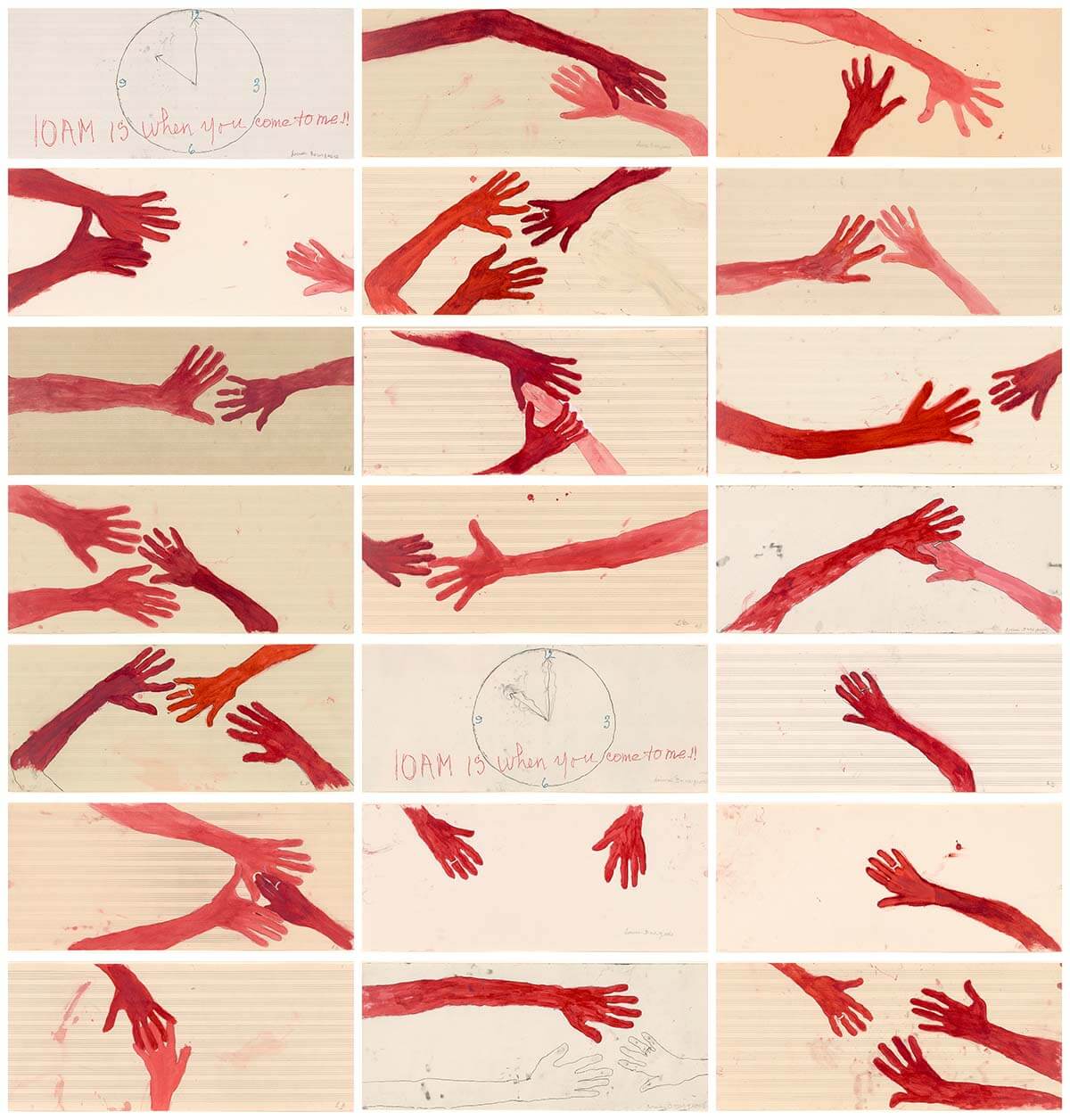
Louise Bourgeois, "10 am is When You Come to Me." Twenty sheets of musical score paper painted with Bourgeois' hands and those of her assistant Jerry Gorovoy. Via 8 Holland Street:
Bourgeois said of Gorovoy: "When you are at the bottom of the well, you look around and say, who is going to get me out? In this case it is Jerry who comes and he presents a rope, and I hook myself on the rope and he pulls me out."
*

John Roddam Spencer Stanhope, detail from "The Women of Sorrento Drawing in the Boats." De Morgan Collection.

*


*

Child's armchair upholstered with petit point sewn by Alice B. Toklas over designs by Pablo Picasso, in the collection of the Beinecke Library.

*

From Anne Truitt's Daybook, via stopping off place.

*

Leonard Baby, "We Must Be Different From Our Parents," 2023. On view starting 2/16/2023 at Fortnight Institute.

*

Crossed letter from 1846 in the collection of tihngs.

*

"What’s going on? One idea is that two titanic forces are battling for control over the world’s heart."

*
But what are comets? The etymology of the term in English—from the Greek word 'komētēs,' meaning 'long-haired'—reminds us that they were once seen as long-tressed stars. For much of human history, comets were less than celebrated. Martin Luther called them “harlot stars,” for their wanton behavior. A Lutheran bishop, in 1578, described them as 'the thick smoke of human sins, rising every day, every hour, every moment full of stench and horror, before the face of God, and becoming gradually so thick as to form a comet, with curled and plaited tresses, which at last is kindled by the hot and fiery anger of the Supreme Heavenly Judge.' A scholar countered that this theory didn’t account for why we saw comets only occasionally. 

Rivka Galchen, "What the Green Comet tells Us About the Past—And the Future." The New Yorker, 1/31/2023.

*

"Commissioned by a cat supply company, A Short Story takes viewers along on the strange, surreal journey of a large black cat seeking something precious in this world..."

*
Brilliant, beautiful Alice is barely believable as a female human being. And why should she be? She’s a quester, an outlier, a method of inquiry, an experiment maybe, experimented upon like a mink crazed in a lab. ... Alice runs circles around this Dr. Cohen. She is the circle, actually, the Ouroboros, the snake of mythology coiled with its tail in its mouth, sacred symbol of the eternal cycle of destruction and rebirth, most secularly realized by the chemist August Kekulé’s dream about the configuration of molecules. Cormac McCarthy is interested in Kekulé’s dream and in the unconscious and in the distaste for language the unconscious harbors and the mystery of the evolution of language, which chose only one species to evolve in. He’s interested in the preposterous acceptance that one thing—a sound that becomes a word—can refer to another thing, mean another thing, replacing the world bit by bit with what can be said about it.

Joy Williams, "Great, Beautiful, Terrifying: On Cormac McCarthy." Harpers, January 2023.

*
And although she was now redundant as a woman, being neither a wife, mother nor mistress, she was by no means redundant as a narratologist ... certain female narratologists talked with pleasurable awe about wise Crones, but she was no crone, she was an unprecedented being, a woman with porcelain-crowned teeth, laser-corrected vision, her own store of money, her own life and field of power, who flew, who slept in luxurious sheets around the world, who gazed out at white fields under the sun by day and the brightly turning stars by night as she floated redundant.

A.S. Byatt, "The Djinn in the Nightingale's Eye."

*
Our mother was not the sort of woman to unpack her heart everywhere; she looked on human speech as a loaded gun, and, to use her own expression, talking often felt to her like an issue of blood.

Simone Schwarz-Bart, The Bridge of Beyond.

*


*
He had a life as well as a career: his ukulele, his animals, his gardening, his inventions—including a model railroad track he’d constructed that ran from his garage workshop to the kitchen to the backyard. Its cars transported snacks to the poolside guests, and the caboose carried Alka-Seltzer. 

John Lahr, "Puzzled Puss." London Review of Books, 1/19/2023. 

*

odds and ends / 11.11.2021


Frederic Edwin Church, Autumn Landscape. Circa 1860-1870. Brush and oil paint on cardboard. Via the Cooper Hewitt.

*

Finely carved woman's hand, in the collection of tihngs.

*


*

Rae Armantrout, "Crescendo."

*


*
Manifesting, by and large, is a single-player sport. Most of what circulates online concerning how to manifest emerges largely out of the work of New Thought philosophers from the early to mid-20th century—American writers such as Neville Goddard and Florence Scovel Shinn, who mobilized biblical scripture in order to cast the argument that life as we know it is merely only a simulation, and that every individual around oneself is simply a non-playable character. To New Thought philosophers such as Goddard and Shinn, neither hustlenomics nor securing the bag were proprietary to neoliberal capitalism—getting what you want, seemingly, boils down singularly to your state of mind, the sheer vibrational force of your imagination. In order to believe in the full powers of manifestation, one has to foremost think that they are indeed the only person who exists, and that the world around themself is simply a mirror reflecting and reaffirming their self-concept—or as Goddard frames more simply, “Everyone is you pushed out.” However, instead of being reassuring, this sort of postulation makes me feel existentially insecure. If you are the only person who exists, why would anything—even, and especially manifesting—matter at all?


Gasira Tamir, "The Year of Magical Thinking." The New Inquiry, 9/13/2021. 

*

"His life was a mixture of realities and self-imposed fictions that were so potent that even he forgot who he was."

*
Yet so blind are we to the true nature of reality at any given moment that this chaos—bathed, it is true, in the iridescent hues of the rainbow and clothed in an endless confusion of fair and variegated forms which did their best to stifle any burgeoning notions of the formlessness of the whole, the muddle really as ugly as sin which at every moment shone through the colored masses, bringing a telltale finger squarely down on the addition line, beneath which these self-important and self-convoluted shapes added disconcertingly up to zero—this chaos began to seem like the normal way of being, so that some time later even very sensitive and perceptive souls had been taken in: it was for them life’s rolling river ...


John Ashbury, from "The System," 1972.  

*

Colors fill up your mind too much with all sorts of muddled stuff. Colors are too sweet a muddle, nothing more. I love things in one color, monotonous things. Snow is such a monotonous song. Why shouldn’t a color be able to make the same impression as singing? White is like a murmuring, whispering, praying. Fiery colors, like for instance autumn colors, are a shriek.


Robert Walser, translated by Damon Searles. "From the Essays of Fritz Kocher," The Paris Review, Issue 205, summer 2013.

*

Here in this little patch of mulch in my yard is a creature that begins life as a microscopic amoeba and ends it as a vibrant splotch that produces spores, and for all the time in between, it is a single cell that can grow as large as a bath mat, has no brain, no sense of sight or smell, but can solve mazes, learn patterns, keep time, and pass down the wisdom of generations.


Lacy M. Johnson, "What Slime Knows." Orion, September 2021. 

*

“We are all lichens,” the biologist Scott Gilbert and his colleagues wrote in a 2012 paper published in the Quarterly Review of Biology. Titled “A Symbiotic View of Life: We Have Never Been Individuals,” the paper argues that human bodies cannot be thought of as individual organisms. Rather, we are dynamic colonies housing a shifting community of trillions of bacteria and fungi that perform many vital functions and determine our health (including a “microbial cloud” that overflows our body, hovering, at all times, in the air around us). From this point of view, “I” has always truly been “we.”


Zoë Schlanger, "Our Silent Partners.The New York Review of Books, 10/7/2021.

*

"A certain form of mysterious shimmering, soaring cloud is starting to appear more often in the night sky, and scientists are working to understand why."

*
What I admire most about science is that it is completely unwilling to accept the many mysteries that surround us: it is stubborn, and wonderfully so. When it comes face to face with the unknown, it whips out a particle accelerator, a telescope, a microscope, and smashes reality to bits, because it wants—because it needs!—to know. Literature is similar, in some respects: it is born from an impossible wish, the desire to bind this world with words. In that, it is as ambitious as science. Because for us human beings, it is never enough to know god: we have to eat him. That’s what literature is for me: putting the world in your mouth.

Benjamín Labatut, in conversation with translator Adrian Nathan West, about When We Cease to Understand the World (one word review: marvelous).

*

"On the morning after Juliane Diller fell to earth, she awoke in the deep jungle of the Peruvian rainforest dazed with incomprehension."(NYT)
*

A short film about komorebi: "a dance of shadows emerging when sunlight filters through trees."