Showing posts with label louise bourgeois. Show all posts

odds and ends / 2.8.2023


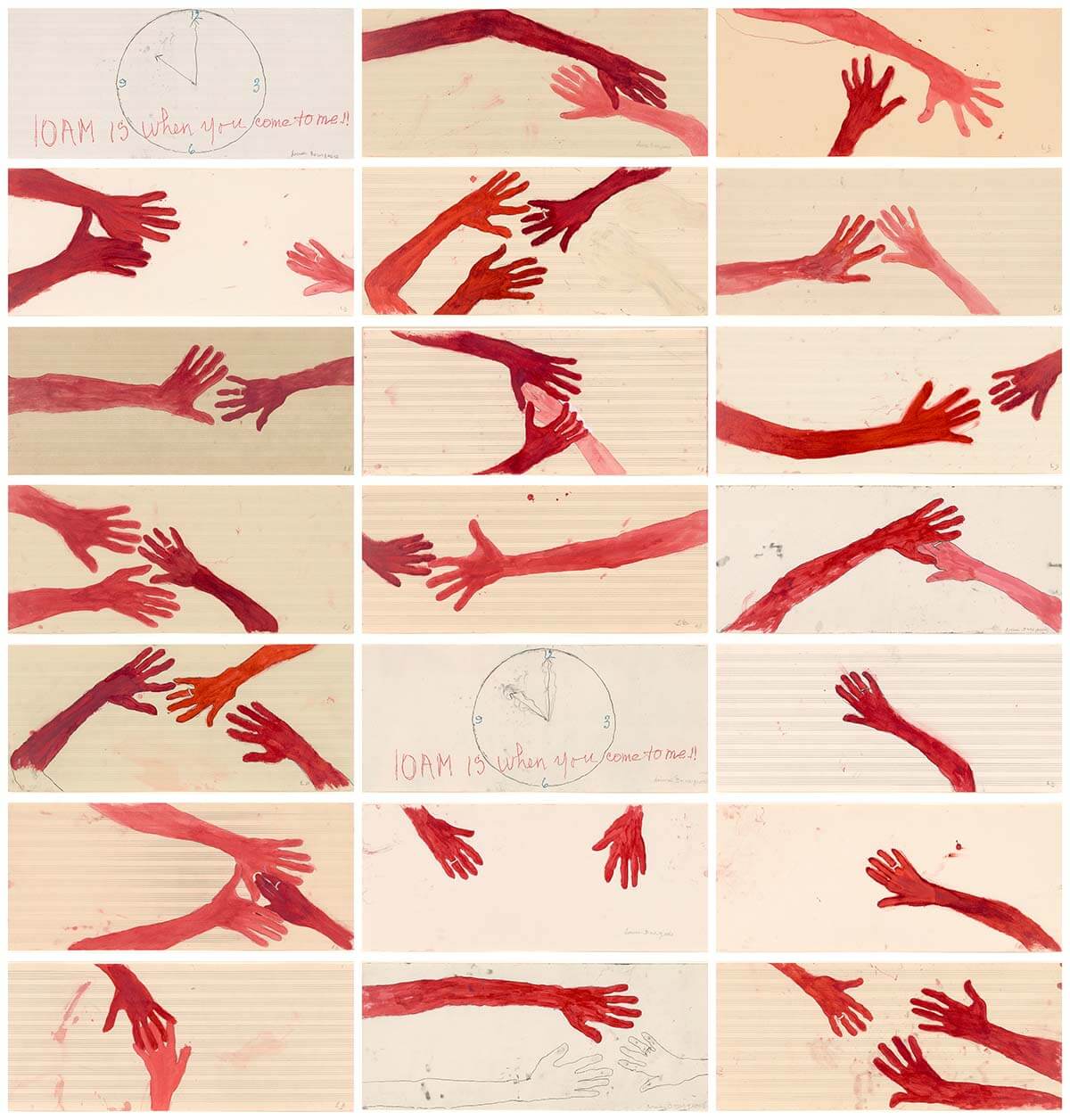
Louise Bourgeois, "10 am is When You Come to Me." Twenty sheets of musical score paper painted with Bourgeois' hands and those of her assistant Jerry Gorovoy. Via 8 Holland Street:
Bourgeois said of Gorovoy: "When you are at the bottom of the well, you look around and say, who is going to get me out? In this case it is Jerry who comes and he presents a rope, and I hook myself on the rope and he pulls me out."
*

John Roddam Spencer Stanhope, detail from "The Women of Sorrento Drawing in the Boats." De Morgan Collection.

*


*

Child's armchair upholstered with petit point sewn by Alice B. Toklas over designs by Pablo Picasso, in the collection of the Beinecke Library.

*

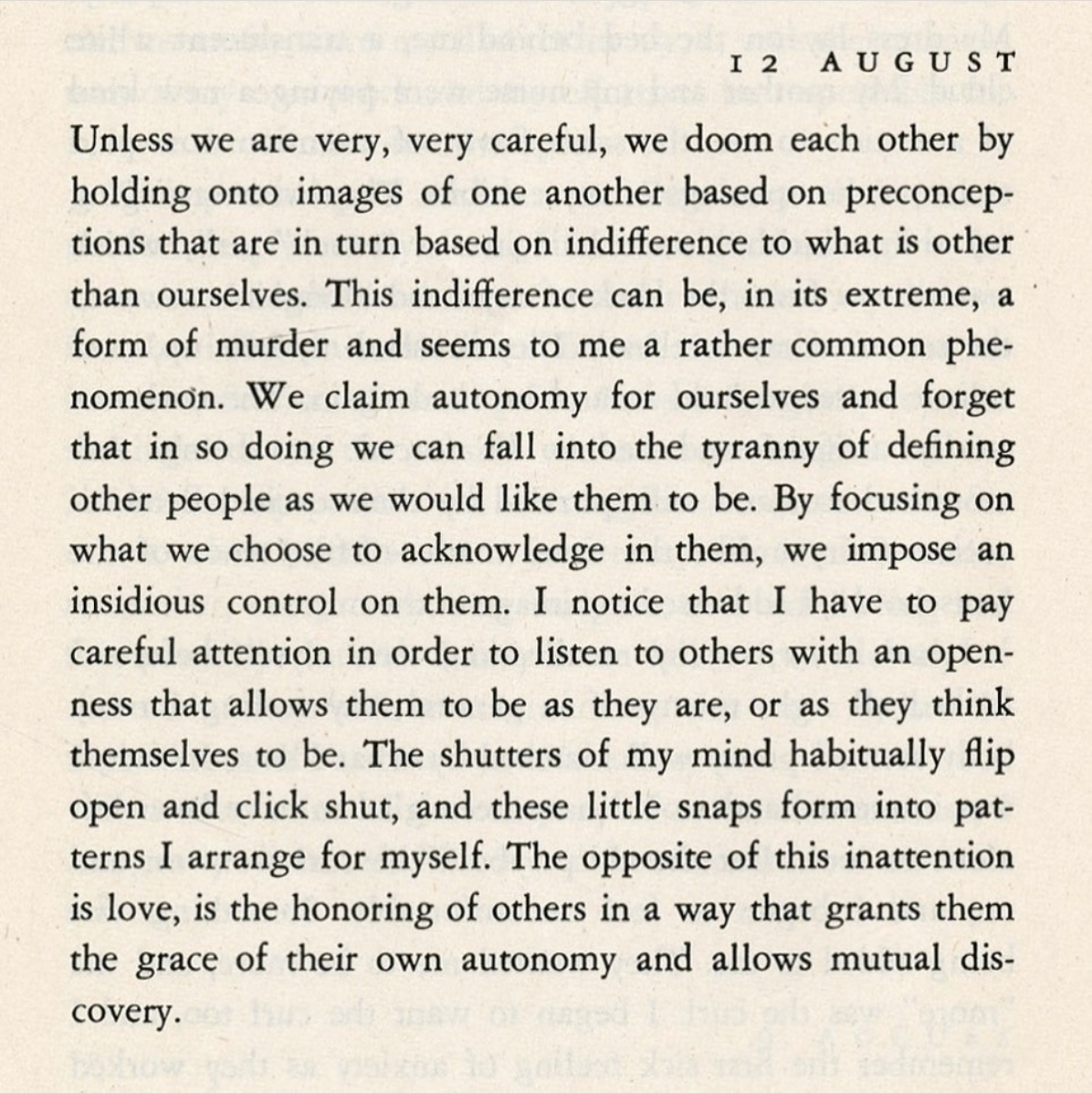
From Anne Truitt's Daybook, via stopping off place.

*

Leonard Baby, "We Must Be Different From Our Parents," 2023. On view starting 2/16/2023 at Fortnight Institute.

*

Crossed letter from 1846 in the collection of tihngs.

*

"What’s going on? One idea is that two titanic forces are battling for control over the world’s heart."

*
But what are comets? The etymology of the term in English—from the Greek word 'komētēs,' meaning 'long-haired'—reminds us that they were once seen as long-tressed stars. For much of human history, comets were less than celebrated. Martin Luther called them “harlot stars,” for their wanton behavior. A Lutheran bishop, in 1578, described them as 'the thick smoke of human sins, rising every day, every hour, every moment full of stench and horror, before the face of God, and becoming gradually so thick as to form a comet, with curled and plaited tresses, which at last is kindled by the hot and fiery anger of the Supreme Heavenly Judge.' A scholar countered that this theory didn’t account for why we saw comets only occasionally. 

Rivka Galchen, "What the Green Comet tells Us About the Past—And the Future." The New Yorker, 1/31/2023.

*

"Commissioned by a cat supply company, A Short Story takes viewers along on the strange, surreal journey of a large black cat seeking something precious in this world..."

*
Brilliant, beautiful Alice is barely believable as a female human being. And why should she be? She’s a quester, an outlier, a method of inquiry, an experiment maybe, experimented upon like a mink crazed in a lab. ... Alice runs circles around this Dr. Cohen. She is the circle, actually, the Ouroboros, the snake of mythology coiled with its tail in its mouth, sacred symbol of the eternal cycle of destruction and rebirth, most secularly realized by the chemist August Kekulé’s dream about the configuration of molecules. Cormac McCarthy is interested in Kekulé’s dream and in the unconscious and in the distaste for language the unconscious harbors and the mystery of the evolution of language, which chose only one species to evolve in. He’s interested in the preposterous acceptance that one thing—a sound that becomes a word—can refer to another thing, mean another thing, replacing the world bit by bit with what can be said about it.

Joy Williams, "Great, Beautiful, Terrifying: On Cormac McCarthy." Harpers, January 2023.

*
And although she was now redundant as a woman, being neither a wife, mother nor mistress, she was by no means redundant as a narratologist ... certain female narratologists talked with pleasurable awe about wise Crones, but she was no crone, she was an unprecedented being, a woman with porcelain-crowned teeth, laser-corrected vision, her own store of money, her own life and field of power, who flew, who slept in luxurious sheets around the world, who gazed out at white fields under the sun by day and the brightly turning stars by night as she floated redundant.

A.S. Byatt, "The Djinn in the Nightingale's Eye."

*
Our mother was not the sort of woman to unpack her heart everywhere; she looked on human speech as a loaded gun, and, to use her own expression, talking often felt to her like an issue of blood.

Simone Schwarz-Bart, The Bridge of Beyond.

*


*
He had a life as well as a career: his ukulele, his animals, his gardening, his inventions—including a model railroad track he’d constructed that ran from his garage workshop to the kitchen to the backyard. Its cars transported snacks to the poolside guests, and the caboose carried Alka-Seltzer. 

John Lahr, "Puzzled Puss." London Review of Books, 1/19/2023. 

*

odds and ends / 10.8.2021


Assorted Fabergé treasures from the collection of Harry Woolf, to be auctioned by Christies on November 29, 2021.

*

Hannah and Mary and the anchovy paste, via Lapham's Quarterly.

*

Louise Bourgeois, Untitled, 2000. Photo by Christopher Burke via Architectural Digest.

*

Mille-feuille silk flats by Sleeper.

*

"Bookworm" holes, via The Thomas J. Watson Library at the Metropolitan Museum of Art.

*

Card from the Astronomia deck published by F.G. Moon, ca. 1829-1831. Yale University Library.

*
There are many things we can live without. Self-respect is not one of them. One would think the absence of self-respect would resemble much of a sameness, but the circumstances that can make people feel bereft of it are as variable as persons themselves.


Vivian Gornick, "Put on the Diamonds." Harpers, October 2021.

*

Living in a fantasy world where you can shit on losers in your published work with no consequences and then cover it up with groupthink isn’t artistic freedom or social change, it’s just being an asshole for no discernible reason other than making yourself and your friends feel superior to a loser who doesn’t know basic social graces or have very many friends.

*

Related: The eighth deadly sin, the "fake skills, fake friends, and fake jobs" of the creative writing industrial complex, and what this is all about: "Who is the bad art friend?" (NYT)

*

First, you hear something slightly titillating, a bit of gossip you didn’t know. A couple has separated, someone says. “They’ve been keeping it secret. But now Angie’s dating Charles’s ex!” Then you hear something wildly wrong. “The F.D.A. hasn’t approved it, but also there’s a whole thing with fertility. I read about a woman who had a miscarriage the day after the shot.” And then something offensive, and you feel a desire to speak up and offer a correction or objection before remembering that they have no idea you’re listening. They’re not talking to you.


Chris Hayes, "On the Internet, We're Always Famous." The New Yorker, 9/24/2021. 

*

"There is no strict frontier between what is pathological and what is not."

*

When I was a kid, I insisted that my mother read me Shel Silverstein’s The Giving Tree over and over. Published in 1964, it’s a story about a boy who takes and takes from a tree over the course of his life until the boy is an old man and the tree is left a stump. “And the tree was happy,” the story ends. It’s a strange book, with an ending that is heartbreaking but also streaked with strange joy. I was surprised to discover recently that The Giving Tree is considered “one of the most divisive in the canon” of children’s literature in large part because its moral is unclear. Why is the tree happy when it has been sucked dry? Are we supposed to understand the relationship as one defined by generosity or abuse of power? There was even a 2014 article in The New York Times about whether The Giving Tree is a “tender story of unconditional love or a disturbing tale of selfishness.” Why not both, or, really, neither? It seems many of us can no longer imagine that children can handle, and may in fact prefer, stories defined by ambiguity—stories that have little to do with contemporary politics but rather to do with life as it is lived.

Sophie Haigney, "Persistence Pays: A Young Reader's Report." The Drift, Issue 5, 9/21/2021.

*
Virginia Hamilton was doing daring, moody, singular character studies in these books and, with her seemingly limitless faith in children’s ability to make sense of the world, to intuit the difference between “sometimes people are like this” and “you, reader, should be like this” – a faith that seems, to put it lightly, not to be the current norm within the field – selling it as children’s fiction. Like all the best character-driven fiction, her work is an act of open-ended empathy and negative capability, a leap into the dark world of another mind. It helps us learn to say to other people, when they show us who they are: I don’t doubt that. And what else?


Phil Christman, "Book Tour: A Leap into the World of Another Mind.Plough, 9/7/2021. 

*
When I was a young physics student I once asked a professor: ‘What’s an electron?’ His answer stunned me. ‘An electron,’ he said, ‘is that to which we attribute the properties of the electron.’ That vague, circular response was a long way from the dream that drove me into physics, a dream of theories that perfectly described reality.


Adam Frank, "Minding Matter.Aeon, March 13, 2017. 

Freud claimed that technology only solved problems that technology itself had created. The alienation and malaise caused by one modern invention was momentarily relieved by another, a process he compared to “the enjoyment obtained by putting a bare leg from under the bedclothes on a cold winter night and drawing it in again.” Nobody seemed capable of articulating what problem these language models were designed to solve. There was some chatter about writing assistance, about therapy bots, about a future where you’d never have to write another email ... all of which seemed to skirt the technology’s most obvious use: replacing the underpaid and inefficient writers who supplied the content that fed the insatiable maw of the internet—people like me.


Meghan O'Gieblyn, "Babel: Could a Machine have an Unconscious?" n+1, Issue 40, Summer 2021.

*

It is not news that writers don’t get paid much, but it will feel like news when you see how little the publisher is actually offering you. Writers from Stefan Zweig to William Burroughs have artfully sidestepped this problem by being born rich. We suggest that you do too.


The Fence, Issue 1: "12 Rules for Getting Your First Book Published."

*

It’s not really possible to neutralize a chaotic life with homemade granola and a collection of jute shopping bags hung from beechwood pegs. 


Mirielle Silcoff, "More is More: The End of Minimalism." The Walrus, 8/12/2021.

*
Lilacs quietly tell the story of climate change. Since the 1950s, phenologists across the U.S. have used them as an “indicator plant” to track the start of spring because of their extreme sensitivity to temperatures. Their blooms elucidate the first warm day of the season as not just a feeling, but a fact. There’s an entire “lilac network” that stretches from coast to coast, made up of volunteers who have spent decades documenting the exact days that the buds burst open and winter becomes a passing thought.


Sara Tardiff, "How L.A.’s Flower District Vendors Are Feeling the Effects of Climate Change." Vogue, 9/10/2021.

*

My generation has arrived at a party which seems to be ending, and it’s getting harder to recall birds as they were in the days of their plenty.


Patrick Laurie, "The Curlews of Galloway." The Paris Review, 9/30/2021. 

*

I asked her what it was like to have her husband home again, piled up in her driveway.

“Well, it’s compost,” she told me. “It’s still precious because it was his body. But it’s also compost.”


Lisa Wells, "To Be a Field of Poppies." Harpers, October 2021. 

*

A very literary high.


inducements


We've drifted past the baby's estimated due date, and we are waiting, waiting, waiting; wondering how exactly this story will start.

*

On the day you were born, it rained buckets, and I sat with my watercolors and tried to paint a fox.

On the day that you were born, your dad read you baseball essays by Roger Angell, and you kicked like crazy whenever he mentioned the Mets. 

On the day that you were born, I woke up in a bad mood and ate three pieces of toast with raspberry jam before I felt better.

*

Moving through these months, I've realized that a fair amount of information about pregnancy and labor is anecdotal. There is a lot of choosing what to believe. No one gets to A/B test any one specific pregnancy/labor/parenthood experience, and every woman and baby are individual beings with an individual relationship and set of circumstances. Correlation and causation are tricky bastards, and no one can predict how things are going to be for you. Every story is unwritten, until it isn't.

Believing X caused Y does make for a good story, though, even if it isn't exactly true, so I've made my own list of ways to induce labor. If I do any one (or several of them) and lo, the babe appears, who's to say they didn't work?

*

Buying opal rings for every finger.
Reading books about summer on islands.
Floating in chlorinated swimming pools until fingers and toes are as wrinkly as raisins.
Drinking three frozen cokes in a row.
Walking up and down the stairs seventeen times.
Getting a peck of peaches, and taking just one bite out of each.
Picking Japanese beetles off the azaleas.
Standing on the shore, and letting waves break around your knees until the sun shifts in the sky.
Eating surskullar (only the yellows) until your eyes water and tongue burns.
Sharpening a pencil to its pointiest point, and drawing a single, continuous line until the lead is completely flat.
Laying very close to the person you love best, and matching your breath to theirs.
Watching for 100 firefly flashes, then wishing.

*

Louise Bourgeois: Pregnant Woman, 2009.

this weekend (and five)


even*cleveland turned five this week, a number that seems impossible to me. Blogging has always struck me as a truly temporary activity, like building a house of cards, so many little pieces artfully piled, repeating patterns of thought and interest suspended in time. Arranging all the pretty scraps and fragments was supposed to be the catalyst for something more, but along the way it became the thing itself. My day job is now a blogging job, which is awesome but a little unnerving. Sometimes it feels like I may have invested in becoming a Betamax repair man. 

Looking ahead:
Happy weekend.

Louise Bourgeois: He Disappeared into Complete Silence, 1947. Via mythology of blue.

never to dream of spiders

Fabric works by Louise Bourgeois, from the show at Cheim + Read:

Untitled, 2005. Fabric. 16 x 20 3/4 inches.
Untitled, 2005. Fabric. 12 1/4 x 15 inches.
Untitled, 2005. Fabric. 9 3/8 x 11 inches.
Untitled, 2006. Fabric with ink and fabric collage. 15 1/2 x 15 5/8 inches.
Untitled, 2005. Fabric. 24 x 31 inches.
Untitled, 2005. Fabric. 16 1/4 x 21 1/4 inches.

I went to this show last month, and I've been thinking about it ever since. It was wonderful.

Post title from a poem by Audre Lorde.

i had a flashback of something that never existed


Ode à l’Oubli (Ode to Forgetfulness)
2004
Hand-made cloth book, 36 pages.
Fabric, lithographic ink and archival dyes
10 ¾ x 13 ¼ inches (27 x 34 cm)
Published by Peter Blum Edition
Produced by Solo Impression, New York and Dye-Namix Inc., New York.

Further reading: NYT 10.17.04.

two dimensions do not satisfy me

one and others

One and Others
1955
Painted wood, 18 1/4 x 20 x 16 3/4 inches
Whitney Museum of American Art, New York
Photo by Jeffrey Clements
Courtesy Cheim & Read, New York.

summation


I am not interested in art history, in the academies of styles, a succession of fads. Art is not about art. Art is about life, and that sums it up.

Louise Bourgeois, as quoted here. Excerpt found here + photo here.