Showing posts with label george eliot. Show all posts

odds and ends / 10.12.2023


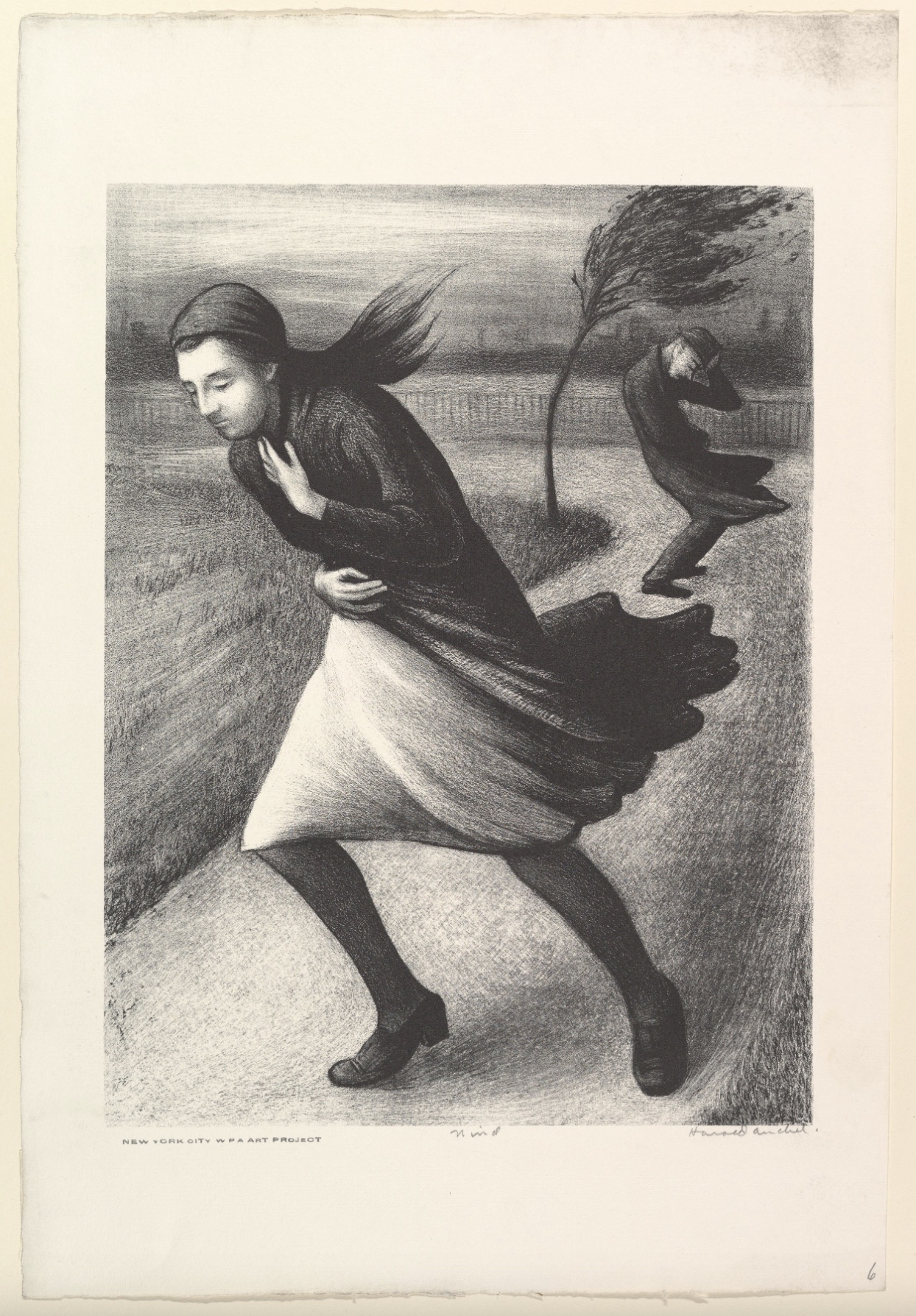
Harold Anchel, Wind. 1935-1943. The Metropolitan Museum of Art.

*

Glove, ca. 1840-1880. Bronze and paint, 1 1/8 × 7 7/8 × 4 7/8". The Menil Collection, Houston.

*

Osborne's Superfine American Water Colours travel set ca. 1830, via criticalEYEfinds.

*

Melissa Catanese, Figures #6, 2021.

*

Still from Himali Singh Soin's "The Spiral," via Ignota Books

*
It has long been the task of the humane left to reject the line of reasoning that would sacrifice civilians on the altar of 'historical inevitability,' whether in its Stalinist or Third Worldist guise—to protest the idea that untold innocents must die in the service of some grand telos. The humane left insists instead on the possibility, on the moral imperative, of bending what others take to be history’s iron tracks. The humane left’s north star is no flag or banner but the unflinching belief in the inherent, even divine, worth of every human life.

After all, it is this same belief out of which the humane left stands in steadfast opposition to Israel’s occupation of the West Bank and siege of the Gaza Strip, that drives our opposition to Israel’s ongoing bombardment of Gaza, our protests against the injustices of apartheid, our demands for a long-term and equal resolution to this conflict. Just as the humane left abhors Hamas’s attack and demands the immediate release of the hostages, the humane left rejects with all its force the exterminationist logic now promulgated by officials in Netanyahu’s government and right-wing politicians in the United States. There is no contradiction here. The left must be humane, or it is no left at all.

*


*
On December 15, 1811, the London Statesman issued a warning about the state of the stocking industry in Nottingham. Twenty thousand textile workers had lost their jobs because of the incursion of automated machinery. Knitting machines known as lace frames allowed one employee to do the work of many without the skill set usually required. In protest, the beleaguered workers had begun breaking into factories to smash the machines. “Nine Hundred Lace Frames have been broken,” the newspaper reported. In response, the government had garrisoned six regiments of soldiers in the town, in a domestic invasion that became a kind of slow-burning civil war of factory owners, supported by the state, against workers. The article was apocalyptic: 'God only knows what will be the end of it; nothing but ruin.'

Kyle Chayka, "Rethinking the Luddites in the Age of A.I." The New Yorker, 9/26/2002. 

*
The knitting machines which provoked the first Luddite disturbances had been putting people out of work for well over two centuries. Everybody saw this happening—it became part of daily life. They also saw the machines coming more and more to be the property of men who did not work, only owned and hired. It took no German philosopher, then or later, to point out what this did, had been doing, to wages and jobs. Public feeling about the machines could never have been simple unreasoning horror, but likely something more complex: the love/hate that grows up between humans and machinery—especially when it's been around for a while—not to mention serious resentment toward at least two multiplications of effect that were seen as unfair and threatening. One was the concentration of capital that each machine represented, and the other was the ability of each machine to put a certain number of humans out of work—to be ''worth'' that many human souls. What gave King Ludd his special Bad charisma, took him from local hero to nationwide public enemy, was that he went up against these amplified, multiplied, more than human opponents and prevailed. When times are hard, and we feel at the mercy of forces many times more powerful, don't we, in seeking some equalizer, turn, if only in imagination, in wish, to the Badass—the djinn, the golem, the hulk, the superhero—who will resist what otherwise would overwhelm us? Of course, the real or secular frame-bashing was still being done by everyday folks, trade unionists ahead of their time, using the night, and their own solidarity and discipline, to achieve their multiplications of effect.

It was open-eyed class war.

Thomas Pynchon, "Is It O.K. to be a Luddite?" The New York Times, October 28, 1984. 

*
At this crisis certain inventions in machinery were introduced into the staple manufactures of the North which, greatly reducing the number of hands necessary to be employed, threw thousands out of work and left them without legitimate means of sustaining life. A bad harvest supervened. Distress reached its climax. Endurance, overgoaded, stretched the hand of fraternity to sedition. The throes of a sort of moral earthquake were felt heaving under the hills of the northern counties. But as is usual in such cases, nobody took much notice.

Charlotte Bronte, Shirley

*
This movie deals with the epidemic of the way we live now.
What an inane card player. And the age may support it.
Each time the rumble of the age
Is an anthill in the distance.

As he slides the first rumpled card
Out of his dirty ruffled shirtfront the cartoon
Of the new age has begun its ascent
Around all of us like a gauze spiral staircase in which
Some stars have been imbedded.

John Ashbery, "This Configuration." The Paris Review, Issue 79, Spring 1981.

*

"It is not true that love makes all things easy: it makes us choose what is difficult."

odds and ends / 9.13.2022


Paula Modersohn-Becker, Rural road with red house, ca. 1902. 

*

Bocca Della Verità headboard by Mario Ceroli, 2015.

Long fruits jacket by Aprés Ski.

*

Natural pigments in the collection of the Cleveland Museum of Art.

*

Georgiana Houghton, The Eye of the Lord (reverse), 1864. Collection of the Victorian Spiritualists’ Union, Melbourne, Australia.

*
The grievance I find in the Cours de la Fidélité is the barbarous manner in which the authorities have cut these vigorous plane trees and clipped them to the quick. In fact they really resemble with their dwarfed, rounded and flattened heads the most vulgar plants of the vegetable garden ... But the wish of M. the mayor is despotic, and all the trees belonging to the municipality are ruthlessly pruned twice a year. ... An old Surgeon-Major of Napoleon's Italian Army, who was living in retirement at Verrières, and who had been in his time described by M. the mayor as both a Jacobin and a Bonapartiste, dared to complain to the mayor one day of the periodical mutilation of these fine trees.

"I like the shade," answered M. de Rênal, with just a tinge of that hauteur which becomes a mayor when he is talking to a surgeon, who is a member of the Legion of Honour. "I like the shade, I have my trees clipped in order to give shade, and I cannot conceive that a tree can have any other purpose, provided of course it is not bringing in any profit, like the useful walnut tree."

This is the great word which is all decisive at Verrières. ... Bringing in profit is the consideration which decides everything in this little town which you thought so pretty.


Stendhal, The Red and the Black, translated by Horace B. Samuel. 

*
When we dig roots, we make little holes. When we build houses, we make little holes. When we burn grass for grasshoppers, we don’t ruin things. We shake down acorns and pine nuts. We don’t chop down the trees. We only use dead wood. But the white people plow up the ground, pull up the trees, kill everything. The tree says, “Don’t. I am sore. Don’t hurt me.” But they chop it down and cut it up. The spirit of the land hates them. They blast out trees and stir it up to its depths. They saw up the trees. That hurts them. The Indians never hurt anything, but the white people destroy all. They blast rocks and scatter them on the earth. The rock says, “Don’t! You are hurting me.” But the white people pay no attention. When the Indians use rocks, they take little round ones for their cooking. The white people dig deep long tunnels. They make roads. They dig as much as they wish. They don’t care how much the ground cries out. How can the spirit of the earth like the white man?


Kate Luckie, "The Water Will Come." Excerpted in Lapham's Quarterly, "Climate" issue, Fall 2019.

*

A Wintun shaman, Kate Luckie attributed her powers to a supernatural experience she underwent as her son lay dying. She is known for a prophecy she gave about how the world would end: “Everywhere the white man has touched it, it is sore. It looks sick. So it gets even by killing him when he blasts. But eventually the water will come.”

*

The terror of being judged sharpens the memory: it sends an inevitable glare over that long-unvisited past which has been habitually recalled only in general phrases. Even without memory, the life is bound into one by a zone of dependence in growth and decay; but intense memory forces a man to own his blameworthy past. With memory set smarting like a reopened wound, a man’s past is not simply a dead history, an outworn preparation of the present; it is not a repented error shaken loose from the life; it is a still-quivering part of himself, bringing shudders and bitter flavors and the tinglings of a merited shame.

George Eliot, Middlemarch.

*
We know that without the sense of temporality embedded within memory, there would be no unitary self, and many emotions dependent on representing what is not immediately present to the mind would not exist—hope, anxiety, regret, pride, sadness, joy, love, guilt. Yet change is embedded within the very current of a unitary, subjective life. We have that “core self” that we feel to be so strong, for instance, in a loved one with dementia. We build an identity through time that is also outside us: things age, and we age in time, all things relative to each other. Being is being in time, in each others’ time.

Noga  Arikha, from The Ceiling Outside: The Science and Experience of the Disrupted Mind, excerpted in Book Post.

*
I was gradually forgetting my story. At first, I shrugged, telling myself that it would be no great loss, since nothing had happened to me, but soon I was shocked by that thought. After all, if I was a human being, my story was as important as that of King Lear or of Prince Hamlet that William Shakespeare had taken the trouble to relate in detail.


Jacqueline Harpman, I Who Have Never Known Men. 

*

The book suggests, repeatedly and in many ways, that perhaps our most essential quality is a void, an incompleteness—that what we need in order to be fully human is to sense something beyond our reach, a future, some possibility, something to be desired or learned or made or done or loved. And that it’s this sense of the something more that kindles imagination, longing, acts of mind—the experiences that enable us to feel human and make life worth living.

Deborah Eisenberg, "Condemned to Life," a review of Jacqueline Harpman's I Who Have Never Known Men in The New York Review of Books, 7/21/2022. 

*

"Urgency is a wretched condition."

*
Microchimerism refers to the exchange of fetal and maternal cells in the womb. The term comes from the Chimera of Greek myth, a monster made up of the parts of various animals. The fetus’s cells are able to pass into the mother’s body through the bloodstream, but the maternal cells can also enter the fetal body through the placenta. And, although this is less likely, a grandmother’s cells may also enter her grandchild’s body. As fetal cells are capable of adapting to the maternal tissue—like foreigners learning a new language—they insert themselves in various organs to become part of the mother’s body. We are made of others.


Jazmina Barrera, translated by Christina McSweeney. From Linia Negra, excerpted in Book Post

*

Lynda Barry in the NYT: "We’re born into a world that’s full of stories and characters that are right there for us. God, 'Grimms’ Fairy Tales' saved my ass."


*

"Perhaps what we take to be genius is simply a term for an anomaly that a market-driven culture, furnished by low expectations, has difficulty understanding and assigning value to."


*

With the theoretical physicist Przemek Witaszczyk I developed an algorithm to identify specific plant species that insects would find most attractive. The resulting garden, made up of 7,000 plants, might look random to the human eye, but it’s very tasteful if you happen to be a 
bee.
Daisy Ginsberg, talking in The Gentlewoman newsletter about creating the Pollinator Pathmaker, "a 55-meter living sculpture for pollinators."

*

Related: Ginsberg's tool for creating a pollinator garden.

*

The end of the world is back.

the flood

For the first time distinct ideas of danger began to press upon her, but there was no choice of courses, no room for hesitation, and she floated into the current. Swiftly she went now, without effort; more and more clearly in the lessening distance and the growing light she began to discern the objects that she knew must be the well-known trees and roofs ... For the first time Maggie's heart began to beat in an agony of dread. She sat helpless—dimly conscious that she was being floated along ...
George Eliot, The Mill on the Floss.

Leonardo da Vinci: Drawing of a Flood, ca. 1500.
 

that enchanted haze

They glided rapidly along, Stephen rowing, helped by the backward-flowing tide, past the Tofton trees and houses—on between the silent sunny fields and pastures, which seemed filled with a natural joy that had no reproach for theirs. The breath of the young, unwearied day, the delicious rhythmic dip of the oars, the fragmentary song of a passing bird heard now and then, as if it were only the overflowing of brim-full gladness ... They spoke no word; for what could words have been but an inlet to thought? and thought did not belong to that enchanted haze in which they were enveloped—it belonged to the past and the future that lay outside the haze.
George Eliot, The Mill on the Floss.

Peter Henry Emerson: Gathering Water-Lilies, 1886.

in case you are interested


*
As ever, the book club is open to anyone who has read the book and would like to come.

If you'd like to know what we are reading next, click here.

her only refuge

Maggie's intentions, as usual, were on a larger scale than Tom had imagined. The resolution that gathered in her mind, after Tom and Lucy had walked away, was not so simple as that of going home. No! she would run away and go to the gypsies, and Tom should never see her any more. That was by no means a new idea to Maggie: she had been so often told she was like a gypsy and 'half wild' that when she was miserable it seemed to her the only way of escaping opprobrium and being entirely in harmony with circumstances, would be to live in a little brown tent on the commons: the gypsies, she considered, would gladly receive her and pay her much respect on account of her superior knowledge. She had once mentioned her views on this point to Tom, and suggested that he should stain his face brown and they should run away together; but Tom rejected the scheme with contempt, observing that gypsies were thieves and hardly got anything to eat and had nothing to drive but a donkey. Today, however, Maggie thought her misery had reached a pitch at which gypsydom was her only refuge, and she rose from her seat on the roots of the tree with the sense that this was a great crisis in her life; she would run straight away till she came to Dunlow Common, where there would certainly be gypsies, and cruel Tom, and the rest of her relations who found fault with her, should never see her any more. She thought of her father as she ran along, but she reconciled herself to the idea of parting with him, by determining that she would secretly send him a letter by a small gypsy who would run away without telling where she was, and just let him know that she was well and happy, and always loved him very much.
George Eliot, The Mill on the Floss.

Originally posted 8/6/2008.

in case you are interested


*

As always, the book club is open to anyone who has read the book and wants to come. 

Here's the club reading list through the end of the year:

June 10: George Eliot: The Mill on the Floss
July 8: Barbara Comyns: Who Was Changed and Who Was Dead
August 12: Virginia Woolf: The Years
September 9: Laura Riding: Progress of Stories
October 14: Edward de Waal: The Hare With Amber Eyes
November 11: Isak Dinesen: Seven Gothic Tales
December 9: James Joyce: Dubliners

I also post related materials about each book over here.

Feel free to shoot me an email at evencleveland (at) gmail dot com if you have any questions.

imaginary outfit: genius burns

I want to do something splendid ... something heroic, or wonderful—that won’t be forgotten after I’m dead. I don’t know what, but I’m on the watch for it, and mean to astonish you all, some day. I think I shall write books, and get rich and famous; that would suit me ... 
Jo March, Little Women

*
I'm shakin' the dust of this crummy little town off my feet and I'm gonna see the world. Italy, Greece, the Parthenon, the Colosseum. Then, I'm comin' back here to go to college and see what they know. And then I'm gonna build things. I'm gonna build airfields, I'm gonna build skyscrapers a hundred stories high, I'm gonna build bridges a mile long... 
George Bailey, It's A Wonderful Life 

*
I long to accomplish a great and noble task, but it is my chief duty to accomplish small tasks as if they were great and noble.
Helen Keller

*

Little Women is the first book I remember reading on my own. I was eight years old, and it took me the better part of a year to work through it, puzzling through the mysteries of Pickwicks and pilgrims, tarlatans and tin kitchens. As soon as I finished it, I began it again. I read it over and over - at least once a year until I went to college. It pointed me to other books - Pilgrim's Progress, The Vicar of Wakefield, endless volumes of Dickens, and the collected works of Louisa May Alcott. Along the way, it wound through the foundation of my childhood, bending and shaping the way I understood the world and what it means to grow up.

Like many before and since, Jo March was my favorite. Smart and impulsive, funny and flawed. I loved picturing her in the attic, writing furiously and telling her family that 'genius burns', or reading on the sofa, eating apples in the company of a pet rat. (Rats were a theme with my childhood heroines - Jo had Scrabbles, Sara Crewe had Melchisedec.) I never expected her to marry Laurie- he was a brother and a friend, and my eight-year-old self didn't see any reason Jo had to marry anyone - but I was crushed to read about her grown-up life. Amy went off to Europe and became the lady fair, Meg got married and had babies, but Jo's dreams never got a full field of play. Instead of the world bending to her will, she bent herself to the rigid shape the world offered. Daughter, sister. Wife, mother. Teacher, authoress. Her family needed money, so she wrote what sold. Her sister needed a nurse, so she put everything aside and devoted herself to the job. In the end, she marries an older, impoverished professor and starts a family and a school for boys (Alcott got so many letters pleading for Jo to end up with Laurie after the publication of the first volume that she decided against it, creating a 'funny match' for her instead. She later said that Jo should have been a literary spinster. Simone de Beauvoir recalled that Jo's refusal of Laurie made her realize marriage was not the only choice.) Eventually, she gets a measure of literary success, but it is of a humbler, homier flavor than what she (and I) hoped for. Duty rules, but she finds happiness.

I can never decide if this was a good thing or a tragic thing for my eight-year-old self to discover.

*

Around this time of year, I re-watch It's A Wonderful Life. I love the story of George Bailey, irritable and idealistic, stubborn and moral. His successes are the humblest and homiest - a loving wife, happy children, necessary work. Like Jo March, he never gets what he wants - to go to college, travel the world, leave Bedford Falls behind. Instead, he gets little victories and a restless heart - and of course, a visit from an angel to show him it was all worthwhile and teach him to love what he has.

Since we don't all get angels, we have to take it on faith that our sacrifices matter. Little Women and It's A Wonderful Life idealize something that is often hard and sad and lonely - unselfish choices made by imperfect people. They fill a hungry space in the heart - the space that wants meaning and matter equal to the most epic stories.

Most people have lives of ordinary greatness, placed in a small circle of love and importance. Extraordinary greatness requires a degree of selfishness, a certain ruthlessness of purpose in addition to ambition and talent. If we can't have that extra part - that part that makes us put ourselves first, first and always, that part that believes that whatever we want most is worth the cost - why have the heart that wants more? Why can't we fit comfortably to the life we have?

Last month, I posted a quote about the pull of instinct - a description of barnyard ducks called to flight by the migrating patterns of wild birds. It's a romantic idea - that hidden deep in domesticated blood, there is something untamed and essential. That we can feel the call to something more is a mixed gift. Without the ability or opportunity to answer, it is a torment to master.  Jo March and George Bailey fight this fight. Their stories are reminders that we have to live the life we have, and all we can do is make the best of what we are even if it is not all we can be.

My favorite passage in any book is the ending of Middlemarch. It's never far from my thoughts:
Certainly those determining acts of her life were not ideally beautiful. They were the mixed result of a young and noble impulse struggling amidst the conditions of an imperfect social state, in which great feelings will often take the aspect of error, and great faith the aspect of illusion. For there is no creature whose inward being is so strong that it is not greatly determined by what lies outside it. A new Theresa will hardly have the opportunity of reforming a conventual life, any more than a new Antigone will spend her heroic piety in daring all for the sake of a brother's burial: the medium in which their ardent deeds took shape is for ever gone. But we insignificant people with our daily words and acts are preparing the lives of many Dorotheas, some of which may present a far sadder sacrifice than that of the Dorothea whose story we know.
Her finely-touched spirit still had its fine issues, though they were not widely visible. Her full nature, like that river of which Cyrus broke the strength, spent itself in channels which had no great name on the earth. But the effect of her being on those around her was incalculably diffusive: for the growing good of the world is partly dependent on unhistoric acts; and that things are not so ill with you or me as they might have been, is half owing to the number who lived faithfully a hidden life, and rest in unvisited tombs.