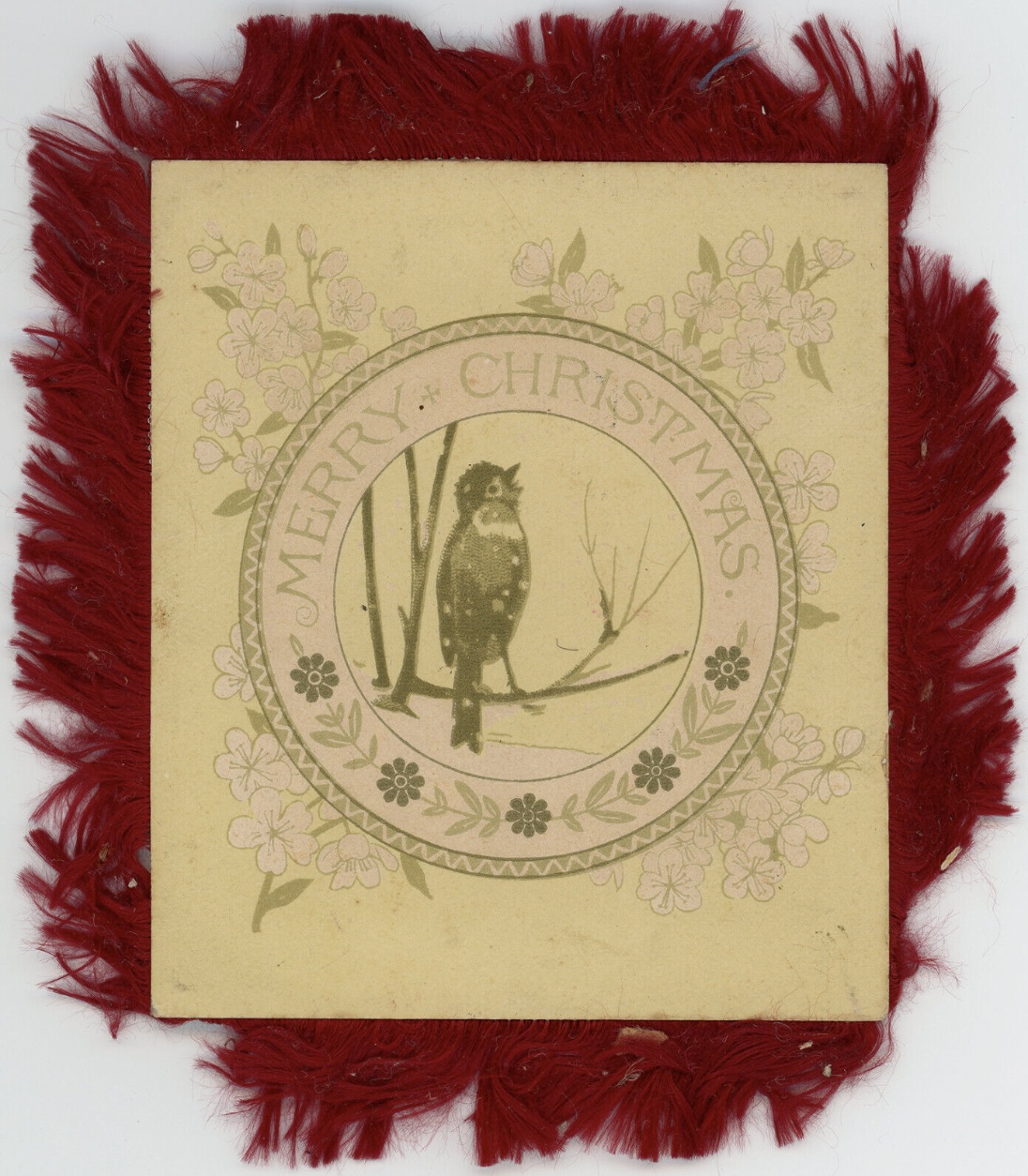
*Originally posted 12/26/2010 + 12/24/2017. Merry Christmas.
Showing posts with label christmas. Show all posts
Showing posts with label christmas. Show all posts
imaginary outfit: jólabókaflóð 2025 + wish-listed books for 2026

The train snakes through the icy mountains, its steady, churning roar breaking the quiet of snow-stilled space. Inside, the traveler gazes idly out the window into the darkening world. An eight-rayed star and glittering snowflake shine from the shoulder of her structured copper cardigan, while wooden adornments dangle from her ears and circle her finger. Slouchy velvet trousers break for a gleam at the ankle, like the rare green flash of sunset, paired with a peculiarly sensible pair of soft shearling shoes. She taps one silvered nail against the glass, then reaches down into a startlingly capacious bag, crammed with things to read. She pulls out a gleaming metal book and opens a marble box of sharpened scented pencils. After ringing the buzzer for a pot of tea and a fresh pear, she turns her attention again to the bag.
Inside, there is Edmund de Waal's "book about archives that is itself archival," Bridget Penney's recreation of a book that "contained enclosures ... and that encompasses all that can be captured through the filter of the writer's gaze and mind," and writings by Jenny Erpenbeck on things that disappear. There is Paul Willem's The Cathedral of Mist, telling of "the emotionally disturbed architectural plan for a palace of emptiness; the experience of snowfall in a bed in the middle of a Finnish forest; the memory chambers that fuel the marvelous futility of the endeavor to write; the beautiful woodland church, built of warm air currents and fog, scattering in storms and taking renewed shape at dusk," and a novel by Maurguerite Young that David Shurman Wallace asserts "eschews any stable sense of reality." He described his emotions reading it:
As I waded through dense paragraphs of long, winding sentences filled with images of stars and waves and angels, of seagulls and silk and butterflies, of dreams and illusions and any other abstraction you can imagine, occasionally I felt angry—on a personal level—at what I took to be the book’s obstinacy, its willingness to reprise what it had said hundreds of times before, not to mention the seemingly endless detours that defy any obvious sense of structure. At other moments, I knew that I was immersed in something beautiful and strange, something too big to understand all at once.
There is also a rare collection of Young's essays with her 1945 piece, "The Midwest of Everywhere," because this is a place, too, that the traveler calls home:
For me, a plain Middle Westerner, there is no middle way. I am in love with whatever is eccentric, devious, strange, singular, unique, out of this world—and with life as an incalculable, a chaotic thing, meaningful above and beyond the necessary and elemental data of my subject ... I am told by commentators both cynical and wistful, those who have never inhabited my regionless region, that we of the Middle West have no Main Stream, no focus, no elite. 'True,' I would answer, 'the Middle West, though it may have a hidden Gulf Steam, has no Main Stream because it is oceanic'—that is, touching on all shores and limitless. There are no boundaries I know of. I have seen, on the grassy ocean, many a lurching ancient mariner—and once, in an Indiana cornfield, a dead whale in a boxcar.
The Middle West is probably a fanatic state of mind. It is, as I see it, an unknown geographic terrain, an amorphous substance, the ghostly interplay of time with space, the cosmic, the psychic, as near to the North Pole as to the Gallup Poll.
There are more hefty tomes to consider: a "death-defying feat of ambition ... a spectacular honeycomb of books within books" and a 544-page monograph on Celia Paul, which recalls to the traveler's mind an afternoon in an airy London gallery being held by painted eyes. A unforgettable exhibit of Surrealist and Romantic work is catalogued, as is "five centuries of stars, dreams, and plenilunes" and 2,000 Japanese rain words. Smaller books fill the corners—late ghost stories by Henry James, a book of "melancholic, wandering castles," another with photographs of hands, and one tense with high-stakes mountain drama.
The traveler thinks. What does she want to read? After all, it is Christmas Eve. Finally, she finds what she is looking for—a book of Yuletide hauntings.
Merry everything, friends.
*
Other jólabókaflóðs (Yule book floods).
*
TOGA PULLA Motif cardigan / Album di Famiglia velvet W & S trousers / Susan Hable ebony drop earrings / early Victorian carved bog oak mourning ring at Erica Weiner / Jean Gerbino cup and saucer, ca. 1950 / Lizzie Ames custom journal cover / Hender Scheme Mouton Henri shoes / Harry and David pears / Choosing Keeping x Perfumer H scented pencils / Maria La Rosa Verdino laminated socks.
candle, snowflake, gingerbread, angel


*
Cecelia Glasher's sketches of snowflakes, ca. 1855.
*
*
Fruit bowl carved by Robert "Mouseman" Thompson, ca. 1950s.
*
From Listen and Hear by Kathleen Shoesmith, 1973, via stopping off place.
*
*
*
A recipe for gingerbread ca. 1395 and gilded gingerbread and mold. The Fitzwilliam Museum.
*
Peter Doig, untitled watercolor, 1999, via le jardin robo.
*
*
Wilson Alwyn Bentley, snow crystal ca. 1910.
*
Merry everything, friends.
branches and wire


Photos of kids in Berlin with Christmas tree branches, 1961. Taken by Paul Schutzer for LIFE and originally posted 12/19/2011, then again 12/22/2017.
imaginary outfit: jólabókaflóð 2024 + wish-listed books for 2025

Where has the time gone? I'm trying to resist feeling frantic; the days have seemed even shorter than usual for December, and many of the things I like to do this time of year are only partway finished or yet to be done. Oh well. They'll be just as enjoyable in the slow week between Christmas and New Year.
I'd like there to be five extra hours in the day today, and I'd love to spend a few of them in a bar—specifically, Auntie Mae's Parlor in Manhattan, Kansas. I stopped there on my big cross-country drive in August, inspired by "Somebody, Somewhere." The drinks were excellent, the atmosphere laid-back, and they had little glasses stuffed with old Trivial Pursuit cards: idyllic. I'd order a whisky sour and sit and read, or at least pretend to read while I eavesdropped on the conversational hum of people drifting in and out. And I'd take along some sort of treat for the folks behind the bar.
What book to bring? Rootling through my to-read pile, which has attained vast and terrifying dimensions, I find novels about questioning perception written by a collective, "weaving, programming, and pioneering women," and a fantasy originally published in 1981. There is a book about faux mountains, another about mountain hoaxes, and a new volume of apologies for stolen rocks. A beautiful edition of two special poems is in the mix, along with a memoir of life with 1,117 pomegranates, recipes for candied fruits, and an exhibition for a show I wish I could have seen. I find this collection of études, though I cannot play them, these photographs of apple trees, and while I'm dreaming, a first edition of Villette. I've somehow turned up a copy of this sold-out work, which is "a loose compendium of photographs and texts that picture, examine, explore, and / or suggest the human body in states of abandon, helplessness, terror, subjugation, serenity, and transcendence" and this "history of feminist designs for American homes, neighborhoods, and cities," described by Paul Goldberg as"full of things I have never seen before, and full of new things to say about things I thought I knew well." And Yoko Ogawa, one my favorite living writers, recommended this two-parter, saying it "portrays with devastating immensity how those on the dark fringes of society can be consumed by the darkness of their own hearts."
Wishing us all the ability to escape the darkness.
Merry everything, friends.
*
Baserange Mea beanie / Atelier Delphine Mana coat in porcini / Vintage wool skirt from Plain Goods / Rodebjer black Cisne ribbed turtleneck / Ersa Dandin mixed pearl earrings / Cirque mother-of-pearl nail polish / The Eleven Associates of Alma-Marceau published by Anomie Press / mendiant shortbread from Nature's Candy / Rosa Mosa Leo shearling clogs / cashmere knee-high socks.
*
Other jólabókaflóðs (Yule book floods).
festive things
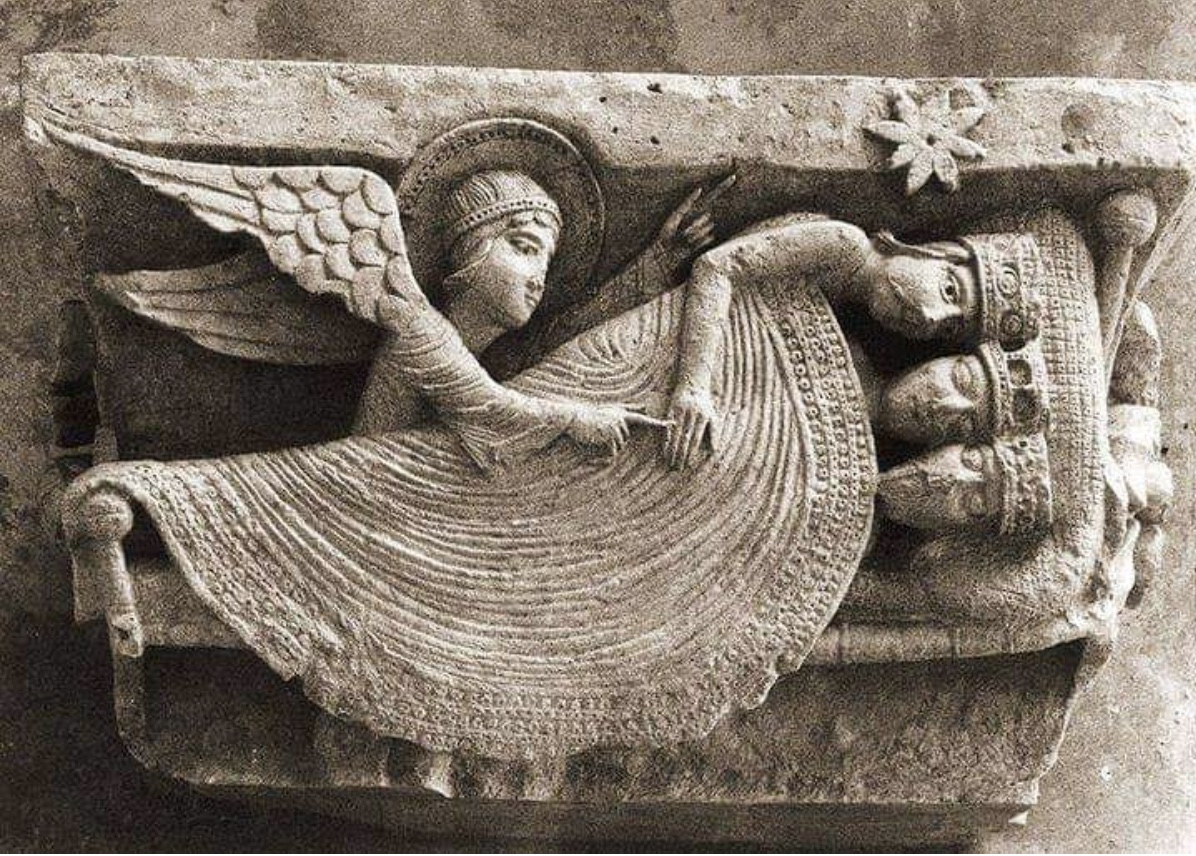


Gislebertus, "Dream of the Magi," circa 1120-30 , Cathedral of Saint-Lazare, Autun, France. Via Stephen Ellcock.
*Mary Delany, "Ilex Aquifolium (Tetandria tetragynia)," from an album (Vol.V, 60); Holly with berries. 1775. Collage of colored papers, with bodycolor and watercolor, on black ink background. The British Museum.
Tacuinum Sanitatis, Milan or Pavia, ca. 1390-1400. Via The Fortnight Institute.
Star Finial, artist unidentified, United States, 1875–1925, paint and gilding on metal, 45 × 22 × 9 in. American Folk Art Museum.
Rivka Galchen, "The Science of Christmas Trees." The New Yorker, 12/6/2022.
*
George Brecht, "A Christmas Play for Joseph Cornell," 1963.
*
Olivier Dassault, "Untitled/Christmas card," 1987. MFA Boston.
*
*
Schreiber pop-up toy theater book, ca.1885. The V & A.
*
*
Holiday dress of my dreams: Rothermal Theater Dress by Bode.
*
*
*
... [W]e are seeing our own mortality in the close of day and year. The hours of sunlight run by more quickly, and we’re left behind in the darkness. It’s hard now to feel the privation of former winters, or experience the desolation of the landscape; it’s not even likely to snow. But we see the trees unleafing, and sense the different strains of winter light: sometimes bright and cold, often thin and misted. Much of our enjoyment of this gauntness is in relief. Fasting for advent used to make a penitence of nature’s dearth, relieved at last by ecstatic abundance. On Christmas Eve congregations would hang the branches of the churchyard trees with apples. In Moscow, they deck avenues of leafless boughs with red and gold baubles, which has the same effect.
Our contrivance of these spots of colour has its roots in nature’s contingencies: red berries on a black branch, an evergreen tree in a field of snow—Ruskin’s lesser beauties perhaps. But it takes a mind to frame them, to put the tree in a painting or a living room. Sometimes novelty itself seems poetic, as though the product of design. ... We aestheticise the tree by changing its setting, or we admire it through a picture. Christmas itself is a removal, separated from the rest of the year by its spangles and pageantry. The season makes us tourists of our own nostalgia; it’s best not to think too hard about the absurdity of chopping down a tree and covering it with tiny ornaments. What do we do with the wanwood when the new year comes? In the 16th century, after the feast and the dancing, the tree would be ceremonially burned, marking the end of festivities with a final brilliant spectacle, which does seem better than leaving it on the street for the council to collect.
Alicia Sprawls, "Christmas Trees." London Review of Books, 1/5/2017.
*
In 1419, the Freiburg bakers’ apprentices noted having seen a tree set up in a hospital, decorated with apples, wafers, gingerbread, and tinsel. In Riga, in 1510, a brotherhood of merchants are said to have set up a tree around Christmastime, then decorated it with thread and straw; they burned it at Lent. Many of the hints of early Christmas-tree—or solstice-tree, or New Year’s tree—traditions come from rules limiting them. A regulation in Upper Alsace specified that each citizen could take from the forest no more than one pine, of a height no more than eight shoes. A 1611 ban against felling trees in the Alsatian town of Turckheim is arguably the first appearance of the term “Christmas tree”: Weihnachtsbaum.
Rivka Galchen, "The Science of Christmas Trees." The New Yorker, 12/6/2022.
*
One thing is for certain—I wouldn’t want to be a Christmas tree. It would be nice to be the center of attention, to be so decorated and lit that people stared at you in wonder, and made a fuss over you, and were mesmerized. That would be nice. But then you’d start dropping your needles and people would become bored with you and say you weren’t looking so good, and then they’d take all your jewelry off, and haul you off to the curb where you would be picked up and crushed and eventually burned. That’s the terrible part. Maybe that’s why so many people today have fake trees. They are quite popular. Their limbs come apart and you can put them in boxes and store them. You can have one of these trees until you die and you can pass them on to your children. They may not be real but when you look at them you can’t tell the difference. That always makes people happy—not being able to tell the difference. And happiness, to want to be happy, is the most natural thing of all.
Mary Ruefle, "Recollections of My Christmas Tree." Harpers, December 20, 2013.
*
See also: Robert Frost, "Christmas Trees."
*
*
Merry everything, friends.
imaginary outfit: jólabókaflóð 2023 + wish-listed books for 2024
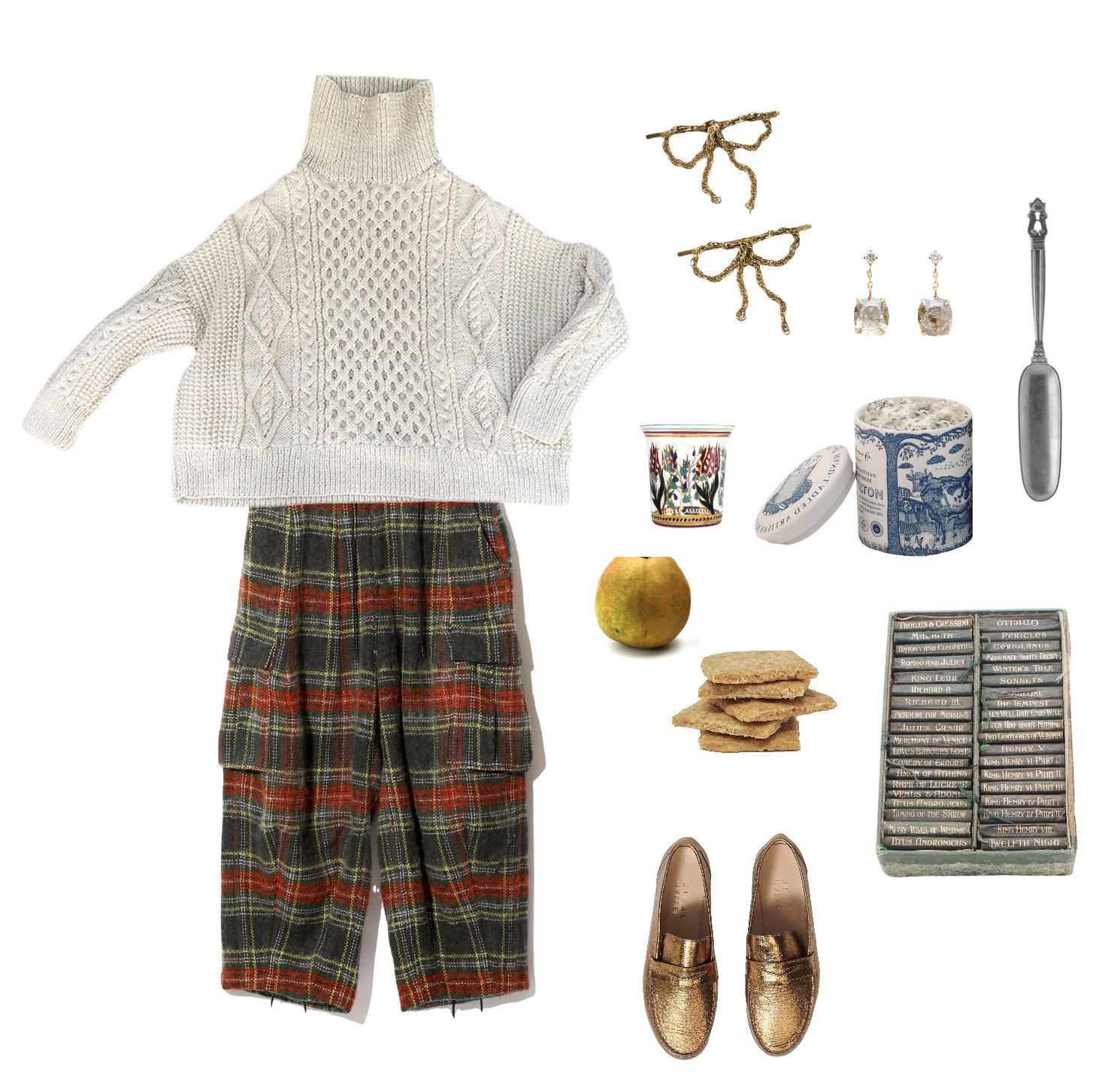
December 24th, and time again for my favorite Icelandic tradition—the Yule Book Flood. So here I am, swaddling myself in knits and plaids and plonking down on the small grey sofa by the fireplace. (Though it is small and upright, it is peculiarly suited to extravagant lolling.) There, in the glow of the Christmas lights and the ambient red heat of the electric fire, with a sharp, salty snack and something to drink to hand, knowing that, finally, everything is wrapped and ready for tomorrow, I'll pick up something to read.
My imaginary to-read shelf is well-stocked. On it, I've finally secured a long longed-for copy of Edith Sitwell's A Book of the Winter, and I have the collector's edition of Michelle Oka Doner's Intuitive Alphabet. Then, there's Alex Arzt's fascination with feral cabbages and Suzie Alan Skunk's Maybe I Think You Stink, a "celebrated work of poetry and skunk culture written by and for the small animal community." Mathias Énard's new novel about "the one day in the year where Death and the living observe a temporary truce" beckons, too. I might while away a happy hour or so learning about the secret lives of stones or exemplary fools or odd jobs, or perusing exhibition catalogs "of the Disappeared, Destroyed, Lost or Otherwise Inaccessible" or Lois Dodd's windows and reflections. There's copy of The Girls, a "wry, macabre tale of simple country living, brutal murder, and a reasonably happy couple" by a "most startlingly offbeat suspense novelist," and Howard Fishman's life of Connie Converse, too:
"Converse was notable for preserving a greater level of obscurity more extreme than any of the others: recordings never commercially available; no connections to any scene or famous figure; being a guitar-playing singer-songwriter (and home-taper) in the early 1950s, before such a thing existed, who played only among friends before dropping out of music in the 1960s and ultimately disappearing shortly after."
(I think I found out about this book through Kelsey Keith's Substack.)
In other Substack recommendations: Jess Stanley's praise of Naomi Klein's Doppelganger landed it on the must-read shelf:
Klein has taken everything frightening in the world—Steve Bannon! Vaccine denial! Fascists! Colonialism and racist scapegoating! Inaction on climate change!—and made the state of the problem clear. Sometimes you just want someone older, wiser and cleverer than you to put your worries in order and point you in the right direction. Klein does this!
More directional reading: Sadiya Hartman, Christina Sharpe, Rinaldo Walcott, and Vicky Osterweil on looting, which Osterweil describes as "a nearly irrecuperable aesthetic gesture against the police, whiteness, and the regime of property that gives those forces power and purpose," and David Graeber's Pirate Enlightenment, or the Real Libertalia, a book about, yes, 17th-century pirates, but also about what Francis Gooding calls "living, practical" experiments in "new ways of organizing social life," not to mention "blood pacts and poisonings, magicians and princesses, off-grid pirate towns on tropical islands, impostor kings lording it over phoney empires, and more."
Back in real life, I'll probably spend the evening in my pajamas with the Penguin Book of Christmas Stories. Italo Calvino and Angela Carter for Christmas—what could be better?
Wishing everyone, everywhere peace and somewhere safe and quiet and calm to read.
*
Aunti Oti fisherman sweater / Needles shaggy wool plaid pants / Lelet chain-bow bobby pins / Satomi Kawakita dangling diamond earrings / Georg Jensen "Acorn" Stilton scoop / Stilton cheese in a ceramic crock / Anthony Treherne & Co. miniature set of Shakespeare / Lobmeyr Persian flower tumbler / Comice pear / Effie's Oatcakes (delicious) / Jamie Haller bronzed penny loafers.
*
Previous jólabókaflóðs!
some books that might be worth giving (or getting)

Me, checking my list and panic-buying books as holiday presents? Nah, it's Parker Posey in "Party Girl."
If you are dealing with specific readers, persnickety readers, the type of person with definite notions about what they will or will not want to read (someone, perhaps, ahem, like me), here are some tailored recommendations. Some are books I read this year. Those I have written about in my newsletter; I've radically condensed reviews from there here, as I've spent the better part of the last month recovering from surgery, and the prospect of a shortcut was too tempting to resist. My apologies if it feels duplicative—hopefully, there is enough freshness mixed in to make it interesting.
Ounce, Dice, Trice by Alastair Reid. A poet's compendium of strange, beguiling, silly, and delightful words (and the first book that made Hugh laugh when he was a baby).
For the macabre:
The Skull by John Klassen. In this droll and deadpan tale, Ottilla is on the run; from what, who can say? She finds a house inhabited by a skull; it is chased nightly by a headless skeleton. With a bucket, a rolling pin, some tea, and some nerve, she finds her way to a happy—or happy enough—ever after. (E*C Digest, 7.21.2023)
Poor Things by Alasdair Gray. Structure is everything in this amazingly gonzo and wickedly entertaining collection of found "historical" documents, including the Frankenstein tale of Bella Baxter, a dead woman brought back to life implanted with the brain from her fetus. Who gets to tell a woman's story? And why is it so much easier to believe a man's lies over a woman's truth?
For readers of The Wager craving additional harrowing shipwreck narratives:
You think crashing on a remote South American island in the 1700s is bad? Ha! Have I got two books for you: Joan Druett's The Island of the Lost (which I am sure I have recommended before but will continue to recommend all of my days) is an eye-popping tale of two shipwrecks on the same Auckland Island. Survivors from each were on the island at the same time, and while one group managed a Crusoe-esque living situation of enviable discipline, startling ingenuity, and ultimately, escape, the others ... did not. If you yearn for even more severe cold and misery, Hampton Sides' In The Kingdom of Ice tells the spine-chilling story of the Arctic-bound Jeannette expedition. The ship was crushed after two years in the pack ice, and the survivors made a bananas thousand-mile journey over the ice to Siberia.
For letter readers:
Letters to Gwen John by Celia Paul. Reading Paul's series of personal letters to her favorite artist, Gwen John, is lulling, almost like ASMR, but there is something formidable beneath the gentleness—the testimony and truth of two women who built their lives around making art and what it cost them to do it.
For amateur mathematicians:
The Housekeeper and the Professor by Yoko Ogawa. A beautiful and idiosyncratic story about numbers creating a pathway to something incalculable between a housekeeper, her ten-year-old son, and a professor whose short-term memory lasts only 8o minutes. (More here: E*C Digest, 2.16.2023)

For small and persistent questioners:
The Little Island, Margaret Wise Brown. This is the picture book we've read more than any other in our family; why this one, I could not tell you exactly. It is a strange and gnomic book about the passage of time and a kitten reaching the limit of what he can know and the place where faith comes in. Leon Wiesgard's beautiful illustrations feel like a time capsule, too; a lost way of seeing and depicting the world.
For the precociously wordy:
Ounce, Dice, Trice by Alastair Reid. A poet's compendium of strange, beguiling, silly, and delightful words (and the first book that made Hugh laugh when he was a baby).
The Swifts, a Dictionary of Scoundrels by Beth Lincoln. A wordy, witty, mordantly clever whodunit for the 8-12 set about escaping the ways your family defines you—in this case, literally, as each Swift is given a name from the family dictionary and expected to live up to it, a prospect that fills Shenanigan Swift with some trepidation. Can she be more than a troublemaker, especially when mysterious accidents begin befalling her kin?
The Girl Who Circumnavigated Fairyland in a Ship of Her Own Making by Catherynne Valente. Twelve-year-old September is whisked away from Omaha to Fairyland on the back of Imogen, Leopard of Little Breezes, by the Green Wind. If that is the sort of sentence that thrills you to your toes, you will love Valente's Fairyland books, rococo narrative confections resplendent with inventive imagination.
For the defiantly young:
Bea Wolf by Zach Weinersmith, illustrated by Boulet. I have read many versions of Beowulf through the years, and none is more delightful than this one, where the tale is recast into an epic confrontation between anarchic childhood and grim age. An absolute pleasure.
For the growing pained:
Franny and Zooey by J.D. Salinger. Franny and Zooey are the youngest of the seven famous Glass children, who were trotted out to perform on the "It's a Wise Child" radio program. Now Franny is in college, and Zooey is an actor on the rise. In these two short stories, Salinger outlines the spiritual crisis that crashes in on Franny—what, exactly, is she supposed to do? And in a world of cruelty, falseness, pomposity, and greed—and Zooey's attempt to help her out. It's maddening, funny, irritating writing that suddenly catches you—well, me at least—up short with heartbreaking wisdom.
For people who get a little too lost in books:
Henry Brocken by Walter de la Mare. One day, riding on his uncle’s horse, Dulcinea, Henry Broken finds himself in a subtly sinister realm beyond the reaches of the ordinary where Jane Eyre and Rochester, Sleeping Beauty and Gulliver, not to mention the peoples of Bunyan’s Pilgrims Progress and Shakespeare’s Midsummer Night’s Dream live in a sort of suspended reality, leaving the reader to question whether knowing how the story ends is really a gift after all. (More here: E*C Digest 5/1/2023.)
For middle-aged witches:
Lolly Willowes, or The Loving Huntsman by Sylvia Townsend Warner. After spending the first part of her life as a resident spinster aunt, Laura Willowes decides to make a change, sparked by a bundle of greenery she picks up in a shop. To the confusion of her staid family, she ups sticks and moves to a remote English village, where she makes a deal with the devil to finally have the life she wants.
For the macabre:
The Skull by John Klassen. In this droll and deadpan tale, Ottilla is on the run; from what, who can say? She finds a house inhabited by a skull; it is chased nightly by a headless skeleton. With a bucket, a rolling pin, some tea, and some nerve, she finds her way to a happy—or happy enough—ever after. (E*C Digest, 7.21.2023)
I Am Homeless If This Is Not My Home by Lorrie Moore. A teacher visiting his dying brother in a New York City hospice goes home to discover his ex, a therapy clown, has committed suicide and been buried; not what she would have wanted. Naturally, he goes to her grave, where there she is, slightly decayed and waiting for him to take her to a forensic cadaver farm. The story of their road trip is interspersed with dispatches from a woman running a boarding house just after the Civil War. Moore, acidly witty, is always ready with one-liners that slap.
Poor Things by Alasdair Gray. Structure is everything in this amazingly gonzo and wickedly entertaining collection of found "historical" documents, including the Frankenstein tale of Bella Baxter, a dead woman brought back to life implanted with the brain from her fetus. Who gets to tell a woman's story? And why is it so much easier to believe a man's lies over a woman's truth?
For the wryly empathetic:
The Unfortunate Life of Earthworms by Noemi Vola. Vola opens this book by recommending against writing a book about earthworms because no one cares about earthworms. But you will, after you read this.
For armchair time-travelers:
Otherlands by Thomas Halliday. An absolutely exhilarating, mind-melting trip back through the history of the Earth that meticulously reconstructs specific ecosystems from different epochs, revealing that everything in our ordinary world is actually a marvelous compendium of time. Watch for the giant penguins!
Life Story by Virginia Lee Burton. Perhaps the most beautiful and breathtaking picture book about how we got here, charmingly framed as an epic play tracing existence from the birth of the sun to the moment you sit, holding this book in your hands. Sarah Larson wrote a lovely review of it in The New Yorker in 2015; a beloved favorite.
For readers of The Wager craving additional harrowing shipwreck narratives:
You think crashing on a remote South American island in the 1700s is bad? Ha! Have I got two books for you: Joan Druett's The Island of the Lost (which I am sure I have recommended before but will continue to recommend all of my days) is an eye-popping tale of two shipwrecks on the same Auckland Island. Survivors from each were on the island at the same time, and while one group managed a Crusoe-esque living situation of enviable discipline, startling ingenuity, and ultimately, escape, the others ... did not. If you yearn for even more severe cold and misery, Hampton Sides' In The Kingdom of Ice tells the spine-chilling story of the Arctic-bound Jeannette expedition. The ship was crushed after two years in the pack ice, and the survivors made a bananas thousand-mile journey over the ice to Siberia.
For letter readers:
Letters to Gwen John by Celia Paul. Reading Paul's series of personal letters to her favorite artist, Gwen John, is lulling, almost like ASMR, but there is something formidable beneath the gentleness—the testimony and truth of two women who built their lives around making art and what it cost them to do it.
Letters to Camondo by Edmund de Waal. De Waal wrote an absolutely extraordinary memoir of his family through the history of a collection of netsuke in The Hare With Amber Eyes. Here, in a series of poignant and shattering letters addressed to Moise Camondo, a banker and collector whose only son died for France in WWI and whose family was murdered by Nazis in WWII, de Waal grapples with the limits of the storytelling and the ways that stories and memoirs fail.
For mycophile wellness hustlers:
The Trouble with Lichen by John Wyndham. Diana Brackley is a brainy, beautiful, pragmatic biochemist who discovers the remarkable property of a rare lichen, and then uses a wellness empire (ha) to set in motion a long-range plan to empower women to reshape their lives—and the world. (More here: E*C Digest, 1.15.2023)
For people contemplating a run for city council:
South Riding by Winifred Holtby. Based on Holtby's mother's experiences in local British government circa 1920-1930, this quietly engrossing book depicts the turbulent flow of ordinary lives with a capacious, unsentimental generosity. It's similar to the magic of Middlemarch but less about the unseen good of individual acts than the imperfect but essential good of community. (More here: 5/2/2022 blog post)
For amateur mathematicians:
The Housekeeper and the Professor by Yoko Ogawa. A beautiful and idiosyncratic story about numbers creating a pathway to something incalculable between a housekeeper, her ten-year-old son, and a professor whose short-term memory lasts only 8o minutes. (More here: E*C Digest, 2.16.2023)
For people interested in AI's roots:
The MANIAC by Benjamín Labatut. In three mesmeric stories, Labatut outlines the costs technology can extract. In the first, Paul Ehrehfest, a physicist driven to despair by developments in the field and the rise of Nazism, takes his own life and the life of a beloved son who was disabled, believing there was no more room in the world for them; in the second, a chorus of voices tells the story of John Von Neumann, the Hungarian-American genius who, perhaps more than anyone else, created the world of computers that we live with now, a world that grew directly out of the development of atomic bombs; the third recounts the defeat of the Go master Lee Sedol by AlphaGo, an AI program. I found it harrowing and absolutely fascinating. Pair it with Turing's Cathedral by George Dyson, the book Labatut cites as an inspiration, which delves more deeply into von Neumann's startling story and the startling stories of the many, many genius minds around him as they played around and developed new tools and methodologies of doom.
For everyone reading the news:
Minor Detail by Adiana Shibli. Two stories of Palestinian women: One in 1949, one sometime in the 21st century, that illuminate with shattering clarity that violence never ends—its aftershocks always reverberate through time, leading to damage and tragedy. (Originally blogged about here on 5.2.2022)
For marveling in humble wonder at the indomitable human spirit and what can be done with words:
The Bridge of Beyond by Simone Schwarz Bart. One of the most wondrous books I have read in a long, long time. It tells the story of Telumee Lougandor and the women in her family and their lives in Guadeloupe in the aftermath of slavery. It lifted me right out of my own life and way of thinking, like someone opeing a hidden door and saying, see? Here is a whole other world, and whole new ways of using words. The way that Schwarz-Bart shows the depths of the resilience, community, and joy in the Lougandor women’s lives is awesome, in the sense of an encounter with something sublime. (More here: E*C Digest, 1.25.2023)
Lois Lenski with the last word:
glad tidings


Streeter Blair, Pasture in Winter, 1960. Hirshhorn Museum and Sculpture Garden.
*
Detail from Is This You? by Ruth Krauss and Crockett Johnson, via Mac Barnett.
*
*
*
Vanessa Bell, hand-painted calendar for friends from 1951.
*
Milton Avery, Pinecones, ca. 1940. The Phillips Collection.
*
Robert Watts, Xmas Event, 1962.
*
Detail from a Christmas card in the collection of Robert E. Jackson.
*
*
'What Josephine said,' explained Robert, 'was simply that it would be pretty to put candles on one of the growing trees, instead of having a Christmas-tree indoors'....
Soon they were busy round a prickly fir-tree at the end of the lawn. Jim stood in the background vaguely staring. The bicycle lamp sent a beam of strong white light deep into the uncanny foliage, heads clustered and hands worked. The night above was silent, dim. There was no wind. In the near distance they could hear the panting of some engine at the colliery.
'Shall we light them as we fix them,' asked Robert, 'or save them for one grand rocket at the end?'
'Oh, as we do them,' said Cyril Scott, who had lacerated his fingers and wanted to see some reward.
A match spluttered. One naked little flame sprang alight among the dark foliage. The candle burned tremulously, naked. They all were silent.
'We ought to do a ritual dance! We ought to worship the tree,' sang Julia, in her high voice.
'Hold on a minute. We'll have a little more illumination,' said Robert.
'Why yes. We want more than one candle,' said Josephine.
But Julia had dropped the cloak in which she was huddled, and with arms slung asunder was sliding, waving, crouching in a pas seul before the tree, looking like an animated bough herself.
Jim, who was hugging his pipe in the background, broke into a short, harsh, cackling laugh.
'Aren't we fools! he cried. 'What? Oh, God's love, aren't we fools!'
*
On Christmas Eve, we build a fire, then snuff it out with an old wet towel, realizing, fearfully, that we haven’t cleaned the flue in five years. Then the boiler breaks down. We plug in the space heaters. We order takeout Chinese. Only then, when almost all is lost and I am feeling so unexpectedly sad, do I realize what a sucker I am for the beautiful fake Christmas that German-American commerce concocted for us years ago. A boon for the economy and a pernicious sweet for the mind. But it moves me. My heart is a chump. I actually like the shopping, the gift wrap, the carols—even the tinkling store music. I like the invented holiday miracles, the unexpected kindnesses and transformations—at least, as they are portrayed on the TV specials! And, looking out the window and seeing only sleet, I realize that I even like the snow. Where, now, is that lovely perfect Christmas? On whose open fire are those goddam chestnuts roasting? I have a fiction writer’s weakness for fiction. It’s an occupational hazard. A business thing.
Lorrie Moore, "Chop-Suey Xmas."
*
Well, why anything? Why do we? Come every year sure as the solstice to carol these antiquities that if you listened to the words would break your heart. Silence, darkness, Jesus, angels. Better, I suppose, to sing than to listen.
John Updike, "The Carol Sing."
*
Despite the forecast's promise,
It didn't snow that night;
But in the morning, flakes began
To glide all right.
Not enough to cover roads
Or even hide the grass;
But enough to change the light.
Bernard O'Donoghue, 'Christmas.'
*
Making orange peel and clove beeswax candles; a garland of straw stars.
*
Merry everything, friends.
a christmas carol: louis armstrong - white christmas
Posted waaaaay back on 12/19/ 2010. It's snowing, so it looks like it will be a white Christmas here.
Wishing you coziness, comfort, and rest however you can find them in these last few days of 2020.
gifts of comfort and connection




An extra-thick pot designed to hold warmth.
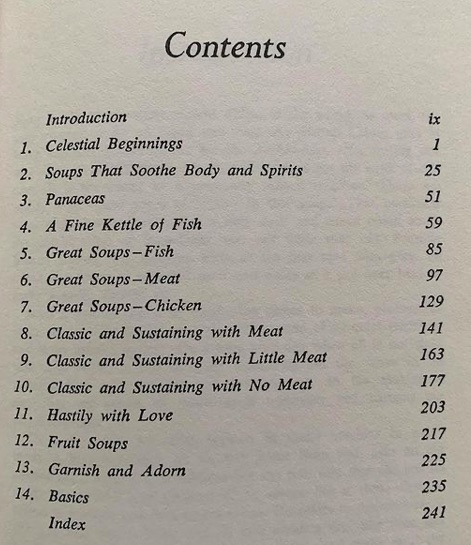
A cookbook with recipes for all the necessary soups.
A friendly handkerchief.
Fruit and flower jam to eat with cheese or toast.
A glass hanging to brighten an outlook.
A handwritten letter that doubles as a bouquet.
Rings with an unbreakable connection.
Subscribe to:
Posts (Atom)