Showing posts with label the metropolitan museum of art. Show all posts

'irrational infinity'


Before we left New York, I went to the Met a few times to spend some hours with the zellij-tiled dadoes in the Moroccan Court.

To make them, tens of thousands of clay tiles were hand cut into one of seventy shapes, then fitted into place, creating an intricate mosaic of repeating pattern (you can watch the mesmerizing process here). Though the overall pattern repeats, the subsidiary patterns-within-the-pattern are what captivate me: repeating circles and squares, rayed stars and labyrinthine lines. They appear and recede, lost and found as my attention wanders.


I still find myself thinking about them. I imagine kilns fired with olive pits and sawdust. I think about anonymous hands marking and chipping each tile, one at a time, thousands of times, then the puzzle-work of setting each piece in place, facedown in reverse. I am curious about the why of these tiles and patterns. A NYT article on the construction of the court notes that "the tiles’ traditional function is to soften the solidity of the walls" and quotes Jonas Lehrman: “The surface is seemingly dissolved, yet throughout the entire organization, even the smallest units are related by the overriding discipline of the geometry.” An Architectural Digest blog post cites Wijdan Ali's The Arab Contribution to Islamic Art: "The proliferation of arabesque abstract decoration enhances a quality that could only be attributed to God, namely, His irrational infinity ... The pattern of the arabesque, without a beginning or an end, portrays this sense of infinity, and is the best means to describe in art the doctrine of tawhid, or Divine Unity.”

Irrational infinity expressed through the discipline of geometry — it's wonderful, in the truest sense of the word.

with cubs


Jean-Léon Gérôme: Tiger and Cubs, ca. 1884.

Another treasure at the Met, on view in Gallery 804.


Schoolchildren in the Metropolitan Museum of Art:

Camp Fire Girls art study hour, 1928.
Student artist at work, 1910.
In the Egyptian Art galleries, 1912,
In the painting galleries, 1917.

All © The Metropolitan Museum of Art.

More here.

imaginary outfit: masterpieces


Why do I like to go look at art?

I wonder about this. I don't feel I know much about it, even after a lot of looking at it or thinking about it or blogging about it. If I had to define it, I'd stumble. I don't have any sort of rigorous academic background that lets me ground what I am looking at into a theoretical framework, or a technical background that gives me insight into how something is made. A lot of it I just see with dumb wonder.

What I like is the shapes it leaves in my mind. For me, this is something that only happens when I see something in person. I look at lots of art on the internet, but digital images are usually outlines, a neat, discrete shorthand for something more. You can like them, but you can't really trust them.

Earlier this year, I read two biographies of Anna Akhmatova. She wrote poems through shattering times. To read those poems and even the barest outline of her life is profound. Her biographers were passionate and thorough, and yet they didn't capture any of the wonder of this. The capacity was lacking. Something within them had responded to her, her life. They had individually dedicated hours - years - in trying to communicate that response through biography, and in the end all they could create was a massive litany of fact. It was painful reading - the product of a thwarted, twisted sort of creative urge. I drove on through it, though, because I was in the same place. Something in her, in her poems, made me need more, even if it was just mediocre biography.

It's a difficult thing to lack the form of expression. There are the golden among us - the people who can create, can conjure worlds in words or paint or music, can give shape to whatever hides in their mind or soul - and I suppose there are people who could care less about creating anything. But then there is the painful middle - those without a vent. I think of the Christmas carol verse 'repeat the sounding joy.' Sounding joy, as if our souls were bells. When I read or listen or look at certain things, I feel a sounding joy. Something inside echoes and creates the ghost of a wished-for form. There's nowhere for it to go, no way to share it, but it's there, and it gives me a little edge of divinity, the smallest share of creative genius.

That's the best answer I have.

ceilings


Plaster ceiling by Joseph Rose for the dining room of Lansdowne House, ca. 1765-1768.

Makes me think of very fancy cake.

imaginary outfit: the museum within the museum


If the Met is Italy, the Robert Lehman Wing is the Vatican - an internal, independent affiliated state with its own rules and logic.

Walking through the first time is an exercise in disorientation. Museums are sorted places with a definite rationale you internalize as you go along walking sedately through historical epochs and artistic periods. To wander into the Lehman Wing is to step out of one order into another. If you've been taking photos, you have to stop - no pictures. It's full of things that seem to be misplaced - Matisses, Renoirs and van Goghs separated from their fellows in the European Painting galleries, quantities of Venetian glass, tapestries, and Louis XV armchairs orphaned from the Decorative Art wings, relics and antiquities and Renaissance madonnas - and everything is mixed (and packed) together. Depending on your mood and blood sugar level, it's either energizing or enervating.

The story is that Lehman left his collection to the Met on the condition that it stayed intact and was displayed as a whole, so they built him a wing of his own - a museum within the museum. They even decorated the galleries to replicate the feel of his house on 54th street. That's clout.

Strolling through always makes me feel fancy and a little fusty, like the kind of person who might collect Majolica planters and glass paperweights and wear ballet flats with golden toes. 

crystal bellies, manticores + dour infants


From top: 

Attributed to Master Heinrich of Constance. The Visitation. Walnut with paint, gilding, and rock crystal cabochons. 1310 - 1320. (Fun fact: the crystal covered cavities in the bellies of Mary and Elizabeth may have originally allowed glimpses of the fetal Jesus and John the Baptist.) 

Hard-paste porcelain figure of a manticore. Austrian (Vienna), Du Paquier factory, ca. 1735.

Jean-Joseph Carriés (1855-1894): The Infanta. Glazed stoneware. 1890-1894.

very old things


From top to bottom:

Limestone mortar and pestle. Syria. Neolithic period: late 8th millennium B.C.
Anthropomorphic pebble figure. Limestone. Israel. Neolithic period. Late 7th millennium B.C.
Jug with concentric circles. Northwest Anatolia. 2700-2400 B.C.
Monstrous male figure (that’s actually what the tag reads). Central Asia or Iran. Late 3rd - early 2nd millennium B.C.
Cube weights from the Indus Valley. 2600 - 1900 B.C. (Like agate dice. I love these especially.)
Gold dog pendant (fantastically tiny - no bigger that the tip of my little finger). Mesopotamia or Iran. 3300-2900 B.C.
Carved ivory pomegranate (it is about the size of an acorn). Neo-Assyrian. 9th-8th century B.C.

imaginary outfit: the egyptian galleries


Making yourself at home in a city like New York is surprisingly easy and deceptively hard. It's big but not private. There are a million places to see and 8 million people to share them with. Finding a place for yourself takes doing.

My home away from home is The Metropolitan Museum of Art. The city is full of amazing museums, but it's the one I find most comfortable. I visit about once a week. It feels like stepping into the home of some carelessly grand, insanely wealthy, and slightly eccentric relation who lets you rifle through her jewel box. It's ideal for wandering, because seeing everything is an impossibility. There is always something new to notice.

The first three or four times I visited, I couldn't get past the Egyptian galleries. They pulled me in like an iron filing to a magnet (it's not just me - the lines to go in those wings are always the longest). If you have never been, to walk through them is to wonder that anything is left in Egypt at all. There are 36,000 objects in the collection - everything from temples to tombs, sphinxes to sarcophagi, ancient raisins shriveled like gravel, string after string of beads sifted from the sand, tiles from faience factories, painter's palettes, tiny hippopotami, unused inlays, golden toe caps, wig rings and makeup applicators - all arranged in a warren-like cluster of rooms, some large and grand, some very small. Long, narrow galleries snake back and through the space, taking you through hundreds of years of history in a few short feet. It's not excellent for hurrying, but that suits me fine.

The study galleries are my favorite - little pocket rooms tucked off to the side and packed floor to ceiling with shelves full of objects that aren't quite special enough to merit a place of honor, but are too wonderful to hide - boxes of gold leaf, fragments of statues, cast-offs from a bead factory. I look at those shelves and imagine armies of men and women making each item, using them, breaking them, discarding them ... and then, thousands of years later, another army of men and women painstakingly searching, treasuring, cleaning and cataloguing each one.

I can't get enough it. After I visit, I always dream of Cairo.

egyptians


A very, very few of the objects on view in the Met's Egyptian galleries. From top:

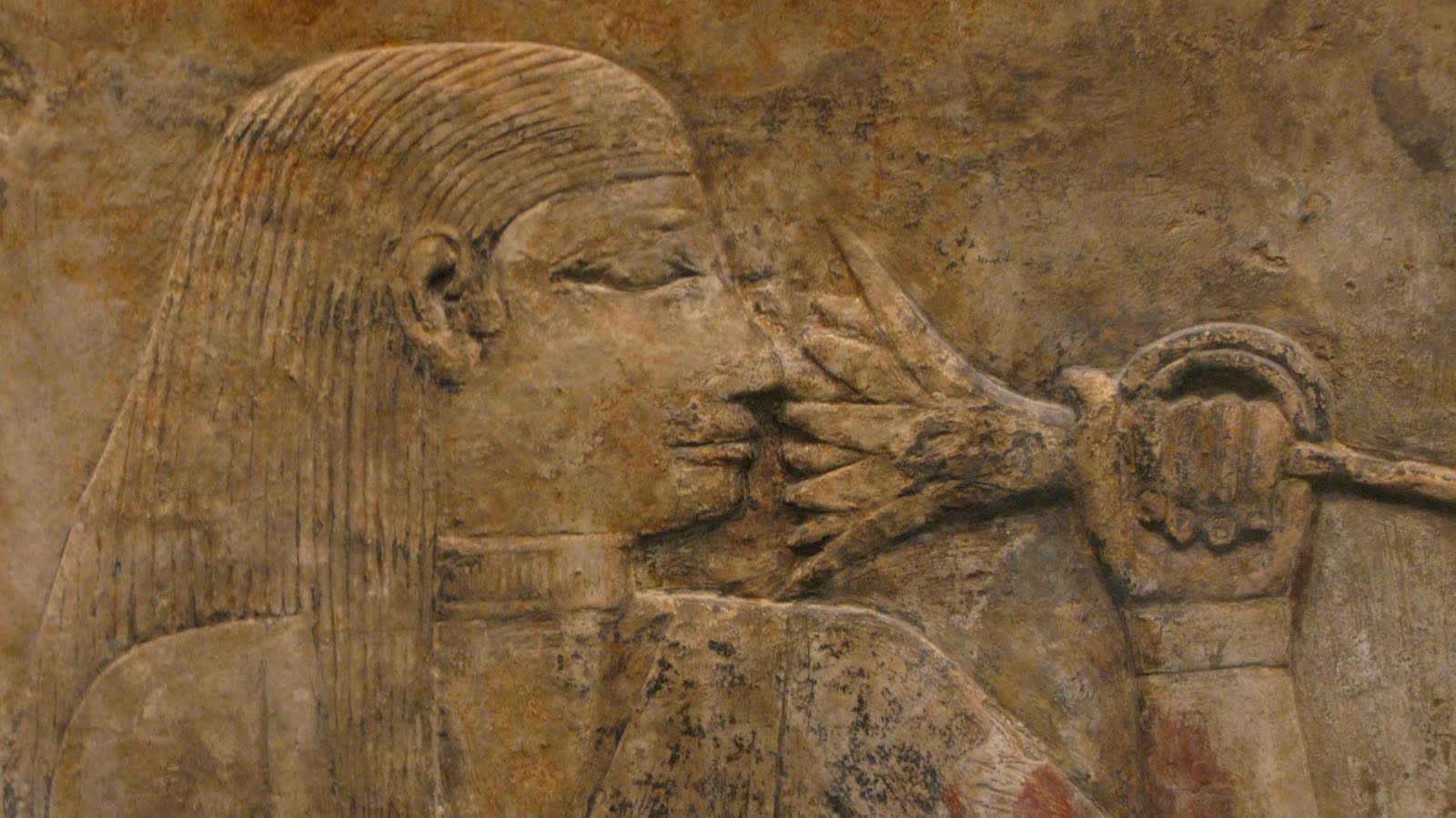
Niankhwadjet inhales a lotus (limestone detail from a false door). 2575-2520 B.C.
A spouted bowl (2649-2465 B.C.) and two plates (ca. 2750-2649 B.C.).
Blue-green faience wall decoration from the funerary apartments of King Djoser, ca. 2630-2611 B.C.
Feet of the Overseer of the Granary Kaiemsenuwy, 2345-2181 B.C.
Assorted hippos
Scarabs from Dynasty 18
Raisins, dates, figs + pomegranates from the tombs of Hatnofer and Amenhopte.
Gold fragments from the North Pyramid Cemetery. 1971-1668 B.C.
Linen sheets from the reign of Hatshepsut. 1479-1548 B.C.
Storage jars from the reign of Thutmose III. 1479-1425 B.C.
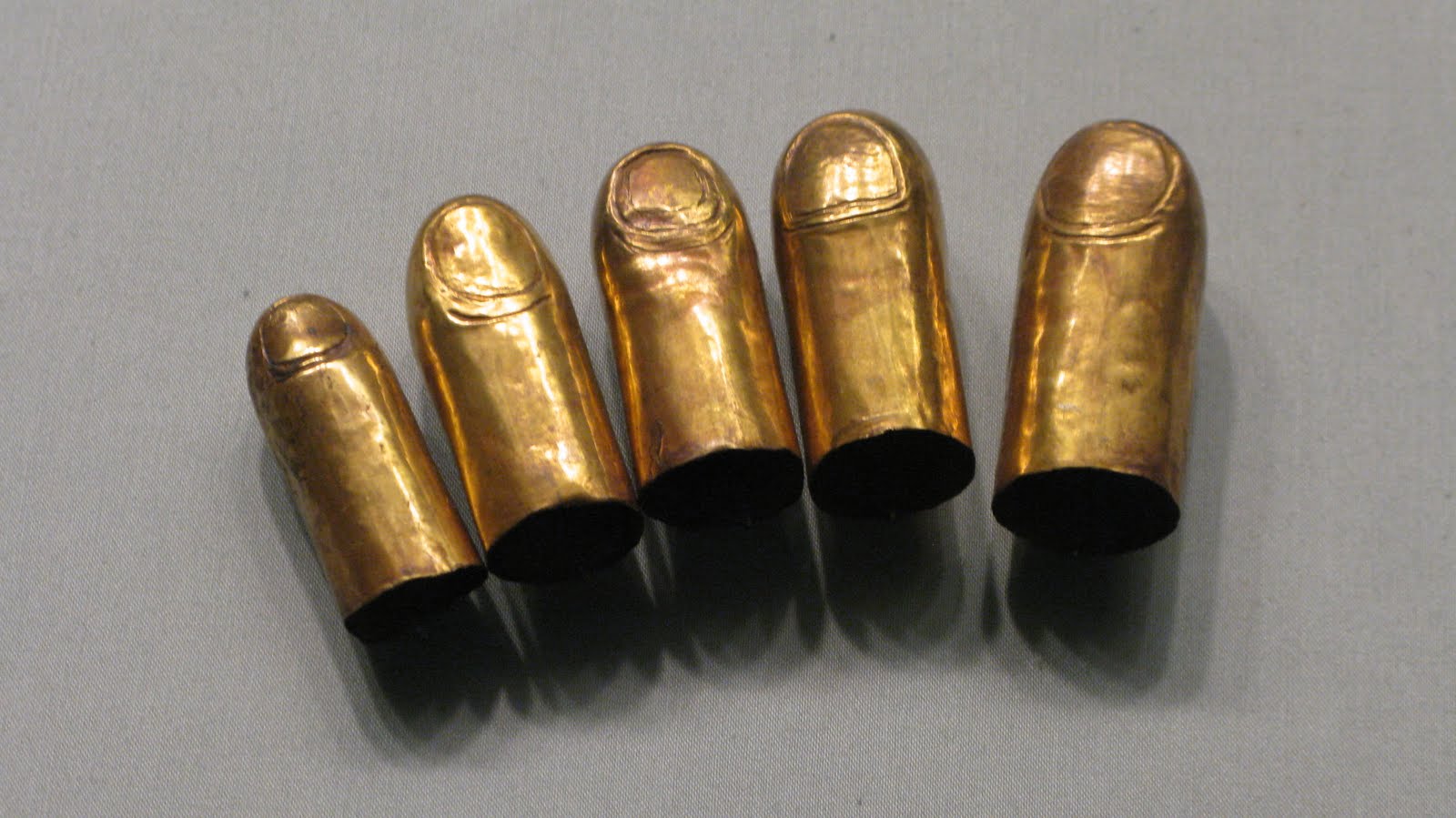
Gold toe caps from the tombs of the three minor wives of Thutmose III. 1479-1425 B.C.
Statuary fragment from the Great Temple of the Aten at Amarna, 1353-1336 B.C.
Lotus blossoms
A detail of a block from the sanctuary in the Temple of Mentuhotep II at Deir el-Bahri, 2010-2000 B.C.
View of Study Gallery 120
Assorted wing fragments
Faience inlay of a hawk from the Ptolemaic period
Mummy wrappings, A.D. 80-100

Claudia knew that she could never pull off the old-fashioned kind of running away. That is, running away in the heat of anger with a knapsack on her back. She didn't like discomfort; even picnics were untidy and inconvenient: all those insects and the sun melting the icing on the cupcakes. Therefore, she decided that her leaving home would not be just running from somewhere but would be running to somewhere. To a large place, a comfortable place, an indoor place, and preferably a beautiful place. And that is why she decided upon the Metropolitan Museum of Art in New York City.
E.L. Konigsburg, From the Mixed-up Files of Mrs. Basil E. Frankweiler.

Like Claudia, the Met is my destination of choice for running away. I get there as often as I can.

a postcard from the met


Old postcard with a view of the Metropolitan Museum of Art's 5th Ave. front. H. C. Leighton Co., Publisher.

Via the NYPL.

this weekend


Goofing off. Also:
Happy weekend.

Photo by Ruth Orkin: Woody Allen at The Met, 1963.