Showing posts with label snails. Show all posts

silvered flowers, beehive bonbons, and a deck of rainbows/gifts some mothers may enjoy


The Shenandoah Mansions linen robe (and/or the matching pajamas and eye mask) by Desmond & Dempsey and Ash Hotels.

Beehive bonbons from Shane's Confectionery filled with honey and black sesame praline.

[A] series of obscure and eccentric English garden-makers who, between the early seventeenth and early twentieth centuries, created intensely personal and idiosyncratic gardens. They include such fascinating characters as the superstitious antiquary William Stukeley and the animal- and bird-loving Lady Read, as well as the celebrated master of Vauxhall Gardens, Jonathan Tyers, who created ... one of the gloomiest and most perverse anti-pleasure gardens in Georgian England. Others built miniature mountains, shaped topiaries, displayed exotic animals, excavated caves, and assembled architectural fragments and fossils to realise their gardens ...


A snail sketch print by Annette Messager, "Locus Solus XIII," because, snail-like, mothers have the power to carry home with them.

An album worth blasting on the way to and from pick-up.

Bienamé hand creams that smell like life in bloom, the color red, or happy days.

Peaceful girl with fist charm by Leith Clark x Catbird (I like to think she is catching a star).


*

Related posts: choosing motherhood / what's possible / true colors

Other gifts some mothers may enjoy: 2017 / 2018 / 2019 / 2020 / 2021 / 2022 / 2023 / 2024 / 2025

a scattering of leaves and petals and sharp and shiny objects / gifts for mothers


A globe for keeping flowers in water, by Jamjar Edit x Skye Corjewin.


A book that is like a walk in the woods: On Listening to Trees, by Albarrán Cabrera, via C4 Journal.


Cuff covers, for reaching into thickets, and Tajika scissors (for flowers or branches) to make strategic cuts.


Pencils that smell like evergreens, or Moro Dabron's Vita perfume, meant to conjure "the Elizabethan tower of Sissinghurst Castle in the 1930s, where writer and poet Vita Sackville-West spent a great deal of her time writing surrounded by old books, period wood, fresh flowers and cuttings from the magnificent gardens which the room overlooked ..."

A key ring from Ark that says it all.

*

Other gifts some mothers may enjoy: 2017 / 2018 / 2019 / 2020 / 2021 / 2022 / 2023


beastly gifts


A set of three Gustavsberg ceramic owls, to wink knowingly.

A Couperier Coursolle rabbit pocket-knife.

Jim Nollman's experiments in interspecies communication, featuring "300 turkeys, 12 wolves, [and] 20 orca whales."

A deck of cards adorned with a menagerie of extinct animals.

A stainless steel fish flask, for drinks to go.

House of Hackney's tigerish loveseat (or, somewhat less grandly but still extravagantly, a tasseled tiger pillow).

A swan pencil-sharpener, for serene sharpening.

Winona Irene's black kitty, to claw back stray tresses, and Catnip, a magazine for cat lovers edited by a person allergic to them (me!).

Brass snail knobs, for gastropodic gleam.

Socks with squirrels, in every size.

The Golden Mole, a "lavishly illustrated collection of the lives of some of the Earth's most astounding animals" by Katherine Rundell. (I'll read anything she writes—an amazing writer.)

One of Alexis Stiteler's creaturely hand-drawn sweatshirts (next drop Sunday, December 10 at 4:00 pm ET.)

A vintage cast-iron monkey hook, for hanging around.

Mosaic scarab ring, because beetles are gem-like beauties.

Natalie Lete's fish belt bag, made to swallow phones and keys.

British Colour Standard's wolf's head candle, for light with bite. 

Cactus Shop's license-plate tribute to slime mold, because being a mammal isn't everything.

*

One more indulgence: These funny gift guides are an annual delight to compile for all of you anonymous folks out there. I don't make any money from them—no affiliate links, no placements, nada! I'm an online renegade!—but if they have brought you joy or amusement, please consider making a donation to Doctors Without Borders. I'm donating what I can, too, and holding the people of Palestine, Ukraine, and Sudan in my heart. Thank you.

odds and ends / 10.12.2023


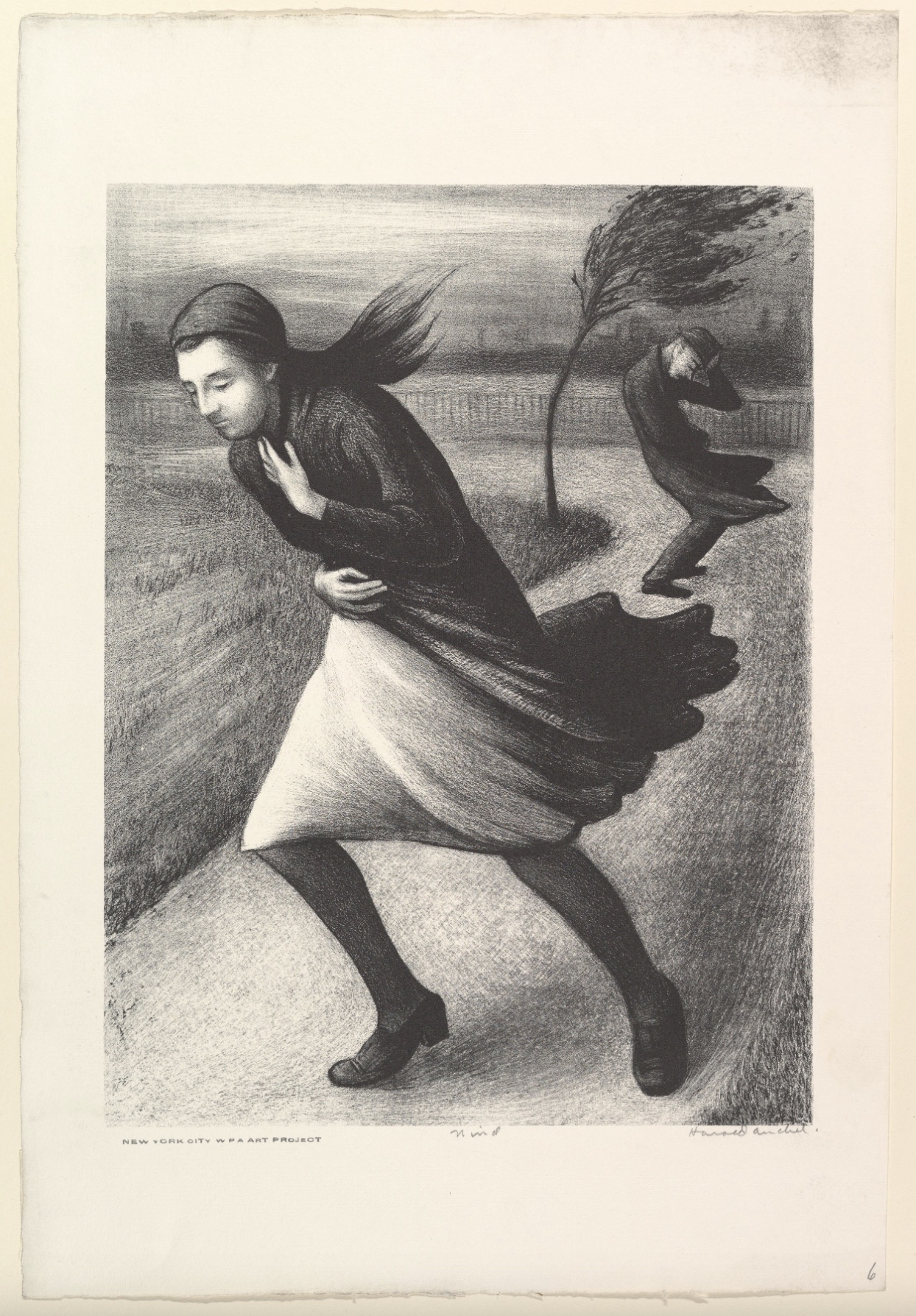
Harold Anchel, Wind. 1935-1943. The Metropolitan Museum of Art.

*

Glove, ca. 1840-1880. Bronze and paint, 1 1/8 × 7 7/8 × 4 7/8". The Menil Collection, Houston.

*

Osborne's Superfine American Water Colours travel set ca. 1830, via criticalEYEfinds.

*

Melissa Catanese, Figures #6, 2021.

*

Still from Himali Singh Soin's "The Spiral," via Ignota Books

*
It has long been the task of the humane left to reject the line of reasoning that would sacrifice civilians on the altar of 'historical inevitability,' whether in its Stalinist or Third Worldist guise—to protest the idea that untold innocents must die in the service of some grand telos. The humane left insists instead on the possibility, on the moral imperative, of bending what others take to be history’s iron tracks. The humane left’s north star is no flag or banner but the unflinching belief in the inherent, even divine, worth of every human life.

After all, it is this same belief out of which the humane left stands in steadfast opposition to Israel’s occupation of the West Bank and siege of the Gaza Strip, that drives our opposition to Israel’s ongoing bombardment of Gaza, our protests against the injustices of apartheid, our demands for a long-term and equal resolution to this conflict. Just as the humane left abhors Hamas’s attack and demands the immediate release of the hostages, the humane left rejects with all its force the exterminationist logic now promulgated by officials in Netanyahu’s government and right-wing politicians in the United States. There is no contradiction here. The left must be humane, or it is no left at all.

*


*
On December 15, 1811, the London Statesman issued a warning about the state of the stocking industry in Nottingham. Twenty thousand textile workers had lost their jobs because of the incursion of automated machinery. Knitting machines known as lace frames allowed one employee to do the work of many without the skill set usually required. In protest, the beleaguered workers had begun breaking into factories to smash the machines. “Nine Hundred Lace Frames have been broken,” the newspaper reported. In response, the government had garrisoned six regiments of soldiers in the town, in a domestic invasion that became a kind of slow-burning civil war of factory owners, supported by the state, against workers. The article was apocalyptic: 'God only knows what will be the end of it; nothing but ruin.'

Kyle Chayka, "Rethinking the Luddites in the Age of A.I." The New Yorker, 9/26/2002. 

*
The knitting machines which provoked the first Luddite disturbances had been putting people out of work for well over two centuries. Everybody saw this happening—it became part of daily life. They also saw the machines coming more and more to be the property of men who did not work, only owned and hired. It took no German philosopher, then or later, to point out what this did, had been doing, to wages and jobs. Public feeling about the machines could never have been simple unreasoning horror, but likely something more complex: the love/hate that grows up between humans and machinery—especially when it's been around for a while—not to mention serious resentment toward at least two multiplications of effect that were seen as unfair and threatening. One was the concentration of capital that each machine represented, and the other was the ability of each machine to put a certain number of humans out of work—to be ''worth'' that many human souls. What gave King Ludd his special Bad charisma, took him from local hero to nationwide public enemy, was that he went up against these amplified, multiplied, more than human opponents and prevailed. When times are hard, and we feel at the mercy of forces many times more powerful, don't we, in seeking some equalizer, turn, if only in imagination, in wish, to the Badass—the djinn, the golem, the hulk, the superhero—who will resist what otherwise would overwhelm us? Of course, the real or secular frame-bashing was still being done by everyday folks, trade unionists ahead of their time, using the night, and their own solidarity and discipline, to achieve their multiplications of effect.

It was open-eyed class war.

Thomas Pynchon, "Is It O.K. to be a Luddite?" The New York Times, October 28, 1984. 

*
At this crisis certain inventions in machinery were introduced into the staple manufactures of the North which, greatly reducing the number of hands necessary to be employed, threw thousands out of work and left them without legitimate means of sustaining life. A bad harvest supervened. Distress reached its climax. Endurance, overgoaded, stretched the hand of fraternity to sedition. The throes of a sort of moral earthquake were felt heaving under the hills of the northern counties. But as is usual in such cases, nobody took much notice.

Charlotte Bronte, Shirley

*
This movie deals with the epidemic of the way we live now.
What an inane card player. And the age may support it.
Each time the rumble of the age
Is an anthill in the distance.

As he slides the first rumpled card
Out of his dirty ruffled shirtfront the cartoon
Of the new age has begun its ascent
Around all of us like a gauze spiral staircase in which
Some stars have been imbedded.

John Ashbery, "This Configuration." The Paris Review, Issue 79, Spring 1981.

*

"It is not true that love makes all things easy: it makes us choose what is difficult."

vegetation's juggler

The mushroom is the elf of plants
At evening it is not;
At morning in a truffled hut
It stops upon a spot

As if it tarried always;
And yet its whole career
Is shorter than a snake's delay,
And fleeter than a tare.

'T is vegetation's juggler,
The germ of alibi;
Doth like a bubble antedate,
And like a bubble hie.

I feel as if the grass were pleased
To have it intermit;
The surreptitious scion
Of summer's circumspect.

Had nature any outcast face,
Could she a son contemn,
Had nature an Iscariot,
That mushroom,—it is him.


model lovers


According to the nineteenth-century American zoologist Louis Agassiz, the snail is “a very model lover” that “will spend hours…paying attentions the most assiduous to the object of [its] affections.” But there is a sting in the tail of snail romance, for as explained by another nineteenth-century observer, the courtship of snails “realises the Pagan fable of Cupid’s arrows, for, previous to their union, each snail throws a winged dart or arrow at its partner.”
Tim Flannery, "Tigers, Humans, Snails." NYRB Volume 58, No. 2, February 10, 2011.

Photo: Christer Strömholm - Jura, 1949.