Showing posts with label eclipse. Show all posts

gifts for the spaced-out


A glassy glimpse of celestial bodies by ilikoiart, for extraterrestrial gazing.

An eclipse viewer made for the total solar eclipse of January 4, 1925: "Of all the wonders of astronomy, there is no spectacle more fascinating than the total eclipse of the sun."

One solar system for suspending (Tour D'Horizon solar system mobile) and another one for wearing (Kapital Universe gabbeh scarf).

A bottle of ink the color of moon dust—Jacques Herbin Pouissiere de Lune

A Keplerian solar telescope, for spotting sunspots.

A dish of stars, by Astier de Villatte.


The 2025 Sora daily calendar, for keeping track of lunar phases.

A top made of vintage Japanese embroidered silk Obi that shimmers like starlight, from Stitch and Tickle.

Marking Time by Chris McCraw, for seeing the mark of the sun, or this book by Emily Sheffer, for seeing the mark of the moon.

An Astroblaster, for demonstrating gravitational rebound (and understanding supernovas).

fragrance based on a scent NASA developed "to train astronauts on how Outer Space actually smells."

Dendera's double-layered shifting maze, for navigating ancient constellations.

A card by Noat that tells it like it is. (There are stars inside.)
'eclipse was all we could see'


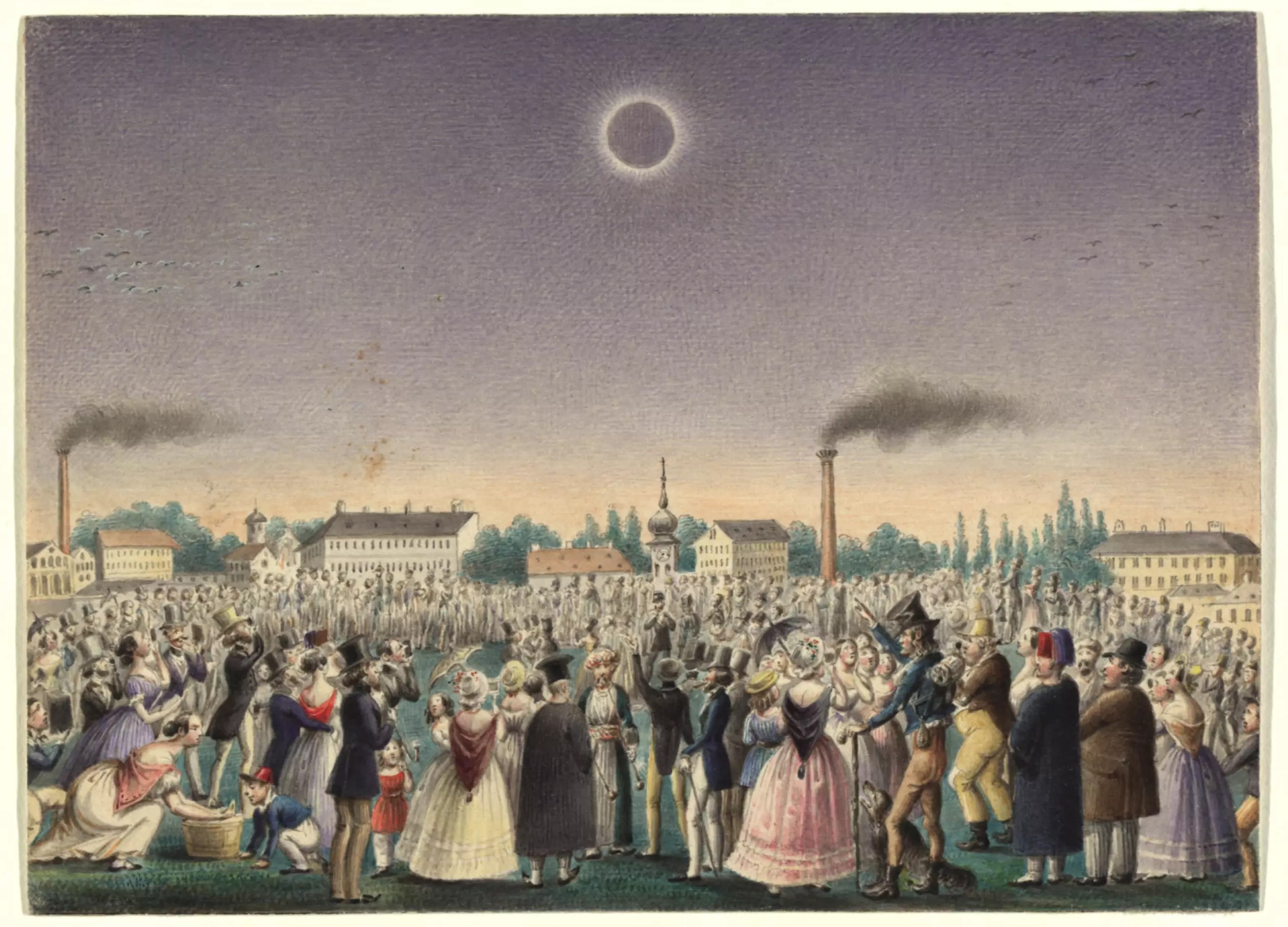
Johann Christian Schoeller, "Sonnenfinsternis, 8. Juli 1842." Wien Museum.

*

John Parker Davis, "Looking at the Eclipse (After Winslow Homer)," 1865. Clark Art Institute.

*


*

Joseph Cornell, "Portrait of Emily Brontë," 1962. The Hudson River Museum.

*

Emily Dickinson archive, Amherst manuscript #256.

*

Crescent-shaped shadows on the snow in the mountains in Bernalillo County, New Mexico, caused by a solar eclipse, photographed by Lee Russell in 1940. New York Public Library Digital Collections.

*

GIFs from Georges Méliès L'éclipse du soleil en pleine lune (The Eclipse: Courtship of the Sun and Moon) from 1907.

*
At one o'clock almost half the sky was blue—two o'clock, and the moon had already bitten a small piece out of the sun's bright edge, still partly obscured by a dimly drifting mass of cloud.

A penetrating chill fell across the land, as if a door had been opened into a long-closed vault. It was a moment of appalling suspense; something was being waited for—the very air was portentous.

The circling sea-gulls disappeared with strange cries. One white butterfly fluttered by vaguely. Then an instantaneous darkness leaped upon the world. Unearthly night enveloped all.

With an indescribable out-flashing at the same instant the corona burst forth in mysterious radiance. But dimly seen through thin cloud, it was nevertheless beautiful beyond description, a celestial flame from some unimaginable heaven. Simultaneously the whole northwestern sky, nearly to the zenith, was flooded with lurid and startlingly brilliant orange, across which drifted clouds slightly darker, like flecks of liquid flame, or huge ejecta from some vast volcanic Hades. The west and southwest gleamed in shining lemon yellow.

Least like a sunset, it was too sombre and terrible. The pale, broken circle of coronal light still glowered on with thrilling peacefulness, while nature held her breath for another stage in this majestic spectacle.

Well might it have been a prelude to the shriveling and disappearance of the whole world—weird to horror, and beautiful to heartbreak, heaven and hell in the same sky.

Absolute silence reigned. No human being spoke. No bird twittered.

Hours might have passed—time was annihilated; and yet when the tiniest globule of sunlight, a drop, a needle-shaft, a pinhole, reappeared, even before it had become the slenderest possible crescent, the fair corona and all color in sky and cloud withdrew, and a natural aspect of stormy twilight returned.

Mabel Loomis Todd, from Corona and Coronet: Being a narrative of the Amherst Eclipse Expedition to Japan, in Mr. James's Schooner-Yacht Coronet, to Observe the Sun's Total Obscuration, 9th August, 1896.

*
It sounded as if the streets were running -
And then the streets stood still -
Eclipse was all we could see at the Window
And Awe - was all we could feel -
By and by the boldest stole out of his Covert
To see if Time was there
Nature was in an Opal apron
Mixing fresher Air

Emily Dickinson 

eclipse of the sun


William Langenheim (American, born Germany, 1807–1874): Eclipse of the Sun, 1854. Daguerreotype.

One of the many things I wish was in my collection instead of the Met's.

masked sun

SUN MASK: In an incredible first, a solar eclipse is captured from space when the Moon passes between NASA’s Solar Dynamics Observatory and the Sun.  Near the bottom left, a solar prominence flares out from the star’s surface.  (Photo: NASA / SDO via the Telegraph)
From here / here.