Showing posts with label skulls. Show all posts

the tense of the unreal


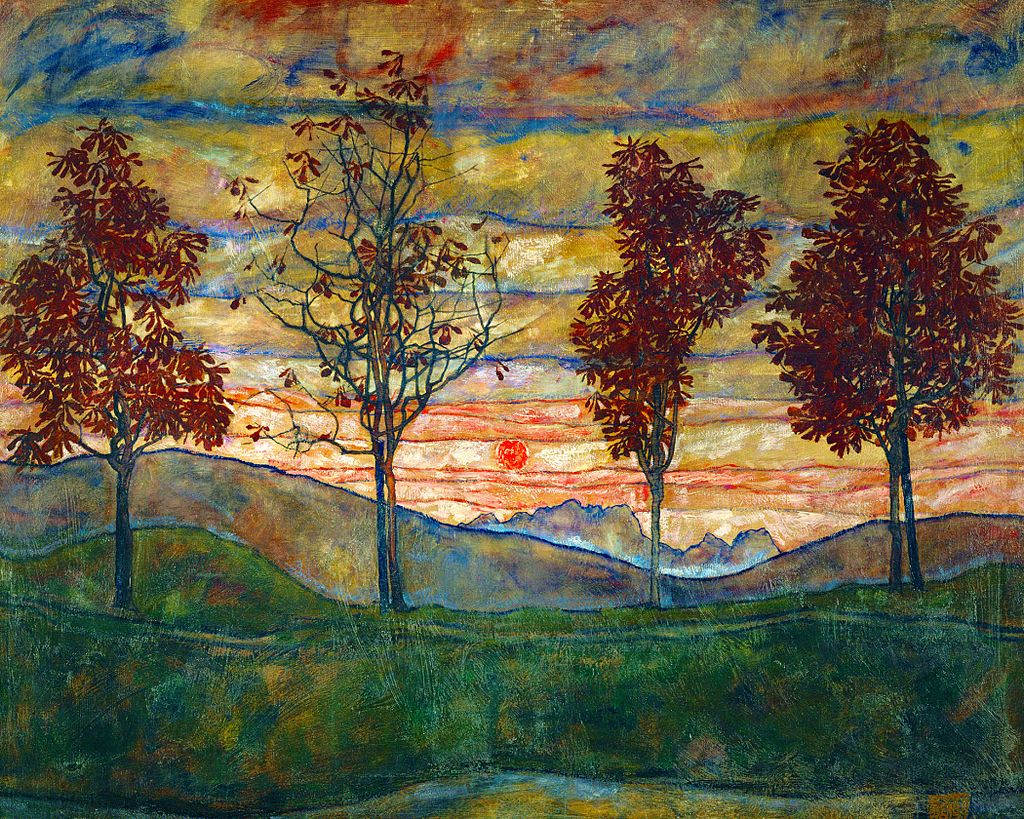
Egon Schiele, Four Trees, 1917. Oberes Belvedere, Vienna.

*

Berlinde De Bruyckere, Arcangelo II, 2020. Hamburger Kunsthalle.

*

C.P. Cavafy, “Clothes,” translated by Daniel Mendelsohn.

*

Anonymous Works: "In what could be called one of the strangest industrial designs ever, the Chicago-based Hurley Electric Laundry Equipment Company in 1936 created a version of their Thor electric washing machines with sculpted hands embossed on the agitator. At the time, some Thor dealers painted the fingernails of the hands on demonstration machines."

*

Gregory Halili, carved shells and pearl

*

Mid-20th century Italian composite marble and limestone grave marker.

*

Margaret Cross blue sapphire "Devotion" ring.

*

James Merrill's Ouija Board.

*

I suppose it is submerged memories that give to our dreams their curious air of hyper-reality. But perhaps there is something else as well, something nebulous, gauze-like, through which everything one sees in a dream seems, paradoxically, much clearer. A pond becomes a lake, a breeze becomes a storm, a handful of dust is a desert, a grain of sulfur in the blood is a volcanic inferno.

W. G. Sebald, The Rings of Saturn.

*
The most interesting and valuable witness of the stupendous eruption of Bandai-san in 1888—which blew the huge volcano to pieces and devastated an area of twenty-seven square miles, leveling forests, turning rivers from their courses, and burying numbers of villages with all their inhabitants­­­—was an old peasant who had watched the whole cataclysm from a neighboring peak as unconcernedly as if he had been looking at a drama. He saw a black column of ash and steam rise to the height of twenty thousand feet and spread out at its summit in the shape of an umbrella, blotting out the sun. Then he felt a strange rain pouring upon him, hotter than the water of a bath. Then all became black, and he felt the mountain beneath him shaking to its roots and heard a crash of thunders that seemed like the sound of the breaking of a world. But he remained quite still until everything was over. He had made up his mind not to be afraid—deeming that all he saw and heard was delusion wrought by the witchcraft of a fox.

Lafcadio Hearn, Glimpses of Unfamiliar Japan.

*
Americans’ belief in ghosts has been on the rise since 2015, according to a poll by YouGov, a research and analytics firm, and paranormal beliefs are becoming common, with 59 percent of women and 52 percent of men expressing a belief in haunted places, according to a 2019 survey by Chapman University. Even the U.S. government has refused to rule out the existence of aliens after making footage of unidentified flying objects public.


Taylor Lorenz, "The 'This American Life' of Ghost Stories is Captivating Gen Z." The Washington Post, 10/22/2022. 

*
The pictures may ostensibly document the realm of the immaterial, the post-human, the ether, but they are moving precisely because of the grubby human and material stories they inadvertently disclose, of boundless grief and stubborn self-deception and feeble guile and pathetic compromise. They speak of propriety and barbarism, doubt and obsession, love and chicanery, exaltation and despair. They embody every sort of contradiction and every affective extreme. They can be terrifying, not because of their sideshow ghosts or tinpot effects, but because of the emotional undertow that lies just beneath their surfaces. It is not hard to imagine being unbalanced by loss and then thrown into a darkened room where the last tenuous grasp of reality finally gives way, or to imagine larkishly producing a hoax and then finding that a great number of people have become psychologically dependent on its indefinite perpetuation. There is a great unwritten book, or more than one, lurking behind these pictures, but it could only be a work of the imagination.
Lucy Sante, "Summoning the Spirits." The New York Review, 2/23/2006.

*
Would have, would have. The dead dwell in the conditional, the tense of the unreal. But there is also the extraordinary feeling that you have become omniscient, that nothing we do or think or feel can be kept from you. The extraordinary sense that you are reading these words, that you know what they’ll say even before I write them.

Sigrid Nunez, "The Blind."

*

Crossing the autumn moor—
I keep hearing
someone behind me!


Yosa Buson

*

odds and ends / 5.27.2022


*

Henri Biva (1848-1929), Villeneuve-l'Étang embrumé. Oil on canvas.

*

Félix Bracquemond, Margot la Critique, 1854. Per The Met:
Here Bracquemond rendered a veiled criticism of critics. The squawking magpie holds a plume and straddles a globe ... Bracquemond underscored his commentary with a reference to Ovid’s description of magpies in "Metamorphoses", citing in the lower margin: "Raucaque garrulitas studium que immane loquendi," which translates to "their hoarse garrulity, their boundless passion for talk."

Skull of a crowned athlete, ca. 300 BCE. Archaeological Museum of Agios Nikolaos, Crete. Per The Greek Reporter: "Inside the mouth, a silver coin was found as a token to Charon, who in Greek mythology was the ferryman of Hades who carried the souls of the newly deceased to the underworld."

*

Poem by Florine Stettheimer, in the collection of the Beinecke Library.

*

Nik Gelormino's prototype for a anti-extraction beehive for Cactus Store.

*
As usual, what “we” could be presumed? Numbers spiked and dropped; outrage and numbness set in. Imaginations stopped trying or got massively creative. Many of us burst into demands for an economic and procedural reboot of safety, security, and community, which included defacing the image of the police as the ideal local military. Meanwhile, mental health crises that faced life as well as death expanded into a pandemic with their own structural bases, their own hotlines, their own everydayness, and their own appearance as intimate partner violence and as police actions, where qualified immunity protects them from the consequences of spraying out their own roiling emotions onto other vulnerable bodies. Like dust bouncing off a trampoline, active counter-dominant solidarity on multiple and conflicting fronts induced pervasive and desired atmospheres, with their uneven rhythms of efficacy. The inconvenience of other people became a pragmatic political topic: With whom can you imagine sharing the world’s sidewalk? What do you do with the figures of threat and dread that your own mind carries around?


Lauren Berlant, from the introduction to The Inconvenience of Other People.

*

About the hermits’ lives, little is known. They appear rarely, and only then to those with the eyes of faith, yet their presence in these forests is undisputed. They might accept an offering of dried chickpeas or a handful of roasted barley left in a clearing, but mostly they subsist on leaves, bitter roots, and prayer. They wear shabby clothes, unkempt beards, dreadlocks. Only the holiest of them achieve a state of invisibility. When someone manages to see them and attempts to take their picture, it is said, their image will not appear in the photograph. A hermit might live in a particular forest for years, going about his hidden work of intercession, and then one day someone walks by a juniper tree and discovers a pile of his bones.


Fred Bahnsen, "The Church Forests of Ethiopia: A Mystical Geography." Emergence, 1/11/2020. 

*

For her, fixity and separateness are deadening specters. The very act of naming arrests and asphyxiates true freedom: as she warns, “don’t identify yourself with your description of yourself.” Dualisms which others might see as contradictions or mutual exclusivities—self/other, individual/collective, moral/theological, earthly/cosmic, work/art—manifest for Howe as uncannily interpenetrative possibilities. She is one of the twentieth century’s great epistemologists, principally through her refusal of discursive tidiness and her magnification of such concerns through indeterminate lenses. Thomas Aquinas thought it a grave failure to confuse knowing and believing. Howe’s is a corpus entrenched in unknowingness.

Jamie Hood, "The Irreconcilable Fanny Howe." The Baffler, 5/16/2022.

*

Reading about a young girl wandering through shipwrecks and dodging American soldiers in The Prowler, I thought of a professional wrestler adjusting their story to allow more truth into the performance. That sounds off, frankly, considering how restrained and briny [Kristjana] Gunnars’s writing is. But what feels similar is that alternation between calling attention to the scaffolding, and then leaping from it. The leap is always real, even if the wins and losses are imaginary.


Sasha Frere-Jones, "The Scent of Light." 4Columns, 5/20/2022. 

*

"I found myself wondering if there’s a difference, anyway, between the things we read and the things we do. Reading is an experience, if an artificial one, constructed and simulated—but then so are many of the others we go out in life to achieve in vaguely artificial ways."

*
Very early on in my “career,” an editor said to me, “You do something that we don’t really do here. I noticed that in your sentences, the word that comes next isn’t exactly the word you’d expect to come next.” And I remember thinking: of course it fucking isn’t. Otherwise why would I write it?

Tobi Haslett, interviewed by Jessica SwobodaThe Point, 5/17/2022.

*
Let’s hope that—at least—we can be in touch through words. I 
remember many beautiful moments in your study, with leafless trees 
outside 
or spring trees.

Adam Zagajewski, writing to Jonathan E. Hirschfeld, quoted in "Without Irony," Hirschfeld's tribute to Zagajewski in PN Review 263, Volume 48, Number 3, January/February 2022.

*
I watched the trees gradually recede, waving their despairing arms, seeming to say to me: ‘What you fail to learn from us today, you will never know. If you allow us to drop back into the hollow of this road from which we sought to raise ourselves up to you, a whole part of yourself which we were bringing to you will vanish for ever into thin air.’ And indeed if, in the course of time, I did discover the kind of pleasure and disquiet which I had just felt once again, and if one evening—too late, but then for all time—I fastened myself to it, of those trees themselves I was never to know what they had been trying to give me nor where else I had seen them. 

Marcel Proust, In Search of Lost Time, Volume 2: Within a Budding Grove, trans. by C. K. Scott Moncrieff and Terence Kilmartin.

*


*

No guns for men.