Showing posts with label william carlos williams. Show all posts

odds and ends / 9.14.2023


Image of two trees, shared by Rebecca Herbert: "The thinner tree was cut years ago and the big one has been holding and feeding it since then. They 'wake up' together in the spring and 'go to sleep' together in the autumn."

*

"Experiments with Dailiness," an exercise from The Art of Science Writing by Dale Worsley and Bernadette Mayer, via Common Books.

*

Fairfield Porter, Interior by electric light, 1966.

*
Soldered house, ca. 1900s, via tihngs.

*

Sarah Holloway's Apple Powered Computer, 2023. Gleaned Macintosh Plus computer (circa 1987) powered by crab apples housed in a cabinet made of repurposed hog-feed crates. For Mold, Holloway writes:
It took a lot of apples to run the computer and it didn’t last for long but the point still was there, that all our systems are connected and our food and ecological systems are either directly or indirectly tied to our computers and digital technologies. Data centers take up space like mono crops and they take insane amounts of energy. The project is meant to be a fun way of wondering how our food and tech systems make strange bedfellows. A few weeks ago I was talking to a friend who told me about a farm her friend manages. It is owned by a tech company based in Vancouver, Canada. They have a farm that tech workers are allowed to go to for “rejuvenation.”(Think therapy horses but like pulling carrots).

The world is a weird place where technology and industry are flowing into all other sectors.
*
I was once driven in a taxi by a man who had no room for a piano in his house and had moved it under an apple tree. He told me he liked to hear the rain falling on the keys or sometimes fruit, and often the wind would arrive at night and bang branches on the broken lid.
 
That was 10 years ago. I imagine it is worn down now to a skeleton of wires. I imagine on windless nights, the moon moves over the wires, playing silence. There are wonderful tunes composed of a piano, but if, like me, you are interested in the edge where the mind gives up and matter begins to describe itself, then these weather tunes, these erosions, unpredictably composed by time itself, are worth celebrating. Perhaps, as Bergsten said, there is a mathematical order inherent in matter, and we have only to stop speaking—we have only to stop composing and performing and singing and thinking to hear it. 

Alice Oswald, from her lecture, "The Art of Erosion," given on 9/12/2019 at the University of Oxford.

*
Many scientists have been upset because Barbara McClintock characterized herself as a mystic. But to her, mystic did not mean someone who mystifies ... Instead, for Barbara McClintock, a mystic was someone with a deep awareness of the mysteries posed by natural phenomena. Mystification came, in her view, when we tried to use our current concepts to explain phenomena that demanded new ways of thinking.


James Shapiro, quoted by Alexis Madrigal in his Oakland Garden Club essay, "What Was Barbara McClintock's Mysticism?" I keep re-reading the ending:

We are assemblages of cooperating cells and tissues, each unit of life competent within the spaces our body creates. Trillions of brilliant little cells each doing its thing to make … me. I’m held together by bioelectric fields and metabolic processes and the convenient sense that I am a single being. At my own scale, I am a galaxy of sorts, hiding in plain sight, obscured by the bright sun of consciousness. And so are you.

Or, as McClintock told her biographer, “Basically, everything is one. There is no way in which you draw a line between things.”

*

Remembering Steve Roden: "In this world there are some artists who listen so very deeply, who cherish the minor, the incidental, the unexpected, the hushed; Steve was one such artist."

*
Not everything she tried worked, and some critics complained about the too-muchness of it all, her books like an overstuffed shopping bag, full of odd characters and clever lines that should have been left on the shelf ... in the end none of those blemishes really matters. What does matter is the ever-continuing ambition, the steady professionalism, the fact that [Zadie] Smith hasn’t frittered away her early success into unproductive stardom. What matters is that it’s a long time since she’s sounded like anyone else. She’s made her world ...

Michael Gorra, "Playing with the Past." The New York Review, 9/21/2023.

*


*
At a time when revolution gripped the country, the Whole Earth Catalog reflected [Stewart Brand's] right-wing thought by omission. After one young staffer suggested ways to make the catalog more political, Stewart vetoed the notion with a surprising set of rules: “No politics, no religion, and no art.” What was left? Computers and shopping. As a futurist, he had that much right.

Malcolm Harris, "The Zen Playboy: The Life and Times of Stewart Brand." The Nation, 6/13/2022. 

*

"o meager times, so fat in everything imaginable !"

daisies


The dayseye hugging the earth
in August, ha! Spring is
gone down in purple,
weeds stand high in the corn,
the rainbeaten furrow
is clotted with sorrel
and crabgrass, the
branch is black under
the heavy mass of the leaves—
The sun is upon a
slender green stem
ribbed lengthwise.
He lies on his back—
it is a woman also—
he regards his former
majesty and
round the yellow center,
split and creviced and done into
minute flowerheads, he sends out
his twenty rays—a little
and the wind is among them
to grow cool there!

One turns the thing over
in his hand and looks
at it from the rear: brownedged,
green and pointed scales
armor his yellow.

But turn and turn,
the crisp petals remain
brief, translucent, greenfastened,
barely touching at the edges:
blades of limpid seashell.

William Carlos Williams, "Daisy."


*

Beatrix Potter, Daisies. Watercolor and pencil, ca. 1905. Victoria & Albert Museum.

*

Egyptian Daisy pendant, ca. 1390–1353 B.C.E. The Metropolitan Museum of Art.

*

Oxeye daisy cigarette card, collection of The New York Public Library.

*

Necklace by Alexis Falize with the enameller Antoine Tard; cloisonné enamel and gold; France; about 1867. Victoria & Albert Museum.

*

Limestone statue fragment of a left hand holding a bunch of daisies, ca. 500-450 B.C.E. Cypriot. The Metropolitan Museum of Art.

*

Woman with wreath of leaves in her hair sitting in a field of daisies, ca. 1900. Unknown photographer. The Library of Congress.

odds and ends / 5.15.2020


Image of masked women, from the collection of Billy Parrot.

*

Charles Mahoney (1903-1968): Miss Edith inspects the Sweetpea, ca. 1934.

*

Excerpt from Self-Hypnosis, Explained, 1978, from stopping off place.

*

Set of ten ink cakes with poems of the Ten Scenes at the Westlake in cursive script style (xingshu), ca. 1736-95

*

Page of an herbarium by Abigail Bainbridge.

*

Henri de Toulouse-Lautrec, Le Lit (The Bed), 1893.
*


*
In fairy tales, form is your function and function is your form. If you don’t spin the straw into gold or inherit the kingdom or devour all the oxen or find the flour or get the professorship, you drop out of the fairy tale, and fall over its edge into an endless, blank forest where there is no other function for you, no alternative career. The future for the sons who don’t inherit the kingdom is vanishment. What happens when your skills are no longer needed for the sake of the fairy tale? A great gust comes and carries you away.

Sabrina Orah Mark, "Fuck the Bread. The Bread is Over." The Paris Review, 5/7/2020.

*
Lockdown has made me aware of something I barely noticed before: the many opportunities that my old life provided for escape. More specifically, the almost gracious way that society was set up to allow me, and many others, to slip from one role into another and another as the day rolled by. This flow strikes me as distinctively modern. And it is gone now, temporarily. The heterogenous, compartmentalized life of before is replaced with a life where your Main Thing is now your Only Thing. At moments it’s fascinating to live this way, but there’s also a sting. It’s the sting of being unable to take turns carrying each other’s burdens.

Katherine Sharpe, "Billionaires of Time." n + 1, 5/11/2020.

*
‘Isn’t this grief?’ I’m asked. Perhaps. So what? We are so accustomed to contrasting sentiment with reason that we have forgotten that emotion can sharpen our vision, opening us to otherwise overlooked evidence on which reason can act. When serene, I threw about the benefit of the doubt as a gift to all. Now I see it is a currency with which our leaders will buy first-class tickets off the hook.

Stephen Methven, "Staying Angry." London Review of Books Blog, 4/16/2020.

*
Viruses are prodigious catalysts of evolution. By shuttling genetic material between organisms they generate evolutionary novelty and have even made possible some of our deepest intimacies: as placental mammals we depend on genes acquired from viruses to develop within our mothers. Viruses enter their hosts and must suspend their immune systems; developing mammals are faced with a similar challenge. In the absence of these viral genes, it wouldn’t be possible for embryos to share bodily space with their mother without being rejected as an other, a non-self. I can’t stop thinking about this. Our parental care, our social bonding, our need for closeness—all have their roots in a viral infection. I hope that the current period of cultural evolution catalyzed by a virus can draw us towards a state of greater care, bondedness, and consideration—both towards other humans, and towards the more-than-humans with whom we share the planet. Of course, it could do quite the opposite.

Merlin Sheldrake in conversation with Robert MacFarlane at LitHub, 5/12/2020.

*

New favorite online timewaster: Gotta Eat the Plums! (Discovered thanks to Nadia.)

*

Dolphins swimming in a bioluminescent sea (found thanks to Ashley).

*

Best sweatshirt.

*

How to make ice cream in a Mason jar. And a recipe for this particular green soup.

*


*
Every choice is a refusal. For Christ’s sake
I am guarding the walls.
Like punctuation,
it could make all the difference.

Karen Solie, from "A Hermit." The Paris Review, Issue 218, Fall 2016.

poets without clothes


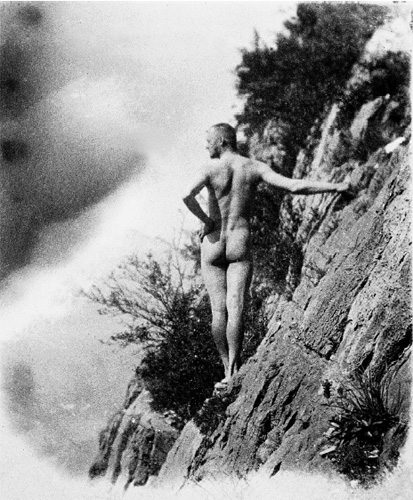
New favorite tumblr: poets without clothes. Pictured from top to bottom: H.D., Walt Whitman, William Carlos Williams, Hermann Hesse.

Discovered thanks to A.N. Devers.