Showing posts with label emily dickinson. Show all posts

'eclipse was all we could see'


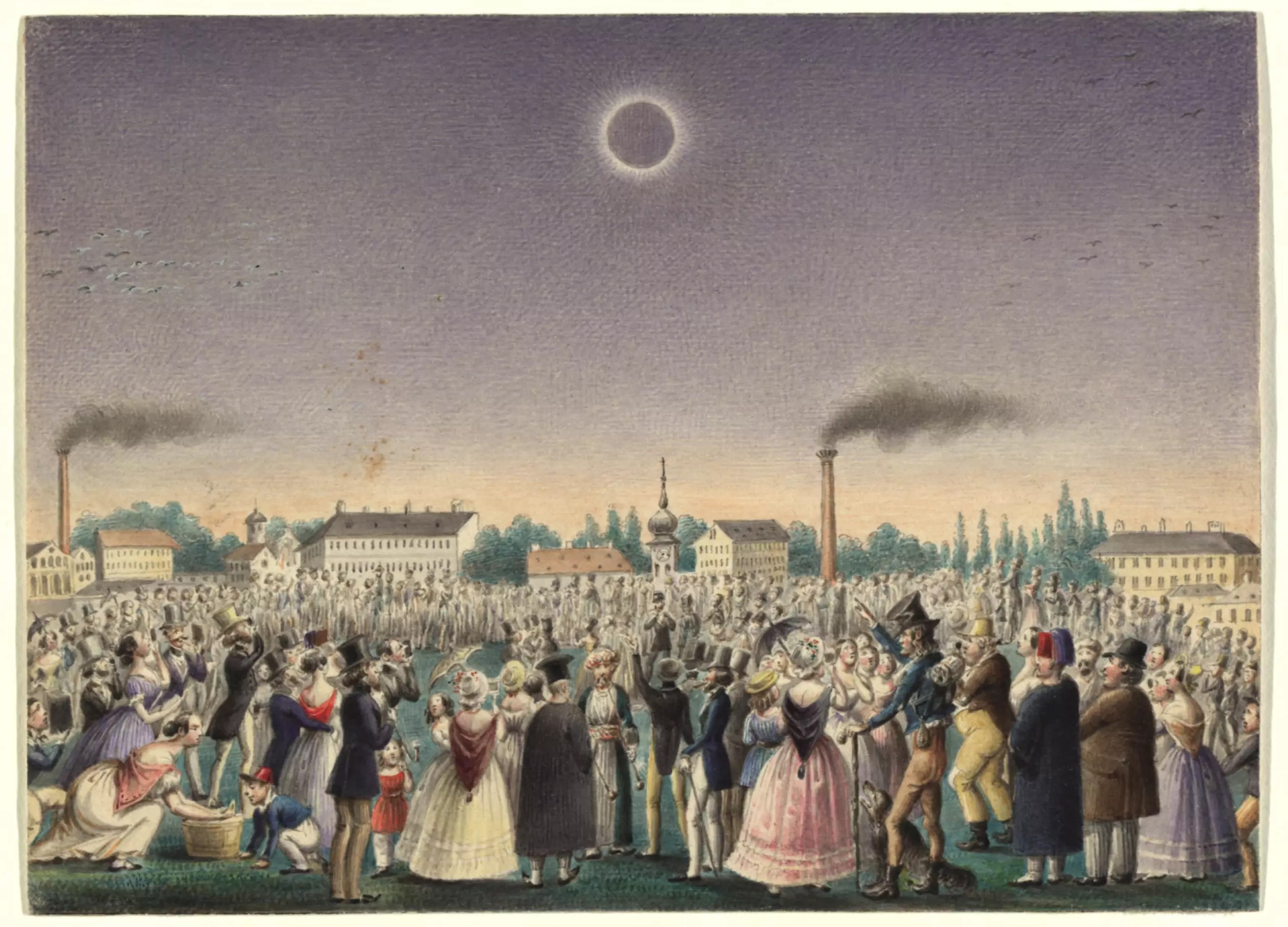
Johann Christian Schoeller, "Sonnenfinsternis, 8. Juli 1842." Wien Museum.

*

John Parker Davis, "Looking at the Eclipse (After Winslow Homer)," 1865. Clark Art Institute.

*


*

Joseph Cornell, "Portrait of Emily Brontë," 1962. The Hudson River Museum.

*

Emily Dickinson archive, Amherst manuscript #256.

*

Crescent-shaped shadows on the snow in the mountains in Bernalillo County, New Mexico, caused by a solar eclipse, photographed by Lee Russell in 1940. New York Public Library Digital Collections.

*

GIFs from Georges Méliès L'éclipse du soleil en pleine lune (The Eclipse: Courtship of the Sun and Moon) from 1907.

*
At one o'clock almost half the sky was blue—two o'clock, and the moon had already bitten a small piece out of the sun's bright edge, still partly obscured by a dimly drifting mass of cloud.

A penetrating chill fell across the land, as if a door had been opened into a long-closed vault. It was a moment of appalling suspense; something was being waited for—the very air was portentous.

The circling sea-gulls disappeared with strange cries. One white butterfly fluttered by vaguely. Then an instantaneous darkness leaped upon the world. Unearthly night enveloped all.

With an indescribable out-flashing at the same instant the corona burst forth in mysterious radiance. But dimly seen through thin cloud, it was nevertheless beautiful beyond description, a celestial flame from some unimaginable heaven. Simultaneously the whole northwestern sky, nearly to the zenith, was flooded with lurid and startlingly brilliant orange, across which drifted clouds slightly darker, like flecks of liquid flame, or huge ejecta from some vast volcanic Hades. The west and southwest gleamed in shining lemon yellow.

Least like a sunset, it was too sombre and terrible. The pale, broken circle of coronal light still glowered on with thrilling peacefulness, while nature held her breath for another stage in this majestic spectacle.

Well might it have been a prelude to the shriveling and disappearance of the whole world—weird to horror, and beautiful to heartbreak, heaven and hell in the same sky.

Absolute silence reigned. No human being spoke. No bird twittered.

Hours might have passed—time was annihilated; and yet when the tiniest globule of sunlight, a drop, a needle-shaft, a pinhole, reappeared, even before it had become the slenderest possible crescent, the fair corona and all color in sky and cloud withdrew, and a natural aspect of stormy twilight returned.

Mabel Loomis Todd, from Corona and Coronet: Being a narrative of the Amherst Eclipse Expedition to Japan, in Mr. James's Schooner-Yacht Coronet, to Observe the Sun's Total Obscuration, 9th August, 1896.

*
It sounded as if the streets were running -
And then the streets stood still -
Eclipse was all we could see at the Window
And Awe - was all we could feel -
By and by the boldest stole out of his Covert
To see if Time was there
Nature was in an Opal apron
Mixing fresher Air

Emily Dickinson 

what's possible


Manuscript of Emily Dickinson's poem 466:

I dwell in Possibility –
A fairer House than Prose –
More numerous of Windows –
Superior – for Doors –

*

“This woman who wanted me always to feel possible.”—Jasmine Mans, describing her mother in Broccoli, Issue 11.

*

I have been pregnant three times. My first pregnancy ended in abortion at 11 weeks, my second pregnancy resulted in a child, and my third pregnancy miscarried. Each time, I willingly chose to enter that space of uncertain possibilities that surrounds pregnancy. Each time, I did not know what to expect, though after that first time, I knew something more about how little anyone can actually know about what to expect when you are expecting. After the second, I was somewhat wiser about how vast and ongoing the commitment to another life is. And the third revealed just how callous practices of care directed toward pregnant people can be. I will not forget walking past all the cozy delivery rooms to access the grubby little curtained alcove where I got a D & C.

To take away what choice a person can have in such an uncertain undertaking as pregnancy, to say to someone, no, you must do this thing, this thing that will radically reshape your life and body and future, is cruel. I do not understand a “love” that looks past the person in front of you, the person who knows their own life, the person who has made a decision, the person asking for help, to prioritize protecting a pulsing clump of cells. Alive, true. But not a life, not yet. Just a possibility.

I wonder about these people, so enamored of blastocysts, of embryos—“a thing at a rudimentary stage that shows potential for development”—that they will demand its potential take precedence over the actualities of the living person sitting in front of them. Is it easier for them to love something abstract and unknown, something that can still be whatever they imagine it to be? Easier than loving actual humans, who can only be what they are? Such hubris, to know better what someone’s options should be. Of course, the fact of being the sort of human who can get pregnant continues to preclude full personhood in our culture, though a few of us may become CEOs and billionaires and whatever else. Better protect the flickering cells, the ones that could actually become a real person, provided it has the correct chromosomes.

Criminalization does increase the risk of physical harm. But that is basically a consumer protection argument: It’s not safe enough. The fact is that whether anyone ever climbed on an abortion table or not, the message of criminalization to all people who can get pregnant is: You don’t have dominion over your own body, you are always vulnerable, always in danger of being surveilled.

Historian Ricki Solinger, from "You Are Endangered as a Citizen." N+1, 5/5/2022


This is a reality like a massive mountain, maybe too massive to see the scope of until the light hits right, and it’s illuminated in its awful vastness. And whenever that happens, when some of us realize yet again that we still are not really seen as actual people, we start sharing our very real stories to assert our full personhood, something only white men and fetuses are granted here in the United States. My feeds this week are full of people sharing their abortion experiences. There are people who didn’t think twice about having an abortion; others, like me, who grieved but felt relieved; still others who later regretted it. And after these outpourings, the certain circle these stories like vultures, picking for narrative morsels that feed their arguments. It’s exhausting.

No single story ever encapsulates any human experience. And I am increasingly wary of stories, anyway. The ugly power of narrative is evident everywhere in this country. Maybe what we need is to step away from storytelling—the repeated tales of what a mother is, of what a person should be—to dwell in possibility. Why is what we do with our bodies endlessly up for debate, whether that is choosing not to be pregnant or getting the care needed to align an inner and outer self? Why are people so afraid of making space for choice? Of accepting that people do, in fact, know what is best for them, in a way others can’t?

What a tragedy to spend fifty years trying to shut a door rather than change the path that leads to it. (See here: the evident hypocrisies in the anti-child policies of so-called pro-life states). What a tragedy that so many people still feel that what they most want is others to have less, not more. What a tragedy that we still have yet to embrace the full bewildering glory of actual human potential.

What I want most for my child is that whoever he is or wants to be feels possible. But I also want him to realize, in such a foundational way that it shapes everything he understands, is that radical possibility extends to everyone around him—that no one is a story set in stone, that everyone is always changing, always becoming. That choice is freedom, and everyone deserves to be free.

*

Other thoughts on choosing motherhood.

cold shivers


*

Franz Sedlacek: Flowers and Insects (Blumen und Insekte), ca. 1939.

*

Jan van de Velde the Younger: The Sorceress, 1626. 

The Latin inscription along the bottom reads:
What evils Desire commands, in the small secluded place; who, by sweet incantation, overcomes the minds of the purest mortals, induces frenzy in everyone! But how quickly it slips by; Death overtakes brief life, brief delights. Laughing for a moment, in eternity suffering regret.
*
A chair with the shivers by Wilkinson & Rivera.

*
Druid news item, via endlesssummer.

*

*
George Schmidt, detail of a scherenschnitte hunting scene, ca. 1863. 

*

*
In night when colors all to black are cast,
Distinction lost, or gone down with the light;
The eye a watch to inward senses placed,
Not seeing, yet still having powers of sight,

Gives vain alarums to the inward sense,
Where fear stirred up with witty tyranny,
Confounds all powers, and thorough self-offense,
Doth forge and raise impossibility:

Such as in thick depriving darknesses,
Proper reflections of the error be,
And images of self-confusednesses,
Which hurt imaginations only see;

And from this nothing seen, tells news of devils,
Which but expressions be of inward evils.

Lord Brooke Fulke Greville, "Sonnet 100," 1633.

*

Fetch (as defined in Brewer's Dictionary of Irish Phrase and Fable): a preternatural vision of a living person, usually seen by a relative or friend. If occurring in the morning the visitation was a sign that the person, whose doppelgänger it was, would have a long and prosperous life; if in the evening it was a portent of imminent death:

She only looked with a dead, dead eye,
And a wan, wan cheek of sorrow:
I knew her Fetch!—she was called to die,
And she died upon the morrow.
John Banim, "The Fetch" (1857).

*
Like one that on a lonesome road
Doth walk in fear and dread ...

Samuel Taylor Coleridge, Rime of the Ancient Mariner, Part VI, lines 37-38.

*

*
During this time, she discovered that her house was haunted. It wasn't only she who felt it—she overheard adults talking about the ghosts as well. She realized that they were as frightened as she was, and were helpless to protect her. She already understood that the world was denser and more crowded than her senses could percieve: there were ghosts, but even those dead who were not ghosts still existed; she was used to hearing talk in which family members alive and dead were discussed without distinction. The dead seemed to her only barely dead.

Larissa MacFarquhar, "The Dead Are Real," a profile of Hilary Mantel in the 10/15/2012 New Yorker.

*
We others are not like you. We are more prickly, more jittery, more restless, more reckless, more secretive, more desperate, more cowardly, more bold. We live at the edges of ourselves, not the middle places. We leave that to you. Did I say: more watchful? That above all. We watch you, we follow you, we spy on you, we obsess over you.

Steven Millhauser, 'We Others.'

*
... [W]e have created a technology that leaves no place for the dead. It is a realm of perpetual present, a realm of simulation, where the past is as fluid as the future. Deepfake, the technology that uses machine learning to create highly realistic false videos, can re-create its subject even posthumously. It can cause us to remember what never happened. No longer will we have any assurance that we are remembering the dead. And the dead will no longer remember us—we will have become unrecognizable.

Anne Michaels, "Mortal Soul, Moral Soul.Lapham's Quarterly: Memory, Vol. 13, No. 1, Winter 2020.

*
One need not be a Chamber -- to be Haunted --
One need not be a House -- 
The Brain has Corridors -- surpassing 
Material Place -- 

Far safer, of a Midnight Meeting 
External Ghost 
Than its interior Confronting -- 
That Cooler Host. 

Far safer, through an Abbey gallop, 
The Stones a'chase -- 
Than Unarmed, one's a'self encounter -- 
In lonesome Place -- 

Ourself behind ourself, concealed -- 
Should startle most -- 
Assassin hid in our Apartment 
Be Horror's least. 

The Body -- borrows a Revolver -- 
He bolts the Door -- 
O'erlooking a superior spectre -- 
Or More --

Emily Dickinson

*
'Goodbye forever! I'm flying away,' shouted Margarita, drowing out the waltz. She then decided that she had no need of the chemise and with an ominous chuckle she threw it over Nikolai Ivanovich's head. Blinded, he tumbled off the bench onto the bricks of the path.
Margarita turned to take one last look at the house where she had suffered so long, and in the lighted window she saw Natasha gaping with astonishment.
'Farewell, Natasha!' Margarita shouted and urged her broom upward. 'Invisible! I'm invisible!' she shouted even more loudly, and with the branches of the maple tree brushing against her face, she flew out over the gates and into the street. And the totally crazed waltz followed her aloft.
Invisible and free! Invisible and free!

Mikhail Bulgakov, The Master and the Margarita, translated by Diana Burgin and Tiernan O'Connor.

*


In the archive: posts of Halloweens past, including Halloween-ish reads for all ages.

set of three / 10.31.2020


In August and September of 1978 ... [Lucille] Clifton received a series of dire warnings about the fate of the human world from a mysterious group of spirits she called “the Ones.” The Ones did not assume the personality of a departed human, and they did not weigh in on day-to-day affairs. They spoke of things of cosmic importance: the deep past of human civilization (for instance, the origins of Atlantis and demystifications of ancient Egyptian civilization) and its tenuous future. They returned “to remind human beings that they are more than flesh,” and in 1978 they warned Clifton:

If the world continues on its way without the possibility of God which is the same as saying without Light Love Truth then what does this mean? It means that perhaps a thousand years of mans life on this planet will be without Light Love Truth It is what we were saying indeed that there will be on Earth that place which human beings describe to the world of the spirits Hell Now there is yet time but not very much your generation Lucille is the beginning of the possibility and your girls generation is the middle etc.


The Ones, characterized by their mythic tone and liberal use of a royal we, peppered their messages with a line they repeated like a refrain: “There are so many confusions so many potential dangers in the world of the Americas.”


Marina Magloire, "The Spirit Writing of Lucille Clifton." The Paris Review, 10/19/2020.

*

The original Greek word for apocalypse—apokalypsis—does not mean “end times.” It means “to unveil.” This is the apocalypse we are living through: a process of unveiling and revealing.

Jess Hill, "Privilege, Power, Patriarchy: Are These the Reasons for the Mess We're In?" The Guardian, 10/17/2020.

*
This world is just a little place, just the red in the sky, before the sun rises, so let us keep fast hold of hands, that when the birds begin, none of us be missing. 

From a letter written by Emily Dickinson in 1860. (Quoted by Barry Lopez here.)

*

From top:

Giuseppe Pellizza da Volpedo, Il sole o Il sole nascente (The sun or the rising sun). 1904.
Leonora Carrington, Orpheus. 1953.
Eugène Carrière, The Contemplator. 1901. The Cleveland Museum of Art.

*


'minds - and winds'


*

A Pang is more conspicuous in Spring
In contrast with the things that sing
Not Birds entirely – but Minds –
And Winds – Minute Effulgencies
When what they sung for is undone
Who cares about a Blue Bird's Tune –
Why, Resurrection had to wait
Till they had moved a Stone –

Emily Dickinson, ca. 1881. Amherst College Archives & Special Collections, via The Morgan Library.


vegetation's juggler

The mushroom is the elf of plants
At evening it is not;
At morning in a truffled hut
It stops upon a spot

As if it tarried always;
And yet its whole career
Is shorter than a snake's delay,
And fleeter than a tare.

'T is vegetation's juggler,
The germ of alibi;
Doth like a bubble antedate,
And like a bubble hie.

I feel as if the grass were pleased
To have it intermit;
The surreptitious scion
Of summer's circumspect.

Had nature any outcast face,
Could she a son contemn,
Had nature an Iscariot,
That mushroom,—it is him.


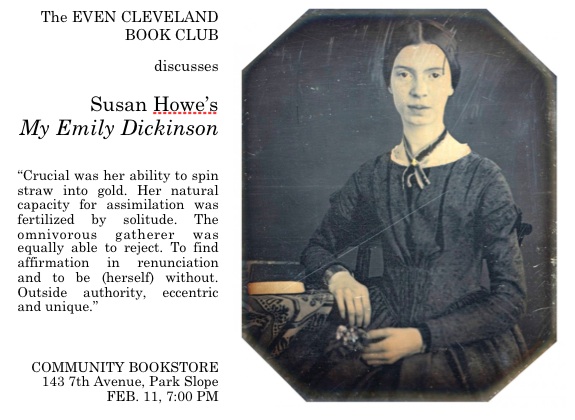
A short but absolutely remarkable book. In a weird stroke of unlucky timing, Susan Howe happens to be giving a reading Monday night. Makes me wish I could be in two places at once.

1320

Dear March — Come in —
How glad I am —
I hoped for you before —
Put down your Hat —
You must have walked —
How out of Breath you are —
Dear March, how are you, and the Rest —
Did you leave Nature well —
Oh March, Come right upstairs with me —
I have so much to tell —

I got your Letter, and the Birds —
The Maples never knew that you were coming — till I called
I declare — how Red their Faces grew —
But March, forgive me — and
All those Hills you left for me to Hue —
There was no Purple suitable —
You took it all with you —

Who knocks? That April.
Lock the Door —
I will not be pursued —
He stayed away a Year to call
When I am occupied —
But trifles look so trivial
As soon as you have come

That Blame is just as dear as Praise
And Praise as mere as Blame.

Emily Dickinson


I started Early – Took my Dog –
And visited the Sea –
The Mermaids in the Basement
Came out to look at me –

And Frigates – in the Upper Floor
Extended Hempen Hands –
Presuming Me to be a Mouse –
Aground – opon the Sands –

But no Man moved Me – till the Tide
Went past my simple Shoe –
And past my Apron – and my Belt
And past my Boddice – too –

And made as He would eat me up –
As wholly as a Dew
Opon a Dandelion's Sleeve –
And then – I started – too –

And He – He followed – close behind –
I felt His Silver Heel
Opon my Ancle – Then My Shoes
Would overflow with Pearl –

Until We met the Solid Town –
No One He seemed to know –
And bowing – with a Mighty look –
At me – The Sea withdrew –
Emily Dickinson

Photos:
LIFE
Edward Weston: Tidal Pool, Point Lobos. 1937.

we send the wave to find the wave

We send the Wave to find the Wave --
An Errand so divine,
The Messenger enamored too,
Forgetting to return,
We make the wise distinction still,
Soever made in vain,
The sagest time to dam the sea is when the sea is gone --

Emily Dickinson

Kodak photo from the collection of the National Media Museum via they humm of mystery.

the norway of the year


It is also November. The noons are more laconic and the sundowns sterner, and Gibralter lights make the village foreign. November always seemed to me the Norway of the year.

Emily Dickinson, letter to Mrs. J.G. Holland, 1864

Intaglio prints of dead flowers by Katie DeGroot. Originally spotted here.

my life had stood - a loaded gun -


754.

My Life had stood - a Loaded Gun -
In Corners - till a Day
The Owner passed - identified -
And carried Me away -
And now We roam in Sovereign Woods -
And now We hunt the Doe -
And every time I speak for Him -
The Mountains straight reply -

And do I smile, such cordial light
Upon the Valley glow -
It is as a Vesuvian face
Had let its pleasure through -

And when at Night - Our good Day done -
I guard My Master's Head -
'Tis better than the Eider-Duck's
Deep Pillow - to have shared -

To foe of His - I'm deadly foe -
None stir the second time -
On whom I lay a Yellow Eye -
Or an emphatic Thumb -

Though I than He - may longer live
He longer must - than I -
For I have but the power to kill,
Without--the power to die--

***
... I think it is a poem about possession by the daemon, about the dangers and risks of such possession if you are a woman, about the knowledge that power in a woman can seem destructive, and that you cannot live without the daemon once it has possessed you ...
Adrienne Rich

***
Photo: a mugshot of Emma Goldman.