Showing posts with label the sun. Show all posts

odds and ends / 1.29.2026


*


Remy Charlip, via Camille Brown.

*

Hiroshi Sugimoto: Glass staircase at Go'o Shrine, Naoshima, Japan, 2002.

*

The sun's rays glanced off the earth at a low angle, bent and twisted through the atmosphere, and refracted in the icy air. Mirages, fogbows, sun dogs, mock moons, and other tricks of the light were so common the men learned not to trust their eyes. On windless days, when suspended ice crystals drifted slowly through the air, they formed prisms that refracted light and made it seem as if there were multiple suns in the sky. The most spectacular such illusion, known as a parhelic circle, caused four false suns to appear at the cardinal points of a halo around the real sun. When conditions were perfect, two perpendicular lines of light, vertical and horizontal, connected these illusory orbs, intersecting in the center to form an enormous talismanic cross. The sight filled even a man as scientifically inclined as Lecointe with reverential awe. "You feel there is something else besides the earth," the captain described. "This sort of religiosity makes you sense a God, not a specific God, but a vastly superior being." 


Julian Sancton, Madhouse at the End of the Earth.

*
What will become of all that has piled up within you, so much, so much, an enormous stock of memories and habits, deferred questions, frozen answers, thoughts, emotions, tender feelings, hardships, everything there, everything there, what will become of it all the moment life extinguishes within you? The disproportionate size of this pile—and all of it for nothing?

Elias Canetti, "Fifty Disguises: Selections from The Book Against Death." The Paris Review, 1/5/2022.

*
INTERVIEWER

What happened when they arrested you?

OSWALD

They read me my rights and asked whether I knew I was breaking the law, and did I want to come easily or did I want to be an obstruction. And I said, “I’m happy to be arrested, because I don’t believe it’s an offense,” and that I didn’t want to come easily, and so I lay down and imagined my heaviest self. I was imagining I was made of gold or lead, just enjoying the difficulty the police were having picking me up. They drove us to some tents, where we gave our names and addresses and were given bail. There was a scene with the officer who arrested me, who kept saying that I was Section 12, and the officer who was writing it down, saying, “Are you sure?” Because Section 12 means up to fourteen years in prison. Section 13 is up to six months in prison or a fine. The officer kept saying, “Yep, Section 12,” but when I looked at my form a couple of weeks later, I saw that she had actually written Section 13. It was confusion. They didn’t really understand why they were arresting old women with signs.

Alice Oswald, The Art of Poetry No. 119, The Paris Review, Winter 2025.

*
Movements need signals and symbols and performance as much as they need on-the-ground commitment.

Protest marches and rallies and strikes and daily calls to elected officials send signals and generate performance and create points of entry that lead to action. A signal from one person becomes action in another. Signals, virtuous or otherwise, help to rally people around a collective cause. So, let your signal be virtuous! Let it inspire! Voicing individual support or disapproval for something you care about creates a ripple effect that begins to change public sentiment, shift culture, alter voting choices, and rejigger patterns of patronage and consumption.

What I want to say to all of the folks with platforms, or without them, wondering if it makes a difference to say anything is, of course it does you giant ding dongs!

Erin Boyle, "Go ahead, send out a signal." Make/Do, 1/28/2026.

(Related: With a post, Erin and Garrett Bucks have raised $25,000 for rent relief in Minneapolis.)

*
The inferno of the living is not something that will be; if there is one, it is what is already here, the inferno where we live every day, that we form by being together. There are two ways to escape suffering it. The first is easy for many: accept the inferno and become such a part of it that you can no longer see it. The second is risky and demands constant vigilance and apprehension: seek and learn to recognize who and what, in the midst of inferno, are not inferno, then make them endure, give them space.

Italo Calvino, Invisible Cities.  

*


*

Tomorrow: a strike


And be ready to help Springfield, Ohio, where a 30-day ICE surge is planned.

mind the step


*


*


*
so this is the sound of you
here and now whether or not
anyone hears it this is
where we have come with our age
our knowledge such as it is
and our hopes such as they are
invisible before us
untouched and still possible

W.S. Merwin, from "To the New Year."

odds and ends / 3.31.2025


Frank Wilbert Stokes, "The Sun’s Rays, Sidney Herbert Bay and Joinville Land, South Pole, Feb. 10, 1902." Via subterranean thunder.

*

Found text via stopping off place.

*
What was being contrived at the time was the abolition of all dissent or nuance, with narrow-mindedness elevated to a universal principle, and betrayal the new public morality.

W.G. Sebald, translated by Jo Catling. From Silent Catastrophes (excerpted in Book Post). 

*
Flooding the ether with bad ideas isn’t Trump’s unique know-how—it’s standard autocratic fare. Hannah Arendt used the word “preposterous” to describe the ideas that underpinned 20th-century totalitarian regimes. Bad ideas do a lot of the work of building autocracy. By forcing us to engage with them, they make our conversations, our media and our society dumber. By conjuring the unimaginable—radical changes in the geography of human relationships, the government and the world itself as we have known it—they plunge us into an anxious state in which thinking is difficult. That kind of anxiety is key to totalitarian control.

Life under autocracy can be terrifying, as it already is in the United States for immigrants and trans people. But those of us with experience can tell you that most of the time, for most people, it’s not frightening. It is stultifying. It’s boring. It feels like trying to see and breathe under water—because you are submerged in bad ideas, being discussed badly, being reflected in bad journalism and, eventually, in bad literature and bad movies.


*
Interruption, incoherence, surprise are the ordinary conditions of our life. They have even become real needs for many people, whose minds are no longer fed . . . by anything but sudden changes and constantly renewed stimuli . . . We can no longer bear anything that lasts. We no longer know how to make boredom bear fruit. So the whole question comes down to this: can the human mind master what the human mind has made? 

Paul Valery, quoted as the epigraph in Zygmunt Bauman's Liquid Modernity.

To put it bluntly, under conditions of ‘liquidity’ everything could happen yet nothing can be done with confidence and certainty. Uncertainty results, combining feelings of ignorance (meaning the impossibility of knowing what is going to happen), impotence (meaning the impossibility of stopping it from happening) and an elusive and diffuse, poorly specified and difficult to locate fear; fear without an anchor and desperately seeking one. Living under liquid modern conditions can be compared to walking in a minefield: everyone knows an explosion might happen at any moment and in any place, but no one knows when the moment will come and where the place will be. On a globalized planet, that condition is universal—no one is exempt and no one is insured against its consequences. Locally caused explosions reverberate throughout the planet.

Zygmunt Bauman, Liquid Modernity.

*
Hard times are coming, when we’ll be wanting the voices of writers who can see alternatives to how we live now, can see through our fear-stricken society and its obsessive technologies to other ways of being, and even imagine real grounds for hope. We’ll need writers who can remember freedom—poets, visionaries—realists of a larger reality. ...  
We live in capitalism, its power seems inescapable—but then, so did the divine right of kings. Any human power can be resisted and changed by human beings. Resistance and change often begin in art. Very often in our art, the art of words.

Ursula K. Le Guin, "Speech in Acceptance of the National Book Foundation Medal for Distinguished Contribution to American Letters." November 19, 2014. Copyright © 2014 Ursula K. Le Guin.

*
A writer can’t not respond to the present, because it’s the only thing that’s actually here. A writer can’t be anyone other than themselves. But an obsession with raw surging nowness or authentic personal experience can often just feel like an excuse for incuriosity. If mainstream literature shows it’s possible to be deeply incurious while maintaining a superficial commitment to diversity, alt lit shows that a superficial commitment to being countercultural and different doesn’t guarantee much either. There is probably no shortcut to a better literature, but a start might be writing that tries more ambitiously to escape its own confines, expanding into the large and sensuous world we actually inhabit, in all its contradictory and ironic dimensions. This writing would take a genuine interest in other people, other eras and other ways of being. 

Sam Kriss, "Alt Lit." The Point, 2/4/2025. 

*
chronoclasm
(plural chronoclasms). From Ancient Greek χρόνος (khrónos, “time”), and κλάστης (klástēs, “a person who breaks something”); from κλάω (kláō, “break”).

 1. The intentional destruction of clocks and other time artifacts
 2. (politics) The desire to crush the prevailing sense of time, due to a conflict regarding the fixation of linear time in a community

*
Time lives in the body, not as the tick of the clock, but as a pulse in the blood. It is a thought, buried deep in nerve, leaf, and gene. It is also a social contract, one we adjust according to different needs, whether for daylight saving or simply setting a watch five minutes fast to avoid being late. Yet, as philosopher Michelle Bastian has recognized, our habitual ways of telling time have their limits. 'While the clock can tell me whether I am late for work,' she writes, 'it cannot tell me whether it is too late to mitigate runaway climate change.' She suggests that, as our usual ways of telling the time flounder, perhaps other living things might become our 'time-givers' instead.

David Farrier, "Wild Clocks." Emergence, January 23, 2025. 

*
What tense would you choose to live in? I want to live in the imperative of the future passive participle—in the ‘what ought to be.'

Osip Mandelstam, Critical Prose and Letters

*

Saturday plans:
Donald Trump and Elon Musk think this country belongs to them. They're taking everything they can get their hands on, and daring the world to stop them. On Saturday, April 5th, we're taking to the streets nationwide to fight back with a clear message: Hands off!

poem for the new year


Darrell Gray, via drifting lament.

*

Edvard Munch, "The Sun." 1910.

gifts for the spaced-out


A glassy glimpse of celestial bodies by ilikoiart, for extraterrestrial gazing.

An eclipse viewer made for the total solar eclipse of January 4, 1925: "Of all the wonders of astronomy, there is no spectacle more fascinating than the total eclipse of the sun."

One solar system for suspending (Tour D'Horizon solar system mobile) and another one for wearing (Kapital Universe gabbeh scarf).

A bottle of ink the color of moon dust—Jacques Herbin Pouissiere de Lune

A Keplerian solar telescope, for spotting sunspots.

A dish of stars, by Astier de Villatte.


The 2025 Sora daily calendar, for keeping track of lunar phases.

A top made of vintage Japanese embroidered silk Obi that shimmers like starlight, from Stitch and Tickle.

Marking Time by Chris McCraw, for seeing the mark of the sun, or this book by Emily Sheffer, for seeing the mark of the moon.

An Astroblaster, for demonstrating gravitational rebound (and understanding supernovas).

fragrance based on a scent NASA developed "to train astronauts on how Outer Space actually smells."

Dendera's double-layered shifting maze, for navigating ancient constellations.

A card by Noat that tells it like it is. (There are stars inside.)

odds and ends / 6.21.2024


Albert Weisgerber: illustration for “The Seven Ravens” from Jacob and Wilhelm Grimm's Kinder-und Hausmärchen (1912). Via The Public Domain Review.

*

Ad from a catalog issued by The Keeley Stove Company for Morning Light Stoves, Philadelphia, 1889.

*

Mosaic-decorated stove from La Maison Picassiette (The Plate-Stealer's House) in Chartres, created by Raymon Eduoard Isidore between 1938-1964; photographed by John Vere Brown for The World of Interiors, January 1982.


*

Albert York, "Figures in a Field," 1963. Via Peter Shear.

*


*
At the heart of the mysteries of the Vedas, revealed by the people of India, lies the Altar of Fire: a sacrificial construct made from bricks laid down in precise mathematical proportions to form the shape of a huge bird of prey—an eagle, or a hawk, perhaps. According to Roberto Calasso, it was a gift from the primordial deity at the origin of everything: Prajapati, Lord of Creatures. When his children, the gods, complained that they could not escape from Death, he gave them precise instructions for how to build an altar that would permit them to ascend to heaven and attain immortality: “Take three hundred and sixty border stones and ten thousand, eight hundred bricks, as many as there are hours in a year,” he said. “Each brick shall have a name. Place them in five layers. Add more bricks to a total of eleven thousand, five hundred and fifty-six.” The gods built the altar and fled from Mrtyu, Death itself. However, Death prevented human beings from doing the same. We were not allowed to become immortal with our bodies; we could only aspire to everlasting works. The Vedic people continued to erect the Altar of Fire for thousands of years: with time, according to Calasso, they realized that every brick was a thought, that thoughts piled on top of each other created a wall—the mind, the power of attention—and that that mind, when properly developed, could fly like a bird with outstretched wings and conquer the skies.

Benjamín Labatut, "The Gods of Logic," Harpers, July 2024. 

*
"I sometimes think," said Olivia, "from watching, of course, because I am not experienced, I think experience can be a—block." Again it was clumsy, but she knew what she meant.

"And why?" asked Angela, amused.

"Because if you think you know, you don't ask questions," said Olivia slowly, "or if you do ask, you don't listen to the answers." Olivia had observed this often. "Everyone, everything, each thing, is different, so that it isn't safe to know. You—you have to grope."

Rumer Godden, An Episode of Sparrows

*
It’s a persistent human error; we cannot resist trying to understand what we are hardwired not to. If anything, the death of God has left a conspicuously empty seat in the rafters that we keep trying to inhabit—that purely transcendent, objective vantage outside the totality of things. Spinoza called it sub specie aeternitatis. Hannah Arendt named it “the Archimedean point.” Thomas Nagel termed it the “View from Nowhere.”

Meghan O'Gieblyn, "The Trouble With Reality." The New York Review, 3/21/2024.

*
An ivory ribbon, a speckled lobster, blown poppies, a lascivious oyster. A hand mirror reflecting a whitish lake, a heavy key. These are seen to be her concerns, lacquerish, decorative, romantic. But the hand mirror fills with blood, the cabinet of wonders displays a skull. On the other side of the pomegranate, maggots like instinct pearls.

Patricia Lockwood, "Isn't that ... female?" The London Review of Books, Vol. 46 No. 12., 6/20/2024.

*
Stephanie remembered other libraries ... She remembered the sensation of knowledge, of grasping an argument, seizing an illustration, seeing a link, a connection, between this ancient Greek idea here and this 17th-century English one, in other words. Knowledge had its own sensuous pleasure, its own fierce well-being, like good sex, like a day in bright sun on a hot empty beach. She thought of these various lights, Plato’s sun, Daniel’s body, that first moment of Will’s separate life, herself in sunlight, and thought, as she had not thought clearly for some long time, of ‘my life’, of the desired shape of ‘my life’ as it had seemed so clear and so bright in that earlier library. She thought: this will not do, I must think about the ‘Immortality Ode’, I have no time, any more. And saw that she was thinking about the ‘Immortality Ode’, that the poem was about all these things, the splendour in the grass, the need for thought, the shape of a life, the light.

A.S. Byatt, Still Life

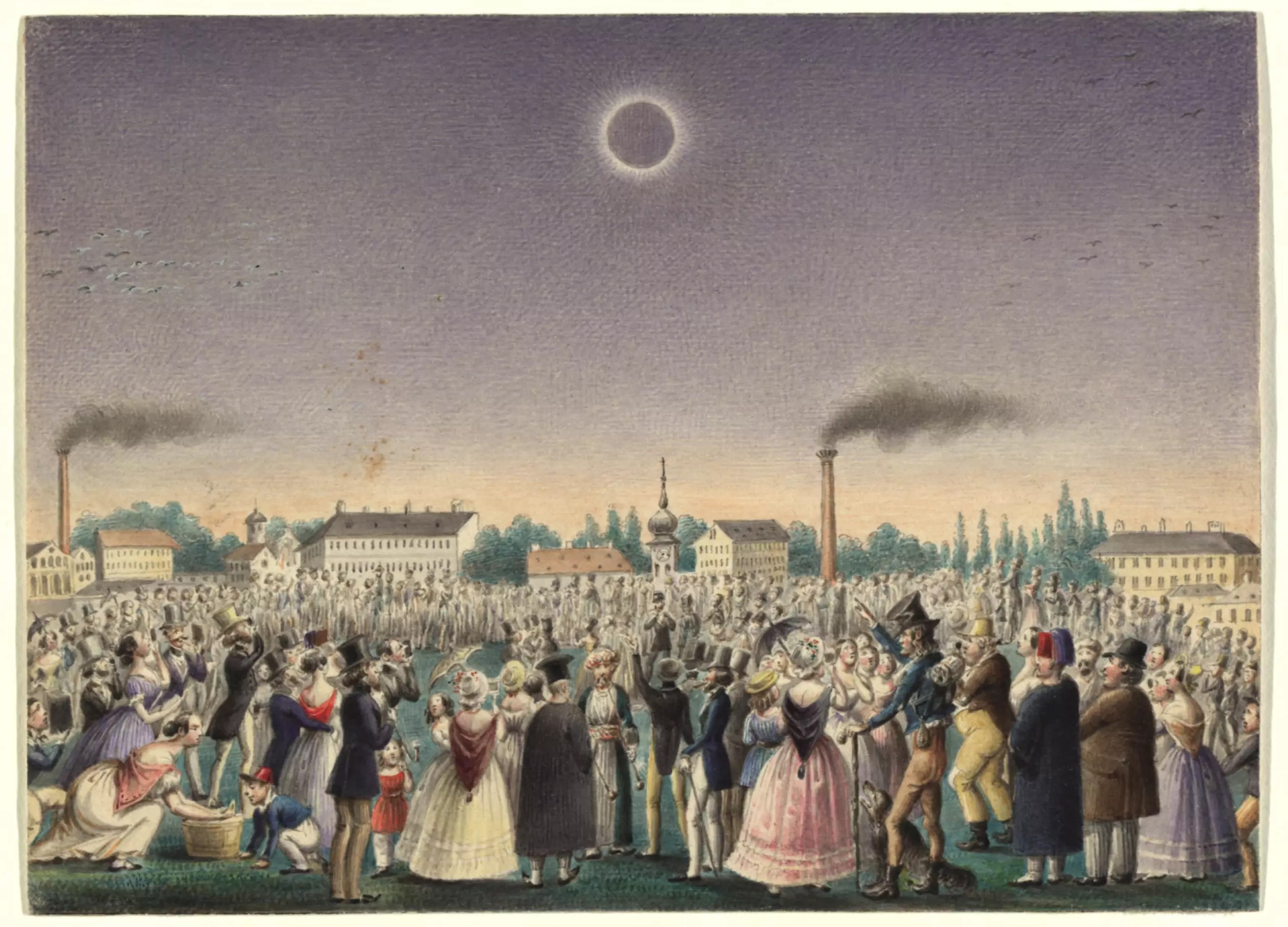
'eclipse was all we could see'


Johann Christian Schoeller, "Sonnenfinsternis, 8. Juli 1842." Wien Museum.

*

John Parker Davis, "Looking at the Eclipse (After Winslow Homer)," 1865. Clark Art Institute.

*


*

Joseph Cornell, "Portrait of Emily Brontë," 1962. The Hudson River Museum.

*

Emily Dickinson archive, Amherst manuscript #256.

*

Crescent-shaped shadows on the snow in the mountains in Bernalillo County, New Mexico, caused by a solar eclipse, photographed by Lee Russell in 1940. New York Public Library Digital Collections.

*

GIFs from Georges Méliès L'éclipse du soleil en pleine lune (The Eclipse: Courtship of the Sun and Moon) from 1907.

*
At one o'clock almost half the sky was blue—two o'clock, and the moon had already bitten a small piece out of the sun's bright edge, still partly obscured by a dimly drifting mass of cloud.

A penetrating chill fell across the land, as if a door had been opened into a long-closed vault. It was a moment of appalling suspense; something was being waited for—the very air was portentous.

The circling sea-gulls disappeared with strange cries. One white butterfly fluttered by vaguely. Then an instantaneous darkness leaped upon the world. Unearthly night enveloped all.

With an indescribable out-flashing at the same instant the corona burst forth in mysterious radiance. But dimly seen through thin cloud, it was nevertheless beautiful beyond description, a celestial flame from some unimaginable heaven. Simultaneously the whole northwestern sky, nearly to the zenith, was flooded with lurid and startlingly brilliant orange, across which drifted clouds slightly darker, like flecks of liquid flame, or huge ejecta from some vast volcanic Hades. The west and southwest gleamed in shining lemon yellow.

Least like a sunset, it was too sombre and terrible. The pale, broken circle of coronal light still glowered on with thrilling peacefulness, while nature held her breath for another stage in this majestic spectacle.

Well might it have been a prelude to the shriveling and disappearance of the whole world—weird to horror, and beautiful to heartbreak, heaven and hell in the same sky.

Absolute silence reigned. No human being spoke. No bird twittered.

Hours might have passed—time was annihilated; and yet when the tiniest globule of sunlight, a drop, a needle-shaft, a pinhole, reappeared, even before it had become the slenderest possible crescent, the fair corona and all color in sky and cloud withdrew, and a natural aspect of stormy twilight returned.

Mabel Loomis Todd, from Corona and Coronet: Being a narrative of the Amherst Eclipse Expedition to Japan, in Mr. James's Schooner-Yacht Coronet, to Observe the Sun's Total Obscuration, 9th August, 1896.

*
It sounded as if the streets were running -
And then the streets stood still -
Eclipse was all we could see at the Window
And Awe - was all we could feel -
By and by the boldest stole out of his Covert
To see if Time was there
Nature was in an Opal apron
Mixing fresher Air

Emily Dickinson 

various suns / midwinter day


Donald Baxter MacMillan, "The last row of suns," 1913-1917. Taken on the Crocker Expedition.

*

Erich Fried, "Toys," translated by George Rapp. Via Drifting Lament.

*


*

Rylands Medieval Collection, Latin MS 53, f. 58v. Christianus Prolianus and Joachinus de Gigantibus (?), Astronomia, 1478: "Comparative view of the magnitudes of the Sun (a large disc of burnished gold), the Moon (silver), Mars (gold), Venus (gold), Mercury (gold) and Earth (pale)." Found at Demonagerie, via A London Salmagundi.

*

Jan Luyken, "Vrouw houdt bij het kijken naar de zon haar hand voor de ogen (The woman holds her hands ovr her eyes while looking at the sun)," 1687. The Rijksmuseum.

*

Bernadette Mayer, from Midwinter's Day, 1978.

odds and ends / 1.12.2023


*

Hugo Simberg, The Wounded Angel, 1903.

*

Léon Spilliaert, Winter round the lake, 1929.

*


*

Sculpture by Tung Ming-Chin.

*

Hans Christian Anderson's sun troll.

*
'Time is incredibly flexible and we all experience it in different ways,' Ogden explains. ... In Iraq, for example, people she surveyed almost universally felt that time slowed. But half of U.K. respondents who experienced time distortion felt it moved faster than in what we've come to think of as 'the before times.' In Argentina, younger, physically active women felt time passed faster than older men. Ogden says it's hard to pinpoint the root cause of those differences, because there are so many different variables. Living in a war-torn area, or under strict lockdown policies, could help explain the differences in each country. 'When life changes, time changes,' Ogden says.

Yuki Noguchi, "How Did COVID Warp Our Sense of Time? It's a Matter of Perception." NPR's Morning Edition,  December 14, 2022.

*
The imperative to always demonstrate the right stuff shaped the language that astronauts used to describe their experiences in space. As Patricia Santy, a longtime psychiatrist at NASA’s Johnson Space Center, in Houston, wrote in 1994, “Expression of emotions such as sadness or fear is considered a weakness.” If the sight of Earth marooned in darkness inspired such feelings in the heart of an astronaut, he was unlikely to admit it, lest he jeopardize his shot at another mission. ... Weibel, who conducts anonymous interviews of astronauts for her research, said that one told her he took one look out the window of the space shuttle and “became absolutely convinced we would kill ourselves off between 500 and 1,000 years from now.” He never said so publicly.

Marina Koren, "Seeing Earth From Space Will Change You; The Question is How.The Atlantic, December 10, 2022.

*

Because of the tutoring, because it is a Teaching Monday after a Friday payday, because I am delirious after three solid hours of two different seminars of two dozen sulky first-years, I buy sneakers I unnecessarily tried on and coveted last week. Cycle of unnecessary shopping becoming rationalized into necessary purchase. I want a uniform. Everything I buy will be the last thing.

My mom texts me an article about uniform shopping, “what if you buy yourself a uniform, a capsule closet,” she suggests. But what if I have claustrophobia.

Adrienne Raphel, "Shopping Diary." The Paris Review, November 25, 2022.

*


*
She was afraid of finding someone else’s thoughts left behind in her personality, like a strange scarf unearthed from the sofa cushions after a party. Books were the most acute threat to the sanctity of the bordered self.

Audrey Wollen, "The Writer Who Burned Her Own Books." The New Yorker, January 3, 2023. 

*

Is there ever anything sham about it, I sometimes wondered reading Tenth of December, moving toward one of his deaths or near-deaths. A cheapness? There was a whiff of robin funerals, of that kid who wants to feel the feeling, something you don’t get with, say, Flannery O’Connor, who might actually have killed people. Then again, robin funerals are kind of the business: a little thing to put in a box, so that the rest of us can be glad to feel alive.

Patricia Lockwood, "Worm Interlude.London Review of Books, November 17, 2022. 

*

"I suppose I’m trying to make a space where people can rest their attention in one place for a while."